

 English
 Deutsch
 Polski
Google Consent Mode: What Data Is Sent When Cookies Are Rejected
Part 2 of 4 in the series Wiring consent correctly

Management Summary
Google Consent Mode adapts website measurement to a visitor’s consent choice. Its basic form waits for agreement, while the advanced form can send small messages without cookies, the files used to remember browser information. These messages help Google estimate visits or advertising results that cannot be measured directly. This matters when interpreting incomplete marketing reports: estimates describe broader patterns, not reconstructed personal browsing histories, and cookie-free does not automatically mean anonymous.
Contents
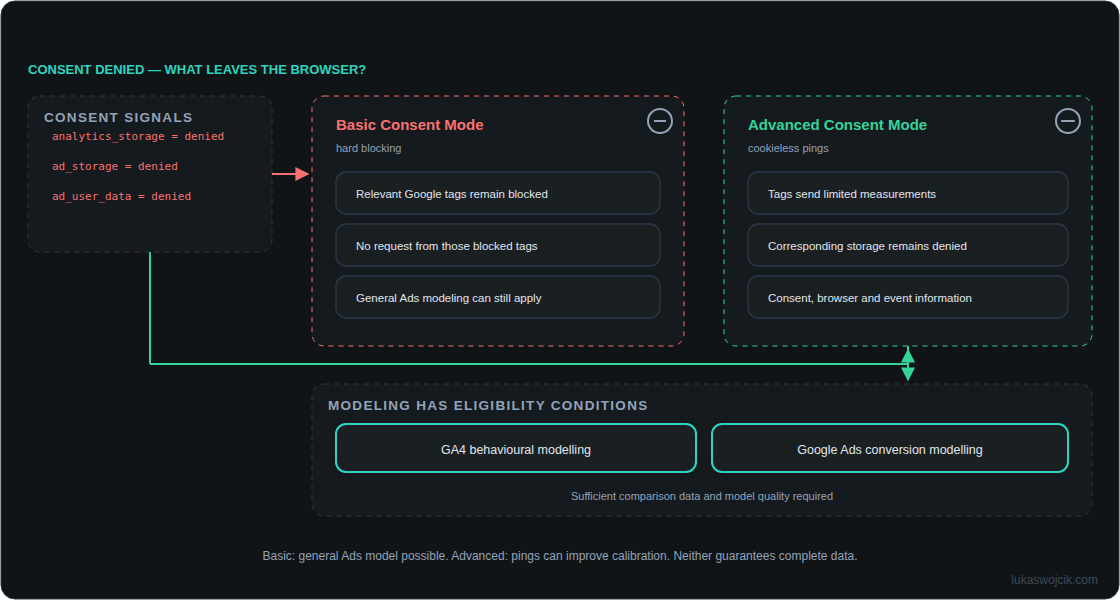
Consent Mode adjusts Google tags, the measurement code used by Google services, to the consent choices supplied by a website. Basic blocks the relevant tags before consent. Advanced also sends limited measurements when storage consent is denied. A cookieless ping is a small network message; it does not recreate a browsing history.

Basic: no measurement request before consent
With Basic Consent Mode, the relevant Google tags remain blocked until consent is granted. A refusal therefore produces no request from those blocked tags. Other Google services on the page require separate checks.
Fewer activities can be measured directly. Google Ads can still estimate some missing conversions using general conversion modeling. Basic therefore does not make every form of estimation impossible.
Advanced: limited requests still leave the browser
Advanced loads consent-aware tags with a defined default state. A denied storage permission prevents the corresponding analytics or advertising cookie access; the different consent types have different effects. Denying advertising personalization alone does not block analytics storage.
Pings can carry consent status, timestamps, browser information and event information. “Cookieless” describes the storage behavior; it does not establish that every transmitted field is anonymous or that sending a request needs no legal assessment. Page URLs, event parameters and the actual network payload need inspection.
GA4: estimates need sufficient data
Without a persistent analytics identifier, ten page views cannot reliably distinguish ten visitors from ten views by one visitor. Behavioral modeling estimates user and session metrics using observed comparison data. This does not recover a known individual journey.
Eligibility requires Advanced Consent Mode and enough data: at least 1,000 denied-storage events daily for seven days, plus 1,000 consenting daily users on at least seven of the previous 28 days. Meeting these published thresholds does not guarantee eligibility. The Blended reporting identity and the report’s data-quality indicator show whether estimates are included.
Google Ads: attribution estimates, not recovered click histories
GCLID and DCLID are advertising click identifiers, often present in URL parameters; neither name denotes a cookie. Storage restrictions can prevent the usual persistent link between an ad interaction and a conversion.
Conversion modeling estimates how many otherwise unassigned conversions are attributable to ads. Cookieless pings can help adapt those estimates to a particular advertiser. Enough data and the applicable eligibility conditions are still required. The estimates can influence automated bids. Their absence alone does not prove that ads will stop being delivered or that campaign results will collapse.
Questions and answers
Does Advanced guarantee better reports?
No. Too little data or unmet requirements for the GA4 property can prevent behavioral modeling. Even when enabled, modeling supplies estimates rather than a complete record of visits.
When is Basic appropriate?
Basic matches a requirement to block the relevant Google requests until consent. The choice depends on the permitted processing and measurement needs, rather than an assumption that Advanced is always necessary.
Wiring consent correctly
- How to Implement Google Consent Mode v2
- Google Consent Mode: What Data Is Sent When Cookies Are Rejected
- Checking GA4 Consent Mode: When the Cookie Banner and Tracking Code Start in the Wrong Order
- Passing Cookie Consent Choices to Server-Side Google Tag Manager
Related articles


