English
 Deutsch
 Polski
Music Plugins for Seven Genres: Functions and Choices

Management Summary
Music plugins add instruments and sound effects to recording software. Across seven genres, the useful choice depends on the job: creating a bass, making vocals clearer or adding space and rhythm. This guide explains free and paid options by those functions rather than treating brands as genre requirements. A small set of well-understood tools can be a practical starting point. A purchase becomes worthwhile when it fills a specific gap and works with the existing music software and sound libraries.
Contents
A useful plugin solves a specific problem: creating a bass sound, making space for the kick drum or correcting a vocal note. A genre name alone does not decide which product is needed. This guide groups instruments and effects by their possible jobs in EDM, house, pop, hip-hop, rap, drum & bass and dubstep.
The selection is an editorial guide, not a measured popularity ranking or a listening-test winner list. Product functions were checked against manufacturer information on 25 October 2026. The linked shops show current prices, taxes, upgrades and subscription terms. The diagram distinguishes free and paid options instead of presenting changing promotional prices as fixed costs.
The terms behind the choices
A DAW is the program used to record, arrange and mix music. An instrument plugin creates sound; an effect changes incoming audio. A preset is a saved collection of settings. An oscillator generates a repeating waveform, and a wavetable contains waveform shapes that can be scanned to change the tone. Modulation means that a control changes another setting over time, such as a filter opening on each beat.
An EQ raises or lowers selected frequency ranges. A compressor changes level according to its settings and the incoming signal; a limiter controls peaks more strongly. Saturation adds distortion that can make a sound rougher or richer in harmonics. A harmonic is a frequency component at a whole-number multiple of a fundamental. Reverb adds a decaying sense of space, while delay creates echoes.
Genre examples, without a compulsory shopping list
Festival-oriented EDM can combine broad lead melodies, short kick drums and moving bass sounds. House often makes the relationship between kick and bass especially clear. Ducking means briefly lowering the bass or other sounds when the kick arrives. This can create an audible pumping rhythm or simply make the kick easier to distinguish.
Pop and vocal rap often need clear words and a stable vocal level. Rap is also part of hip-hop culture, so the two labels do not define separate sets of tools. Sample-based hip-hop, trap and instrumental beats can all use synthesizers, recorded instruments and effects. An 808-style bass often has a long pitched tail; that tail can be tuned to the musical notes. A short noisy kick does not necessarily have one stable pitch.
Drum & bass and dubstep offer useful examples of moving bass timbres and edited drum patterns. A Reese-type bass can begin with two slightly detuned sawtooth oscillators, but that is a starting method rather than a complete definition. Tempo ranges and plugin brands do not set the boundaries of any of these genres.
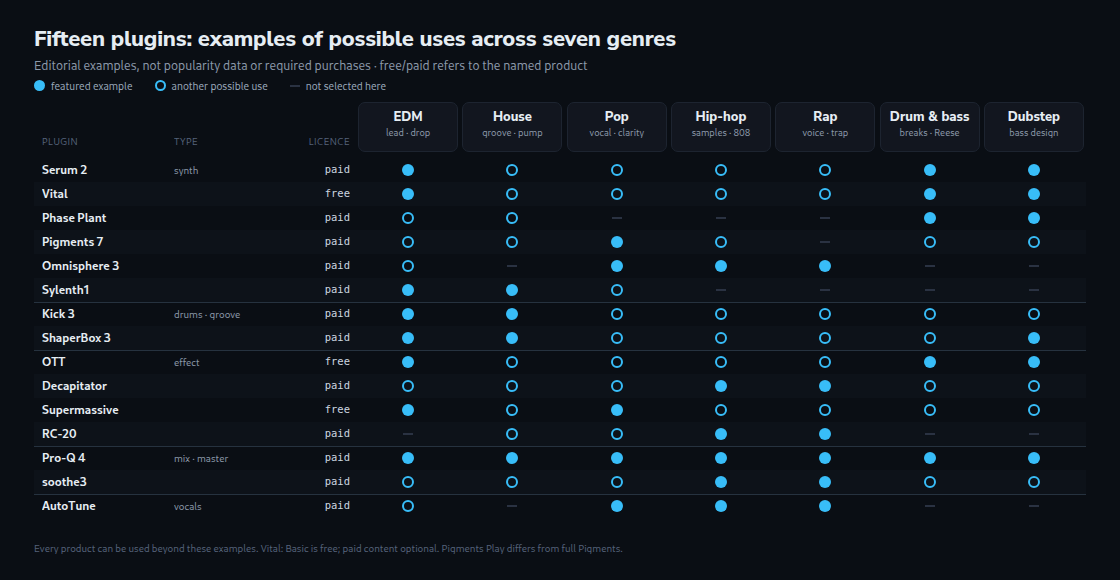
Synthesizers and sound libraries
Xfer Serum 2 combines wavetable, multisample, sample, granular and spectral sound generation with modulation, effects and sequencing. Granular processing divides a recording into small pieces; spectral processing works with its frequency components. These methods can help build changing leads and basses. Xfer lists VST3, AU and AAX versions and a free upgrade for Serum 1 owners. Neither those features nor a large preset market prove that Serum is required for a genre.
Vital Basic supplies the full synthesizer free, including 75 presets and 25 wavetables. Plus and Pro expand the supplied content. Text-to-wavetable is an online service with request limits; unlimited access is a separate tier benefit. Basic therefore offers a practical way to learn wavetable movement and modulation without first buying a synthesizer.
Kilohearts Phase Plant allows sound generators, modulators and effects to be combined in a flexible arrangement. Three effects lanes can process different parts of a patch. Kilohearts Essentials effects are included; premium effects require the relevant licences or a suitable bundle/subscription. The benefit is control over a complex sound, not a requirement to buy every module.
Arturia Pigments 7 combines six synthesis methods and displays modulation with colour-coded controls. This can make connections easier to follow. The free Pigments Play includes 100 presets and limited parameter control; it does not provide the full editing and modulation access of Pigments. The distinction matters when the goal is learning sound design rather than playing prepared sounds.
Spectrasonics Omnisphere 3 combines synthesis with a large library of prepared sounds, including 18 new factory libraries. Pads are sustained sounds that can sit behind a melody or vocal; textures add movement or atmosphere. Omnisphere is one possible source for these jobs. A library’s usefulness depends on the sounds needed and how quickly suitable patches can be found.
LennarDigital Sylenth1 uses virtual-analogue synthesis, which models familiar analogue-style oscillators and filters in software. It can be considered for layered leads and basses with a relatively direct control layout. Current compatibility and the available controls matter more for this choice than assumptions about future features. The manufacturer’s current download page also distinguishes Windows and macOS version numbers.
Native Instruments Kontakt 8 plays sample-based instruments such as pianos, strings and guitars. The free Kontakt Player runs compatible, officially licensed libraries; some other libraries require full Kontakt. A free player does not make every library free or compatible. The library’s requirements are therefore part of the choice, alongside storage space and the operating system.
Kick drums and rhythmic level changes
Sonic Academy Kick 3 combines five layers and can analyse imported kicks to separate the click and reconstruct the low-frequency part. Pitch and level curves help shape the beginning and decay. Importing a sample does not automatically tune the result to a song or guarantee an exact reconstruction.
Cableguys ShaperBox 3 combines eleven shaping effects, including volume, filter, width and pitch. Drawn curves can produce tempo-synchronised changes. A repeating volume curve can duck the bass without an external kick signal. For irregular kick patterns, audio triggering or another suitable trigger method is more appropriate than assuming every kick falls on the same beat.
Nicky Romero Kickstart 2 focuses on volume ducking. Its prepared curves offer a simpler route when that is the only task. A tempo-synchronised curve and a response triggered by the actual kick are different methods; the chosen mode and routing determine which is used.
The Note to Frequency and MIDI Converter helps relate pitched bass notes to frequency. With A4 at 440 Hz and equal temperament, F1 is about 43.65 Hz and G1 about 49.00 Hz. Octave naming can differ between DAWs, so frequency and MIDI note number are useful cross-checks.
Distortion, density and space
Xfer OTT is a free multiband effect combining upward and downward compression. Quiet details can become more prominent while louder parts are reduced. This can make a bass sound denser, but can also lift noise, breath sounds and reverb tails. OTT is an optional effect; the useful mix percentage depends on the track.
Soundtoys Decapitator offers five hardware-inspired saturation models. Added harmonics can make a low bass easier to notice on small speakers, although those speakers still cannot reproduce a missing fundamental. FabFilter Saturn 2 offers 28 distortion styles across up to six bands. Separate bands allow the low range to receive less processing than the mids; a clean low end still depends on the settings.
Valhalla Supermassive is free and combines delay and reverb in 22 modes. It can add long echoes or sustained spaces. Valhalla VintageVerb offers 22 reverb algorithms and three colour modes in the current manufacturer listing. The choice depends on the decay and space needed, not on a rule that one genre must use one reverb.
XLN Audio RC-20 Retro Color adds noise, pitch fluctuations, distortion, reduced digital resolution and other ageing effects. For example, a steady piano sample can become less stable in pitch and gain a record-like background noise. This creates a stylistic effect; it does not establish that a recording came from an old record.
Mixing, mastering and vocals
FabFilter Pro-Q 4 provides ordinary, dynamic and spectral EQ processing. A dynamic band changes its effect when the selected range becomes more prominent. This can reduce a harsh note only when needed. An EQ already included in the DAW may be enough for a simpler fixed adjustment. Pro-Q is an option across genres, not a compulsory purchase.
FabFilter Pro-C 3 offers fourteen compressor styles and several trigger options. oeksound soothe3 instead follows resonant frequency peaks and reduces selected problem areas. A resonance is a narrow range that stands out strongly, such as a ringing note or a piercing vocal sound. Excessive reduction can remove desired tone, so neither processor guarantees an unchanged or naturally clearer voice.
FabFilter Pro-L 2 offers true-peak limiting and loudness metering. True peak estimates the reconstructed waveform’s peaks, including between stored samples. iZotope Ozone 12 combines mastering tools, with different features in Elements, Standard and Advanced. Stem EQ belongs to Advanced: it processes estimated vocal, bass, drum and instrument parts inside a stereo mix. These estimates are not the original separate tracks and do not guarantee separation without artefacts.
AutoTune offers real-time pitch correction, while AutoTune Pro 11 also supports detailed manual editing and harmony generation. Fast correction can create abrupt note transitions, but the scale, input performance and other settings also affect the result. Pitch correction is a creative or corrective choice, not a requirement for a modern vocal.
Celemony Melodyne 5 presents detected notes for editing pitch, timing and other properties, depending on the edition. ARA is an integration method that lets a compatible DAW exchange audio and timeline information directly with the plugin. Support varies by DAW and version. Normal plugin operation and ARA integration are separate compatibility questions.
Compatibility before purchase
VST3, Audio Units, AAX and CLAP are different connections between a plugin and its host. For third-party plugins, Logic Pro uses Audio Units; current Pro Tools uses 64-bit AAX. A product offering only VST3 and AU therefore does not automatically work in Pro Tools. FL Studio on Windows can use compatible VST3 versions; Audio Units are a macOS format.
CLAP is another available format, supported by hosts such as Bitwig Studio, REAPER and FL Studio. Its usefulness depends on the exact plugin and host versions. VST2 support also differs between hosts. Steinberg’s VST 3.8 SDK uses the MIT licence, but that does not make commercial plugins free or remove their own licence conditions.
A practical compatibility check includes the host version, operating system, processor architecture, activation method and required library. A trial in an actual project can reveal CPU load, delay and missing functions. The same plugin family on Mac and Windows also does not guarantee that two different DAWs can open the same project file.
A small starting setup
A possible free starting point is Vital for synthesis, Supermassive for space and the DAW’s own EQ and dynamics tools. OTT can be added for a deliberate compression effect. Kontakt Player and Pigments Play offer other starting sounds with the limitations described above. No single combination guarantees a complete setup for every arrangement.
A paid plugin is easier to assess when the missing job is concrete: a particular library, editable modulation routing or faster resonance control. Comparing the existing tool and a trial at similar loudness helps prevent the louder version from seeming automatically better. A short list of understood tools makes experimentation easier; the musical result still depends on arrangement, performance and mixing choices.
Questions and answers
Does one plugin collection cover all seven genres?
Many instruments and effects can be used across all seven. The important difference is the job in a particular song: a synthetic bass, recorded piano, clear vocal or rhythmic level change. The examples above suggest possible roles rather than fixed genre requirements.
What changes when OTT and reverb exchange positions?
With reverb before OTT, the compressor can act on the reverb tail as well as the dry sound. With reverb after OTT, that reverb instance is not processed by the earlier OTT. Its input has still changed, and later processors may affect both. Less processing or a lower wet proportion can preserve more contrast, but the result needs a level-matched comparison.
Is a free player the same as a free instrument library?
No. A player is the software that loads compatible content. Individual libraries can require payment, a specific player version or a full sampler licence. The library’s product page provides those conditions.
Sources
- Xfer Records: Serum 2
- Vital: editions and included content
- Kilohearts: Phase Plant and included effects
- Arturia: Pigments and Pigments Play
- Spectrasonics: Omnisphere 3
- LennarDigital: Sylenth1 downloads
- LennarDigital: Sylenth1 licensing
- Native Instruments: Kontakt and Kontakt Player
- Sonic Academy: Kick 3
- Cableguys: ShaperBox 3
- Cableguys: Kickstart 2
- Xfer Records: OTT downloads and release notes
- Soundtoys: Decapitator
- FabFilter: Saturn 2
- Valhalla DSP: Supermassive
- Valhalla DSP: VintageVerb
- XLN Audio: RC-20 Retro Color
- FabFilter: Pro-Q 4
- FabFilter: Pro-C 3 and Pro-Q 4.10 announcement
- oeksound: soothe3
- oeksound: soothe3 manual
- oeksound: soothe3 release notes
- FabFilter: Pro-L 2
- iZotope: Ozone 12 editions and Stem EQ
- Antares: AutoTune pitch correction products
- Celemony: Melodyne technical requirements and ARA
- CLAP: compatible hosts and plugins
- Steinberg: VST 3.8 SDK and MIT licence
- Avid: Pro Tools plugin format
- Apple: Audio Units in Logic Pro
- LennarDigital: Sylenth1 synthesis and effects
Related articles