English
 Deutsch
 Polski
European Cookie Rules: The ePrivacy Directive, the Withdrawn ePrivacy Regulation and the Digital Omnibus

Management Summary
Cookie rules govern when websites may store or read information on a visitor’s device. Existing European and national requirements still apply even though the proposed ePrivacy Regulation was withdrawn. The article separates current rules from proposed Digital Omnibus changes, which were not yet law at its October 2026 review. This matters for website planning: decisions about consent need to follow actual data use and applicable exceptions, rather than assuming that a withdrawn proposal removed existing obligations.
Contents
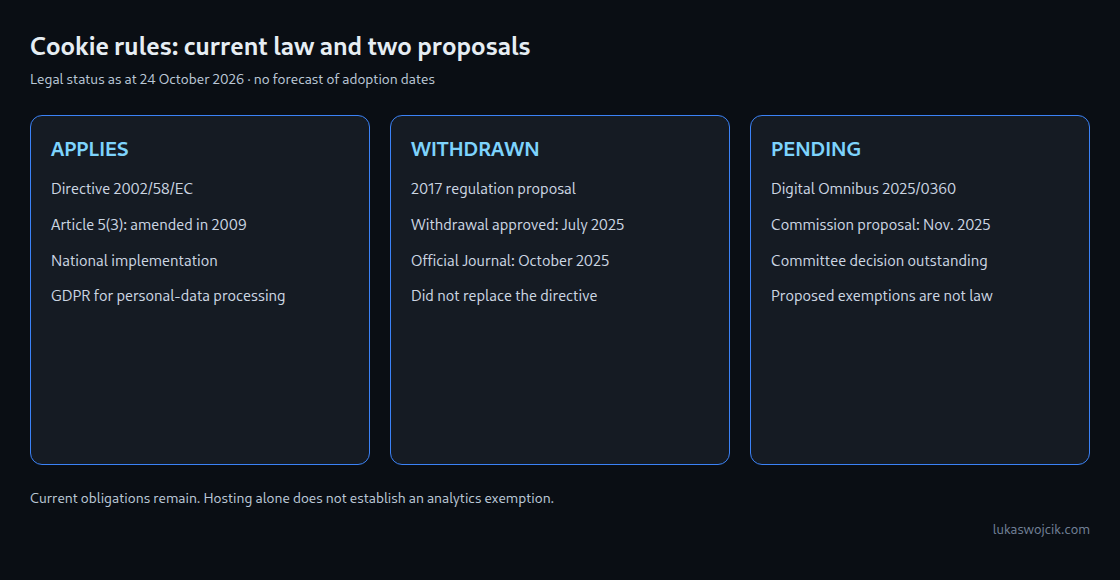
The withdrawal of the proposed ePrivacy Regulation did not remove the cookie consent requirement. The ePrivacy Directive and national implementing laws continue to apply. The Digital Omnibus proposal concerning data and cookies remains a legislative project: the European Parliament procedure file still records an outstanding committee decision on 24 October 2026.
The article distinguishes the rules currently in force, a withdrawn proposal and a proposal still under discussion. Keeping current obligations separate from proposed changes prevents a consent banner from being rebuilt around rules that have not been adopted.
What applies today
| Instrument | Status | Consequence |
|---|---|---|
| Directive 2002/58/EC, Article 5(3) | In force; the consent wording was amended in 2009 | National implementing law governs device storage and access |
| Proposed ePrivacy Regulation, 2017/0003(COD) | Withdrawn in 2025 | No replacement of the directive |
| Digital Omnibus, 2025/0360(COD) | Legislative procedure pending | No new cookie exemption in force through this proposal |
Article 5(3) concerns storing information on a device and accessing information already stored there. The protection includes information without a personal character. The two exceptions cover storage or access for the sole purpose of transmitting a communication over an electronic communications network, and operations strictly necessary for an explicitly requested information society service. In Germany, section 25 TDDDG implements these requirements and expressly refers to transmission over a public telecommunications network.
Subsequent processing of personal data also needs to satisfy the GDPR. An exemption from device-access consent is therefore not a general exemption from data protection law. Conversely, an interest assessment under the GDPR cannot replace consent required for device access.
What was withdrawn
The Commission approved withdrawal of the 2017 regulation proposal on 16 July 2025; publication followed in Official Journal C/2025/5423 on 6 October 2025. The European Parliament records both dates. The intended replacement ended, while existing law remained applicable. That does not mean the directive has never changed or can never be amended.
What the original Digital Omnibus proposed
The Commission proposal of 19 November 2025 would place personal-data-related device access in new GDPR Article 88a. Non-personal information would remain under the directive. Proposed exceptions include limited audience measurement and security purposes. These are changes to the existing framework, not merely a restatement of its two exceptions.
The original proposal also envisages a six-month interval before a renewed consent request for the same purpose following refusal. Article 88b concerns consent choices in a form that software can read and process automatically. These mechanisms could reduce repeated prompts; neither amounts to a guarantee that every banner would disappear. References to these article numbers describe the Commission proposal, not an adopted final text.
The pending cookie/data file must also be distinguished from the separate AI Omnibus procedure. Adoption of another part of the simplification programme does not bring the proposed cookie rules into force. A future implementation timetable depends on the adopted text and its published application dates.
Why hosting location does not decide the analytics question
Self-hosted analytics is not automatically exempt, and use of an external processor does not automatically rule out an exemption. The assessment depends on which data is collected, why it is collected, who receives it and what else it is used for.
The French CNIL permits narrowly limited audience measurement under published conditions. A processor may serve several publishers when the data and trackers remain independent for each publisher. Some tools can be configured to disable the provider’s own reuse. These French criteria are not a blanket exemption under German law or a certification of every product carrying an analytics label.
| Operation | Relevant assessment |
|---|---|
| Basket session or authentication protection | Strict necessity for the requested function; no additional tracking purpose |
| Language preference | Requested function, contents and proportionate storage period |
| Audience measurement or A/B testing | Applicable national criteria, configuration, isolation and reuse |
| Advertising profiling across services | No automatic exemption as a necessary site function |
A product name such as GA4 or Meta Pixel does not replace an inventory of actual operations. A useful inventory records each cookie or storage access, purpose, lifetime, recipient, configuration and legal justification. A generic declaration that all hosted testing crosses customer boundaries is insufficient.
What a consent interface needs now
Consent-dependent storage and access must remain blocked until valid consent. Acceptance, refusal and withdrawal must correspond to the actual behaviour of tags and requests. The EDPB cookie-banner taskforce found that a large majority of authorities regard missing refusal options alongside acceptance as incompatible with valid consent. The CNIL expressly requires refusal to be as easy as acceptance.
A practical verification covers a fresh visit, refusal, a later return, acceptance and withdrawal. The checks cover both information saved in the browser and data sent from the browser to servers. A visible banner alone does not demonstrate that tracking is blocked. These checks apply under current requirements; waiting for the Omnibus does not solve an existing consent defect.
Questions and answers
Does the withdrawal allow cookies without consent?
No. The withdrawn regulation was a proposal. Existing device-access rules and their exceptions remain applicable, including protection for non-personal information.
Is there already a general EU six-month refusal rule from Article 88a?
No. The six-month interval discussed here belongs to the original Commission proposal. National guidance on retaining consent choices must be considered separately. A refusal can be recorded without creating an advertising identifier; deletion of that record or a different browser limits recognition.
Does self-hosting prove that analytics is exempt?
No. Server ownership does not establish strict necessity. The documented purpose, data flows and applicable national criteria remain decisive. A limited measurement configuration and an advertising profile are different operations.
Does the GDPR one-stop-shop cover every cookie complaint?
No. EDPB Opinion 5/2019 distinguishes enforcement of national ePrivacy rules from enforcement of GDPR obligations for subsequent processing. The GDPR cooperation mechanism does not automatically apply to the former. The responsible authority and territorial scope require a case-specific assessment.
Sources
- EUR-Lex: Directive 2002/58/EC, Article 5(3), consolidated text
- TDDDG § 25
- European Parliament: ePrivacy reform
- European Parliament: 2025/0360(COD)
- EDPB–EDPS: Joint Opinion 2/2026, sections 10.1–10.2
- CNIL: Cookies et mesure d’audience
- EDPB: Cookie Banner Taskforce, 2023
- CNIL: Cookies, lignes directrices et recommandation
- EDPB: Opinion 5/2019, paragraphs 75–85
- European Commission: Digital rulebook
- MDN: Set-Cookie
Related articles