English
 Deutsch
 Polski
Preventing cancellation: better onboarding, a pause or a discount?

Management Summary
Software subscriptions can be cancelled for different reasons: setup difficulties, a temporary lack of need or insufficient value. The article explains when help getting started, a pause or a discount fits the problem. These offers should support useful continued service rather than merely delay cancellation. For the provider, retained revenue needs to justify the extra work. Clear rules for pauses and straightforward cancellation remain part of an understandable offer.
Contents
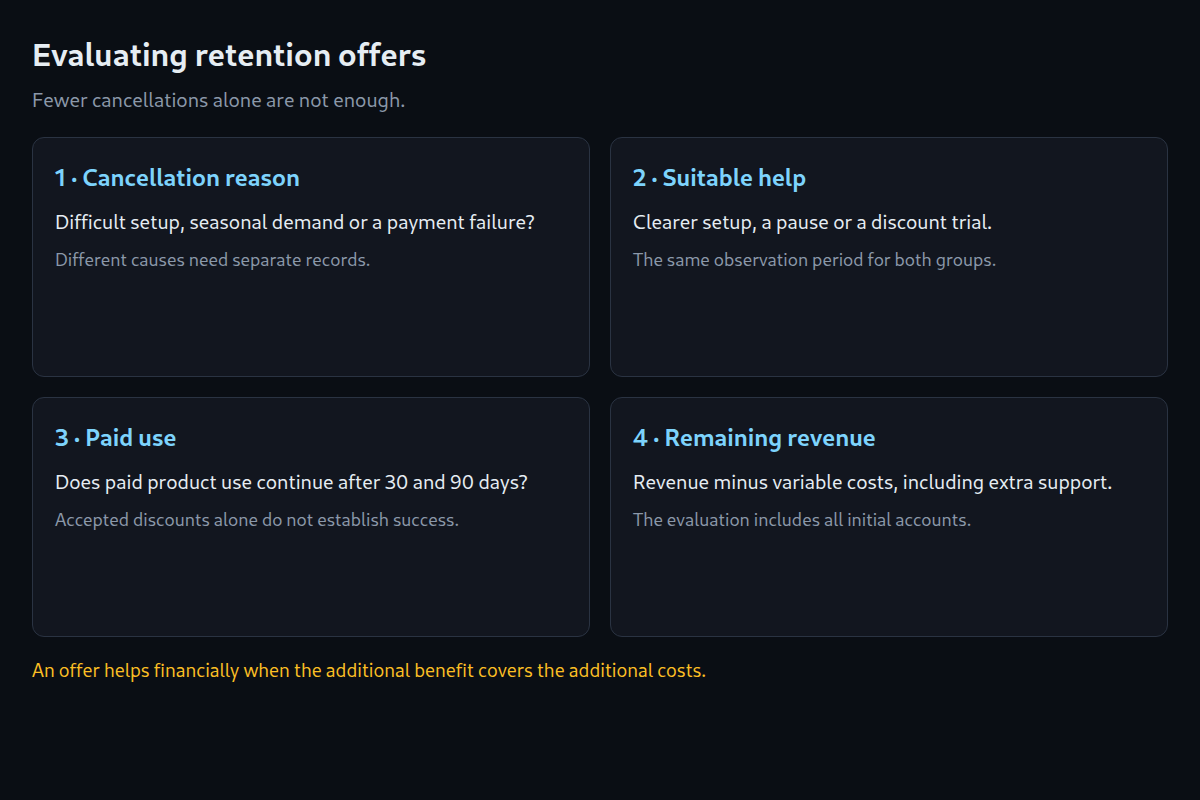
A lower cancellation rate alone does not prove success. A discount may only postpone departure. What matters is whether paid use continues later. The useful response depends on the reason: a difficult start, a temporary lack of demand, a lasting lack of value, or a payment failure.
Four causes, suitable responses
A difficult start may show up as a failed first data import. Onboarding means help from setup to the first useful result. In this case, a clearer import process is more useful than another marketing message.
Seasonal demand may suit a pause or a smaller plan. When value is permanently missing, straightforward cancellation remains appropriate; a later return offer can point to a real product improvement. Payment failures instead need clear error messages and a way to change the payment method. These causes belong in separate evaluations.
Onboarding: from setup to the first result
Activation here means reaching the first important result. An export service might define it as a correct file within one day. Completing a product tour does not yet demonstrate that result. Abandonment at each setup step reveals possible problems. The importance of the step, the cause of abandonment and the effort to fix it also matter; the largest abandonment count alone does not decide the next improvement.
A comparison can use two groups from the same period: one with extra setup help and one with the previous process. Random assignment of eligible accounts reduces differences between groups. With voluntary participation, motivation may already differ. Both groups need the same observation period. Evaluation covers the first result, repeated use, paid renewal and extra support costs. Small groups provide uncertain evidence.
Pauses: access and payment need separate rules
A pause needs clear terms: start and end, available features, access to saved data and the next payment date. Stripe allows payment collection to pause while the subscription stays active and invoices continue to be created. This does not automatically stop product access. The application must implement and test the intended access rules. [2]
A pause mainly fits demand that is expected to return. An offer before every cancellation may merely keep unused accounts around longer. Data export and cancellation should remain easy to reach.
Discounts: what remains after costs?
A hypothetical example starts with 20 accounts considering cancellation. The monthly price excluding tax is €29 and variable costs are €9 per account. A 30% discount reduces the price to €20.30. Subtracting €9 leaves €11.30. This amount is the contribution margin; fixed operating costs have not been deducted, so it is not profit. If eight accounts pay for exactly three more months only because of the discount, the added contribution is 8 × 3 × €11.30 = €271.20 before extra support and payment fees.
The eight additional retained accounts are an assumption, not a measured result. For an individual account, the outcome without a discount cannot be observed directly. A comparable trial with and without the offer can estimate the extra effect. Discounts for accounts that would have stayed anyway reduce revenue. The 90-day comparison therefore includes the total contribution of all accounts considered at the start, including those that left. Stripe provides cancellation reasons and optional coupons in its customer portal; those features alone do not establish effectiveness. [1]
Comparing results after 30 and 90 days
The comparison records the reason before the offer where possible, then the measure and usage after 30 and 90 days. MRR is recurring subscription revenue expressed as a monthly amount. MRR, the number of paying accounts and contribution margin answer different questions: a discounted account can remain active while contributing less toward costs.
Cancellation remains available without extra obstacles. Stripe provides separate options for immediate cancellation and cancellation at the end of the billing period. [3] An economically useful offer produces further paid use whose revenue exceeds the extra costs. The linked calculators show possible outcomes based on entered assumptions.
Related tools
Sources
Sources checked: 25 October 2026.
Questions and answers
Is a lower cancellation rate always better?
No. Large discounts and extra support can reduce remaining revenue more than the retained account count suggests. Paid use and revenue after variable costs also matter.
Does pausing collection automatically stop product access?
No. Pausing payment collection does not automatically block the product. The application needs clear rules for access, invoices and resumption.
Related articles