English
 Deutsch
 Polski
DJ technology: from vinyl to USB and the cloud

Management Summary
DJ technology has evolved from records and CDs to computer files, USB players and online music libraries. These tools change how music is prepared, transported and played at clubs and events, while track selection and musical transitions remain creative decisions. The history explains why older and newer setups still coexist. Choosing equipment depends on the event, compatible connections and reliable music access; automatic beat matching and an internet connection alone do not ensure a successful performance.
Contents
- Early transitions: cueing and keeping the beat
- 1972 and 1979: Technics SL-1200 and SL-1200MK2
- The 1990s and 2001: CDs gain performance controls
- Controlling digital files with a record
- From 2009: music and preparation on a USB drive
- 2025 and 2026: cloud access and new players
- Controllers, streaming and separated sound components
- Which equipment fits a current event?
- Questions and answers
- Related tool
- Sources
From turntables through CDs to USB drives, DJ technology has mainly changed how music is prepared, carried and played. The central task remains choosing suitable tracks and shaping a musical transition. A touchscreen or automatic synchronization does not make that decision.
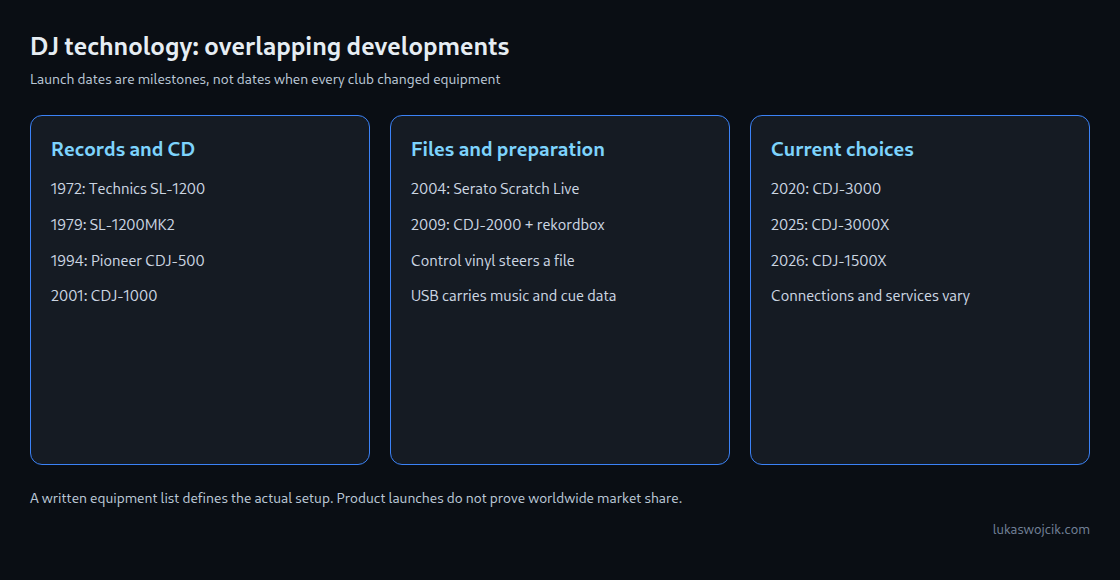
This timeline covers selected devices and working methods up to October 2026. A launch year shows when a technology became available. It does not mean that every club immediately adopted it. Vinyl, laptops, USB players and streaming coexist.
Early transitions: cueing and keeping the beat
Beatmatching means adjusting two tracks to a matching tempo and aligning their beats. Francis Grasso was an influential early practitioner. In a 1999 interview, Grasso describes working in New York clubs from around 1967/1968 and keeping the rhythm going across record changes.
Headphone cueing makes preparation possible: the next track is initially audible only in the headphones. In a first-person lecture, Alex Rosner describes the early “Rosie” mixer and its headphone cueing path. These are individual steps in a wider history, rather than proof that one person invented every DJ function.
Another development came from Bronx parties. DJ Kool Herc extended rhythmic breaks—the percussion-focused sections of records—using two players. Cindy Campbell’s party on 11 August 1973 at 1520 Sedgwick Avenue is an important reference point in hip-hop history. Beatmatching, repeating breaks and scratching are distinct techniques: in scratching, moving the record backward and forward creates sound itself.
1972 and 1979: Technics SL-1200 and SL-1200MK2
Technics released the SL-1200 in 1972 and the SL-1200MK2 in 1979. Direct drive means that the motor drives the platter directly. The MK2 added features including quartz control and a sliding speed control. This pitch fader made precise matching of two records easier.
At 128 BPM, or 128 beats per minute, a range of ±8 percent covers 117.76 to 138.24 BPM. Turntable speed also changes pitch. An 8 percent speed increase produces about +1.33 semitones; an 8 percent reduction produces about −1.44 semitones.
Two turntables, a mixer, headphones and a monitor speaker form one example of a classic booth. Equipment was nevertheless not identical everywhere. Rotary mixers control channel volume with knobs; other mixers use sliding faders. A crossfader blends between assigned channels. These control types do not establish a universal ranking of sound quality.
The 1990s and 2001: CDs gain performance controls
DJ CD players made precise starts and speed changes possible with CDs. Denon dates the DN-2000F’s introduction to the 1991 NAMM show. It was an important early dual CD player.
Pioneer followed with the CDJ-500 in 1994. The CDJ-1000 of 2001 offered a large touch-sensitive jog wheel and a vinyl mode. A jog wheel is a control surface: hand movement affects digital playback instead of moving a real record. Burned CDs also made newly finished tracks easier to play.
The accompanying mixer range expanded too. Pioneer’s chronology dates the DJM-500 to 1995, the DJM-600 to 1999 and the DJM-800 to 2006. These dates describe releases, not a fixed moment when vinyl disappeared from every club.
Controlling digital files with a record
A digital vinyl system connects turntables and a laptop. A control record carries a control signal instead of the desired music. Software reads position and movement from that signal and uses them to control an audio file. The stylus reads the groove; it does not move the record.
Final Scratch was among the early systems of the 2000s. Serato and Rane launched Scratch Live in 2004. Turntable gestures remained useful while the music collection lived on a computer. The required cables and audio interfaces depend on the specific system and mixer.
From 2009: music and preparation on a USB drive
The CDJ-2000 and rekordbox arrived in 2009. rekordbox prepares a collection: a beatgrid marks beat positions, while cue points mark starting or jumping positions. These data can be exported alongside supported music files to USB storage.
Pro DJ Link connects suitable devices over a network. It supports functions such as sharing music sources and exchanging control data. The audio connection to the mixer remains a separate matter. A network cable alone therefore does not make every older mixer compatible with every new feature.
The CDJ-3000 of 2020 has a 9-inch screen and eight Hot Cue buttons for saved jump positions. The manufacturer describes up to six networked players in a suitable configuration, for example with a six-channel DJM-V10. The number of network devices and the number of usable audio channels need separate checks.
2025 and 2026: cloud access and new players
AlphaTheta introduced the CDJ-3000X on 9 September 2025. It includes a 10.1-inch touchscreen, Wi-Fi, NFC login by holding a suitable smartphone close to the reader and USB-C connections. CloudDirectPlay and streaming require compatible services, accounts and, where applicable, subscriptions. Wi-Fi here provides internet access; it does not imply a wireless audio connection to the mixer.
The CDJ-1500X introduced in 2026 also offers a 10.1-inch display and online access. CoBeat allows audience requests and messages using a prepared selection. A request does not promise that the track will play automatically.
A loaded track may be cached by the player; loading further online tracks still depends on connectivity. Locally prepared music and a tested fallback reduce dependence on the network and account login. Export and file compatibility depend on the individual player.
Controllers, streaming and separated sound components
A controller supplies buttons and knobs for DJ software on a computer. A standalone all-in-one system can instead combine players and a mixer without that computer. Both designs coexist with separate club players; neither is mandatory for every setting.
Spotify integrated Premium with rekordbox, Serato and djay on 24 September 2025. Permission for personal, non-commercial use does not authorize public playback in a business or club. In Serato, Spotify currently requires an internet connection; support for offline tracks or stem separation does not follow from the integration.
Stem separation estimates separately controllable components such as vocals, bass and drums from a finished mix. These are estimated separations, not automatically the original studio tracks. Software and music source determine whether processing is available in advance or during work. Traktor Pro 4 also offers stem separation. On 8 May 2026, inMusic announced an agreement to acquire Native Instruments and committed to further investment. That is a manufacturer’s statement of intent, not a guarantee of a particular update.
Which equipment fits a current event?
One possible setup uses two or more USB players and a mixer with enough inputs. Other events use turntables, controllers or an all-in-one system. Before a booking, a technical rider—a written equipment list—defines the actual models, connections and backups required. Individual rider templates cannot establish the worldwide distribution of club equipment.
Mixer controls remain a separate choice. Allen & Heath’s Xone:96 uses linear channel faders and is not a rotary mixer. The euphonia introduced in March 2024 instead uses rotary channel-level controls. It was the first mixer under the AlphaTheta name, but not the first device under that brand: OMNIS-DUO had already been introduced in January 2024.
Questions and answers
What does a wider pitch range provide?
At 128 BPM, ±16 percent covers 107.52 to 148.48 BPM. With equal linear fader travel, the change per millimeter is twice that of ±8 percent. A narrower range therefore makes small corrections easier. Actual resolution also depends on the device.
Does Master Tempo hold pitch steady?
This digital function aims to preserve pitch while tempo changes. Processing can produce audible artifacts, especially with large changes. An ordinary analog turntable without additional processing instead couples speed and pitch.
Does sync guarantee a successful transition?
No. Sync follows detected or edited beat positions. An incorrect grid causes incorrect alignment. Some programs offer flexible grids for changing tempo. Even correctly aligned beats still need compatible musical sections: a chorus over another vocal line can remain distracting.
Related tool
Sources
- Francis Grasso: Interview
- Alex Rosner: Lecture
- Technics: SL-1200 Heritage
- USC Libraries: Hip-Hop 50
- Denon: DN-2000F LTD
- Pioneer: DJM-500 history
- Pioneer: CDJ-1000MK2 announcement
- Pioneer: 1990–1999
- Pioneer: 2000–2007
- Serato: company history
- Pioneer: 15 years of rekordbox
- Pioneer: CDJ-3000
- AlphaTheta: CDJ-3000X
- AlphaTheta: CDJ-1500X
- Spotify: DJ software integration
- Spotify: public or commercial use
- Serato: Spotify FAQ
- Native Instruments: Traktor Pro 4
- inMusic and Native Instruments
- Allen & Heath: Xone:96
- AlphaTheta: euphonia
- AlphaTheta: OMNIS-DUO
Related articles