English
 Deutsch
GA4 Data Strength: Validate data quality before collecting more

Management Summary
Google uses Data Strength to describe building a dependable data foundation for analytics and advertising. It combines connected sources, clearly defined events and suitable identifiers for customers or orders. The current Analytics guide places these tasks in one workflow. For businesses, the practical benefit is reporting that can be explained and compared with operational records. Collecting more data alone cannot correct wrong amounts, duplicate orders or unclear definitions of success.
Contents
- What Data Strength means
- Three responsibilities need separate answers
- Order identifiers provide a business reference
- Customer identity and campaign context serve different purposes
- A small reconciliation beats a large collection checklist
- A useful sequence for the next improvement cycle
- Measurement Summary
- Related articles and tools
- Questions and answers
- Sources
Research checked on 11 November 2026.
What Data Strength means
Google's current Analytics guide groups four tasks: connect sources, enrich signals, activate data for analysis and advertising, and assess the business contribution. The term describes a plan for improving the measurement foundation. Alongside the new Data Manager, it brings data provenance into sharper focus. For operational work, a concrete question is more useful than an abstract quality claim: which field represents which business activity, and which record can validate the result?
Three responsibilities need separate answers
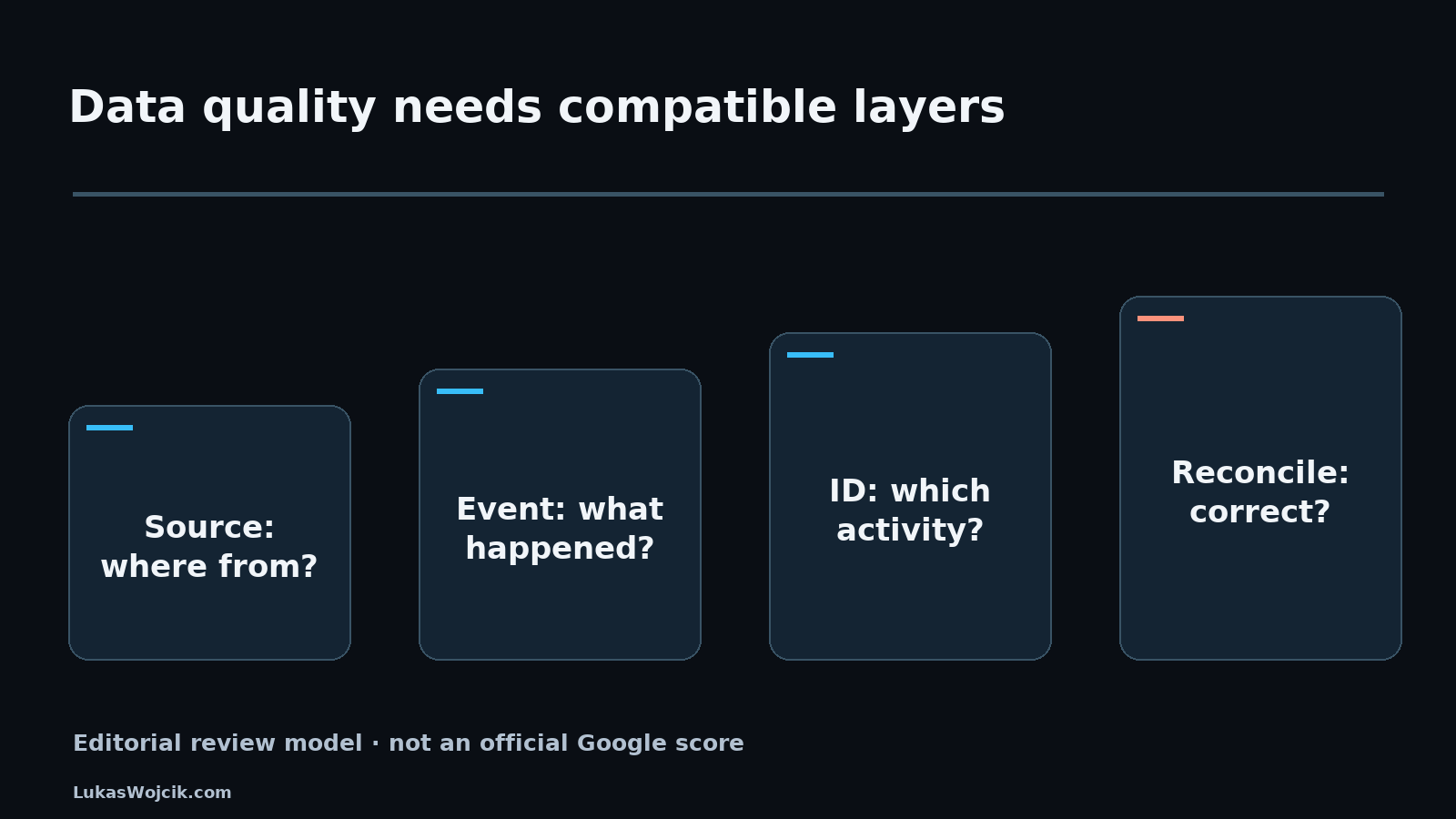
A connection establishes whether data can move between systems. An identifier distinguishes an order or a signed-in account. An event definition explains what happened. These responsibilities support each other, but are not interchangeable. Adding a CRM import cannot repair purchase events that trigger at the wrong moment. A stable order identifier cannot correct an amount that includes shipping in one system and excludes it in another. A useful review therefore starts with definitions and known examples before adding sources.
Order identifiers provide a business reference
The transaction_id identifies an individual transaction and supports matching against order records. Google also documents it as a way to reduce duplicate purchase events. Each order needs a unique, non-empty identifier without personally identifying information. This does not make it a universal defence against every duplicate Ads conversion; the specific collection route still matters. An internal review can use a known order, a repeated delivery of that order and a second order with another identifier. Expected results should be recorded beforehand.
Customer identity and campaign context serve different purposes
A User-ID associates signed-in account activity across sessions or devices. An order identifier instead represents one purchase. Reusing a shared placeholder for all signed-in accounts would collapse that distinction. Campaign parameters such as utm_source, utm_medium and utm_campaign describe acquisition context. Consistent spelling avoids unnecessary fragmentation across report rows. None of these identifiers replaces the others. A clear owner for the origin of each parameter helps later corrections reach the right system.
A small reconciliation beats a large collection checklist
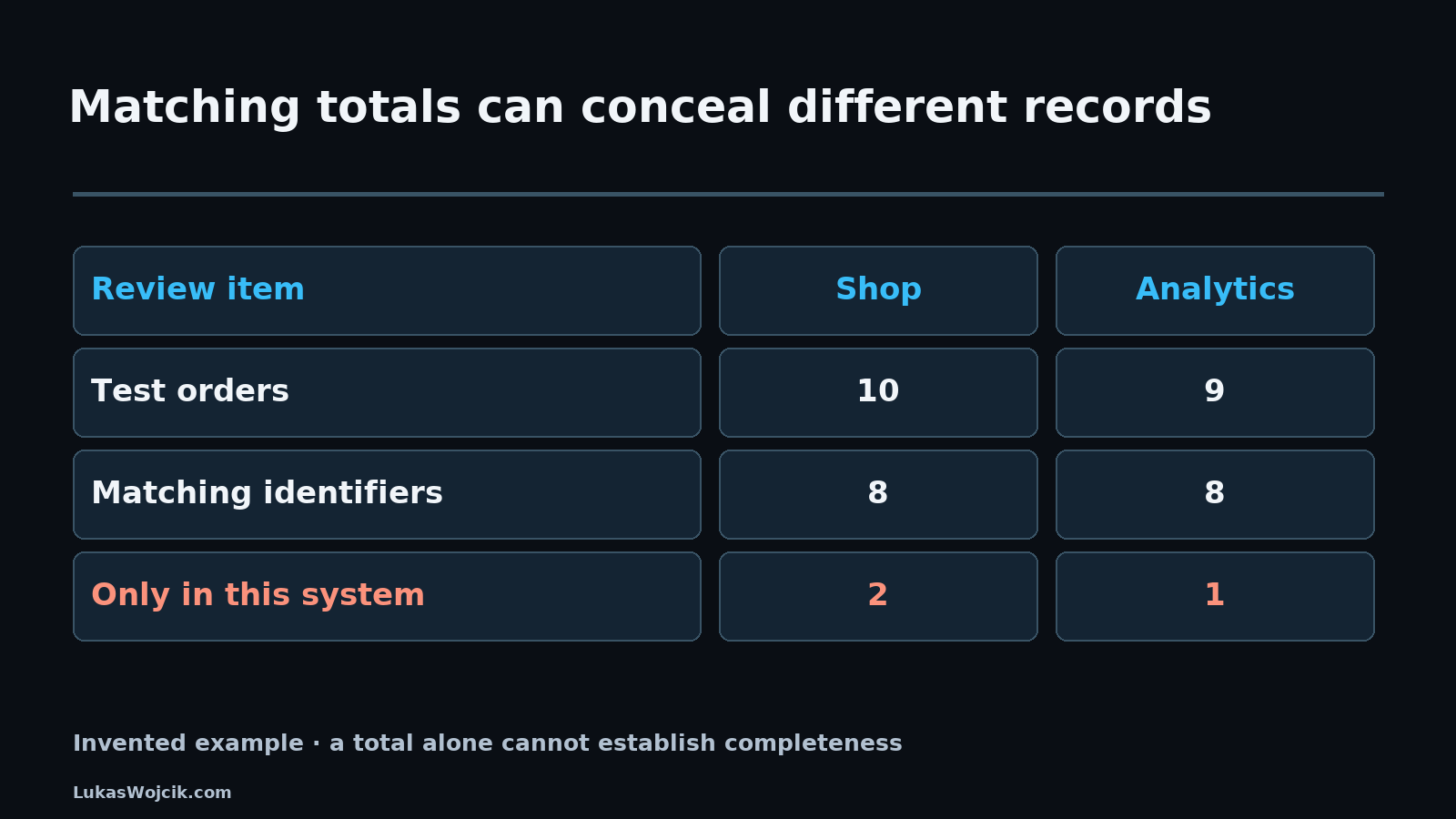
An invented example contains ten test orders of EUR 100 each, totalling EUR 1,000. Two order identifiers are missing from the matching Analytics export, while an additional identifier has no corresponding shop order. The overall amount might still look similar by coincidence. Matching by identifier exposes missing and additional records. The period, timezone, currency and amount definition need alignment first. The existing shop and Analytics reconciliation tool compares local CSV files and flags differences. A missing record alone still does not establish a tracking defect; consent choices and different data availability need investigation.
A useful sequence for the next improvement cycle
A bounded cycle starts with one business goal and one traceable source. It then reviews event definitions, identifiers, amount basis and a small record comparison. Further activation in advertising products becomes more meaningful on that foundation. Google's guide lists many possible signals; that does not imply collecting every available customer detail. Product policies and applicable consent choices still apply. An AI summary cannot retrospectively establish missing business records either. A plausible explanation still needs a report that can be checked.
Measurement Summary
Suggested internal review measures include orders without valid identifiers, unresolved amount differences and inconsistent campaign naming. No universal thresholds are asserted. The numeric example is invented. This article does not document a measured revenue increase or a completed customer migration.
Related articles and tools
- Reconcile shop and Analytics orders locally
- Inspect sources and campaign spelling variants
- Carry campaign parameters into the CRM
- Validate Ask Advisor answers
Questions and answers
Does Data Strength simply mean more tracking?
Useful improvements come from suitable sources, clear definitions and verifiable business records. Additional data without a defined purpose does not repair existing measurement errors.
Are User-ID and transaction_id interchangeable?
User-ID represents a signed-in account; transaction_id represents a transaction. An account and an individual purchase play different roles in measurement.
Does matching total revenue prove complete collection?
Missing and additional records can partly offset in the total. Order-level reconciliation provides more evidence, while still depending on aligned periods and amount definitions.
Does a better data foundation guarantee higher ROAS?
Traceable measurement supports decisions. It does not guarantee a return: demand, the offer, costs and campaign strategy remain separate influences.
Sources
Related articles