Stereo Widening: How Much Width Three Methods Add and What They Cost in Mono, Measured

Contents
A mix is supposed to sound wide, and every DAW keeps the tools for it within reach. What they cost is rarely printed next to them. The bill arrives later: on a phone speaker, in a bar, in any lift, everywhere both channels get folded together. This measurement puts figures on both sides, the width gained and the mono sum lost.
Three ways were compared: raising the side, which is what Fruity Stereo Enhancer does through its stereo separation, a delay based widener, and the Haas method with the two channels delayed against each other. A counter-check with a signal that has no side at all comes on top.
How this was measured
- Signals: a 32 second piece at 44.1 kHz from the same workshop as the measurement on true peak after encoding, with kick and bass in the centre and pads and lead on the sides. As a counter-check pink noise, identical in both channels, so without any side at all.
- Methods: the side doubled through a mid and side matrix,
extrastereowith factors 1.5 and 2.5,stereowidenat its default values (20 ms delay, feedback 0.3, crossfeed 0.3, dry mix 0.8) andhaasonce at its default and once with a 10 ms delay. All with ffmpeg 7.1.5 on a Raspberry Pi 4. - Figures: correlation between left and right, side against mid in dB, loudness according to ITU-R BS.1770 and true peak.
- Mono sum: before the comparison every version was brought to the loudness of the original, so that a difference in level does not show up as a loss in mono. The comparison then ran in twelfth octaves from 25 Hz to 16 kHz, because third octaves average the comb filters of the delay based methods away.
What the methods add in width
| Method | Correlation | Side against mid | Width gained |
|---|---|---|---|
| Original | 0.921 | −13.83 dB | – |
| extrastereo 1.5 | 0.830 | −10.31 dB | 3.52 dB |
| side doubled | 0.716 | −7.81 dB | 6.02 dB |
| stereowiden, default | 0.677 | −7.15 dB | 6.68 dB |
| extrastereo 2.5 | 0.589 | −5.87 dB | 7.96 dB |
| haas, 10 ms | 0.052 | −0.43 dB | 13.40 dB |
| haas, default | 0.037 | −0.31 dB | 13.52 dB |
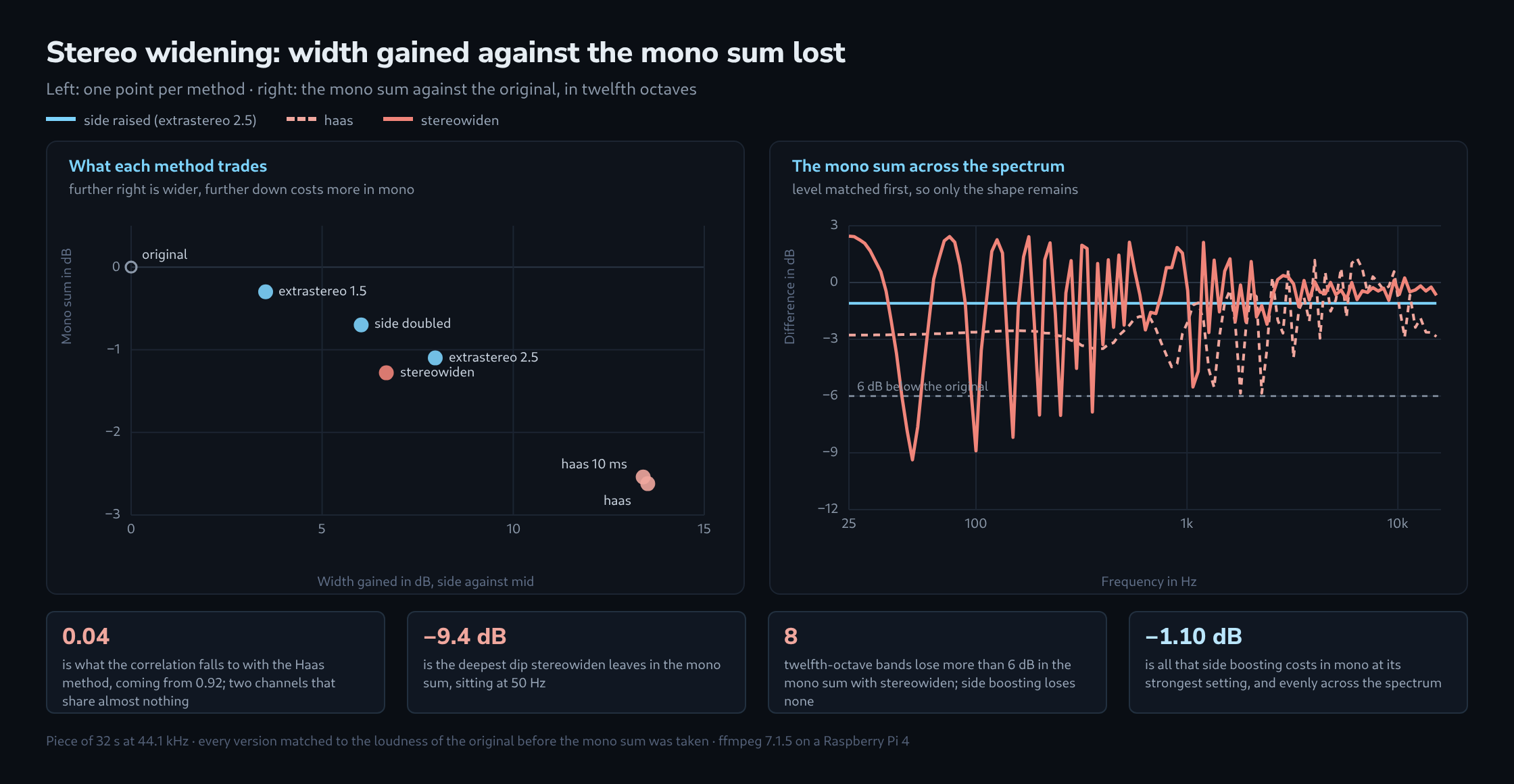
The order is clear: the Haas method adds the most width. With it the side sits level with the mid, and the correlation falls from 0.921 to 0.037. Two channels that share so little are a risk for any playback through a single speaker. Side boosting stays in the middle range, and even stereowiden, despite its delay, gets no further than a firm side boost.
What they cost in the mono sum
| Method | Level matched by | Mono sum | Deepest dip | Bands below −6 dB |
|---|---|---|---|---|
| extrastereo 1.5 | −0.30 dB | −0.30 dB | even | 0 |
| side doubled | −0.70 dB | −0.70 dB | even | 0 |
| extrastereo 2.5 | −1.10 dB | −1.10 dB | even | 0 |
| stereowiden, default | +4.40 dB | −1.28 dB | −9.37 dB at 50 Hz | 8 |
| haas, 10 ms | −2.70 dB | −2.54 dB | −5.88 dB at 1.6 kHz | 0 |
| haas, default | −2.80 dB | −2.62 dB | −5.85 dB at 1.8 kHz | 0 |
Side boosting behaves predictably: what it loses in mono matches exactly the level it gained overall, and the loss spreads evenly across the spectrum. Not a single twelfth-octave band drops by more than 6 dB. That follows from the mechanism: scaling only the side leaves the mid untouched, and the mono sum is the mid.
With stereowiden it is different. Eight bands lose more than 6 dB, the deepest dip sits at 50 Hz with 9.37 dB. That is a comb filter from the 20 ms delay, and it hits exactly the region where kick and bass live. The Haas method gets off more lightly but loses 2.6 dB evenly and gives up almost all of the correlation for it.
The level deceives unless it is matched
One intermediate step of the measurement is worth mentioning, because the same thing happens while listening. Without matching the level, stereowiden looked like a mono loss of 5.68 dB. In truth the version sits 4.40 dB quieter overall, because the dry mix is set to 0.8; of the rest, 1.28 dB remain. Comparing two versions without matching therefore measures mostly the difference in volume. How large that error gets is covered in the tutorial on loudness matching with reference tracks.
Counter-check: a signal without a side
Pink noise, identical in both channels, has a correlation of 1.0 and no side. Side boosting changes exactly nothing about that: the correlation stays at 1.0 and the mono sum stays at 0.00 dB, whatever factor is set. The Image-Line manual says the same about Fruity Stereo Enhancer: the control has no stereo effect on mono sounds as it works by processing the difference between the left and right channels, and where there is no difference there is no stereo to enhance.
Width out of a mono signal comes only from the delay based methods: haas reaches a correlation of 0.137, and stereowiden again tears six bands more than 6 dB out of the sum, the deepest 8.77 dB at 50 Hz. The same manual names the usual setting for this, namely phase offsets of 20 to 40 ms for a realistic stereo effect on mono signals. The measurement shows what that effect costs in the sum.
What follows from this
For a mix that should also come out of one speaker, the order is clear. Side boosting is the safe path: it works where stereo already exists and costs nothing in mono beyond its own level. Delays remain something for single tracks, not for the sum, and they have no business in the bass; keeping the kick in mono loses nothing with any of these methods.
Checking it inside FL Studio works with Wave Candy in its vectorscope mode, which shows the channel differences as a Lissajous figure. For a number instead of a picture, the tool for stereo correlation and mid/side reads correlation, side against mid and the loss of the mono sum straight from the file, per band as well.
What this covers and what it does not
- The measurement used the filters of ffmpeg, not the plugins of FL Studio. Fruity Stereo Enhancer works on the same two principles, but its controls are divided differently.
- The figures hold for this piece. A mix with more side content loses more in mono, an almost mono mix loses less.
- The correlation is an average across the whole piece. Short out-of-phase moments barely show in it, while the vectorscope shows them at once.
- The level was matched by programme loudness. With strongly differing dynamics, matching over shorter sections would be more precise.
Sources
- Image-Line: Fruity Stereo Enhancer: stereo separation, phase offset up to 500 ms, phase inversion; no stereo effect on mono sounds because the control processes the difference between the channels; 20 to 40 ms for a realistic effect on mono signals.
- Image-Line: Wave Candy: vectorscope as a Lissajous figure for stereo content, panning and phase.
- ffmpeg: Filters Documentation: the sections on
haas,extrastereoandstereowidenwith their controls; the default values used here come from the built-in help of ffmpeg 7.1.5. - ITU-R BS.1770: Algorithms to measure audio programme loudness and true-peak audio level: the basis of the level matching before the comparison.
Related articles