

 English
 Deutsch
 Polski
Unassigned Visits in GA4: Finding and Fixing Missing Channel Attribution

Management Summary
Google Analytics groups visits into channels such as search or advertising to explain how traffic reaches a website. “Unassigned” means that the available information does not match a channel rule. This can make marketing comparisons less clear without proving a specific tracking failure. The article explains how campaign names, links and the course of a visit affect the classification. Better future data and a different grouping of historical data are separate improvements.
Contents
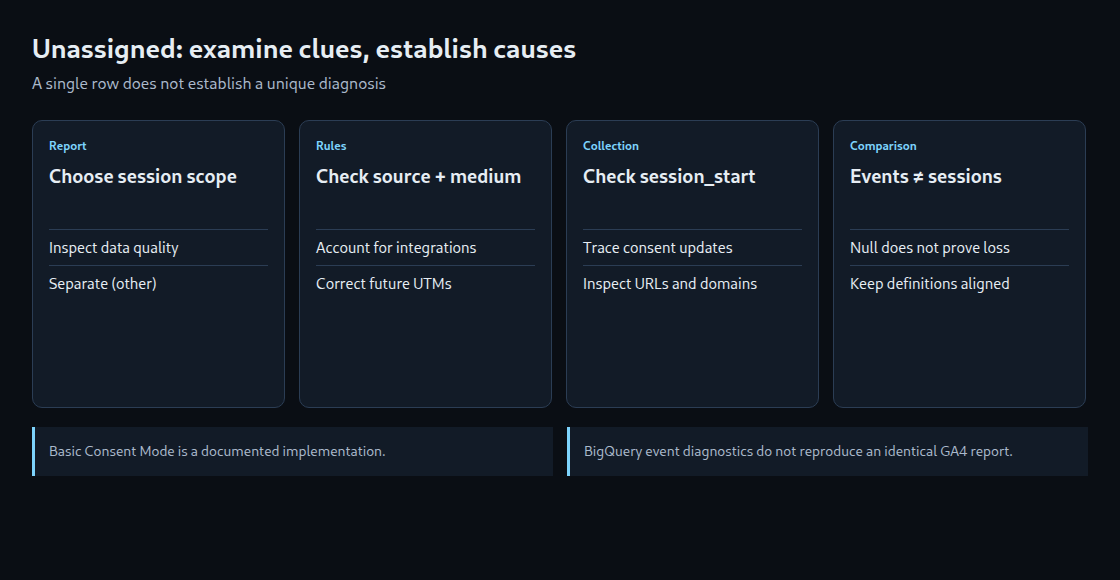
“Unassigned” in GA4 means that no matching channel rule was found. It identifies missing classification, not a specific cause. Unexpected campaign values, missing session information or incorrect event ordering can contribute. Diagnosis starts with a suitable report and a traceable test visit.
1. Establish the reporting scope
For sessions, the relevant comparison pairs Session default channel group with Session source / medium. User acquisition describes the first user source, while event-scoped channel dimensions answer other questions. Different scopes can produce different results, but do not automatically create Unassigned.
The review uses a completed period, consistent filters and the data-quality indicator. (other) is a combined row used when a report has too many distinct dimension values, not Unassigned. (not set) means that information is unavailable for the particular dimension; it does not locate the failure.
2. Compare campaign values with the actual rules
For manual tagging, utm_medium=email is a clear choice for email campaigns. The medium newsletter does not meet the Email rule by itself. That does not necessarily mean Unassigned: source, campaign name or other rules may produce another channel. Organic Search can also be identified through a recognized search source. Google Ads traffic additionally uses integration information such as network and campaign type.
https://example.com/offer?utm_source=mailchimp&utm_medium=email&utm_campaign=october-promoDefault channel definitions are case-insensitive. Different spelling can still create separate source or campaign rows, so consistent naming remains useful. A missing medium can hinder classification without making classification impossible in every case.
The default group cannot be edited. A custom channel group can classify existing historical values differently, but does not repair those original values. Corrected links improve future collection. A complete assessment considers the applicable rules together instead of treating isolated medium values as universally correct or incorrect.
3. Investigate missing values technically
Google identifies a missing session_start as a cause of (not set) for session source and medium. Checks should therefore cover Google tag configuration before event tags, consistent cookie settings, session identifiers and correctly communicated consent updates. Conversely, a real source value does not prove that every other field arrived intact.
- Redirects: Test parameters need to remain traceable through the entire navigation chain into the actual measurement request. Lost UTMs can also cause Direct rather than Unassigned.
- Single-page applications: The check establishes whether routing or URL cleanup changes the landing address before permitted collection. Configuration and the initial page view need the correct address without accidentally creating a duplicate page view.
- Domain changes: For jointly measured owned domains, verification covers the same G-ID, appropriate domain configuration and acceptance of the
_glparameter. A payment processor without the site’s tag is not simply another measurable owned domain.
Returning from a payment processor does not necessarily start a new session. Ignoring unwanted referrals prevents their use as a source; it does not automatically erase all existing attribution. Cross-domain measurement and the unwanted-referral list solve different problems.

4. Interpret consent behavior correctly
Basic Consent Mode, with tags blocked before consent, is a documented implementation. Missing measurement during that period does not justify indiscriminately bypassing the chosen consent behavior. Advanced Consent Mode can send measurements without cookies when storage is denied, but does not guarantee complete session attribution.
Consent updates need to take effect on the page where the choice changes. Repeating a default command instead of an update, or navigating immediately, can disrupt attribution. Advertising and analytics storage are separate states and should not be treated as interchangeable.
URL passthrough is an optional aid with specific prerequisites for links on the same domain. It replaces neither complete cross-domain configuration nor every missing campaign detail. Modeled user and session values also require sufficient suitable data; not every property qualifies. Raw events, observed sessions and modeled report values remain different levels.
5. Use BigQuery for event diagnostics
collected_traffic_source contains source values collected with an event. It is not automatically the attributed session source; session_traffic_source_last_click exists for session attribution. Available nested fields and their historical population require inspection in the actual export schema; exports cannot generally be assumed to lack channel information.
The query below deliberately counts event rows and session_start events, not unique sessions or an Unassigned percentage. Null values remain visible. The project, dataset and dates are placeholders requiring replacement; the query uses daily tables.
SELECT
  collected_traffic_source.manual_source AS collected_source,
  collected_traffic_source.manual_medium AS collected_medium,
  COUNT(*) AS event_rows,
  COUNTIF(event_name = 'session_start') AS session_start_events
FROM `project.analytics_XXXXXXXXX.events_*`
WHERE _TABLE_SUFFIX BETWEEN '20260901' AND '20260930'
GROUP BY collected_source, collected_medium
ORDER BY event_rows DESC, collected_source, collected_medium;
Several events from one session can have different collected source values. Nulls establish neither parameter loss nor Direct. Distinct exported sessions require suitable stream, user and session identifiers, with missing identifiers reported separately. Filtering to session_start would hide precisely those events without a start. Comparisons with reports must also account for modeling, freshness and attribution differences.
Questions and answers
How can a problematic redirect be demonstrated?
A browser network log with preserved requests shows navigation and measurement. curl -sIL can inspect HTTP headers, but uses HEAD and does not execute JavaScript. The actual destination and transmitted measurement values matter, not just an isolated Location header.
Does saving the landing address help?
A single-page application (SPA) can change the visible screen and URL without loading a new document. Saving the original landing address can prevent the measurement from accidentally reading a later URL after that change. Passing it as page_location must match the actual initial measurement and respect the consent decision. The address must not contain unnecessary personal data. This does not automatically restore lost identity or complete attribution.
Is a small stable Unassigned percentage harmless?
Both the count and percentage need interpretation against volume, campaign structure and implementation. Stability alone does not prove correct collection. Before-and-after comparisons need the same definitions and sufficiently completed data.
Sources
- GA4: Default channel group
- GA4: (not set) values
- GA4: Tagging best practices
- GA4: Custom channel groups
- GA4: Direct traffic
- GA4: Cross-domain measurement
- GA4: Unwanted referrals
- Google: Consent mode implementation
- Google: Basic and advanced consent mode
- GA4: Behavioral modeling
- GA4: BigQuery export schema
- GA4: BigQuery export
- GA4: Developer guide
Practical check: audit real acquisition rows
The Acquisition Audit in the Channel Debugger adds a report-based check to the individual channel-rule examples. After Google authorization, a property and an explicit date range determine the query. The tool reads session source, medium, campaign and default channel group together with sessions. It does not mix first-user acquisition with session acquisition.
- A completed reporting period provides the basis for the audit. Recent data may still change.
- Rows in Unassigned with the largest session values take priority. The comparison checks source and medium against the channel rules described above.
- Naming checks cover variants such as
Emailandemail, or campaign names with extra spaces. A candidate is a naming inconsistency to investigate, not an automatic correction. - Interpretation requires a review of the returned metadata. Thresholding, sampling and an
(other)row can hide detail. - A CSV export documents the findings. Corrections to future campaign links or tracking configuration depend on the supporting evidence.
The displayed Unassigned percentage uses the sum of the returned session values. It is not an independently retrieved property total. The tool rejects incomplete pagination and does not rewrite historical attribution. A row containing (not set) alone cannot establish whether consent, redirects or tagging caused the missing value.
Technical references: Data API dimensions and metrics and response metadata.
Related articles


