English
 Deutsch
 Polski
Checking DNS Servers Separately: What Different Answers Mean

Management Summary
DNS acts as an internet address book, turning a website name into the address needed to reach its server. Several servers usually provide this information for one domain. Comparing their answers can reveal an incomplete update after a website move and help explain inconsistent access. The article also shows why different answers are not automatically mistakes: providers may organise their systems differently, and stored older answers take time to expire. The intended configuration supplies the basis for judgement.
Contents
DNS turns a domain name into the address of a server. Several nameservers usually hold the information for a domain. Asking them separately can reveal a missing update—but different answers do not automatically mean that something is broken.
Two ways to ask
A resolver is a service that looks up DNS information and keeps answers temporarily. A normal lookup may therefore return a saved answer without contacting the domain’s nameservers again. It does not show what every nameserver currently returns.
A direct query asks a selected server. For example, after a website moves, one server might still return the old address. Comparing answers helps locate that difference. Standard tools such as dig can make direct queries; a custom packet builder is one implementation choice, not a requirement.
What the historical check covered
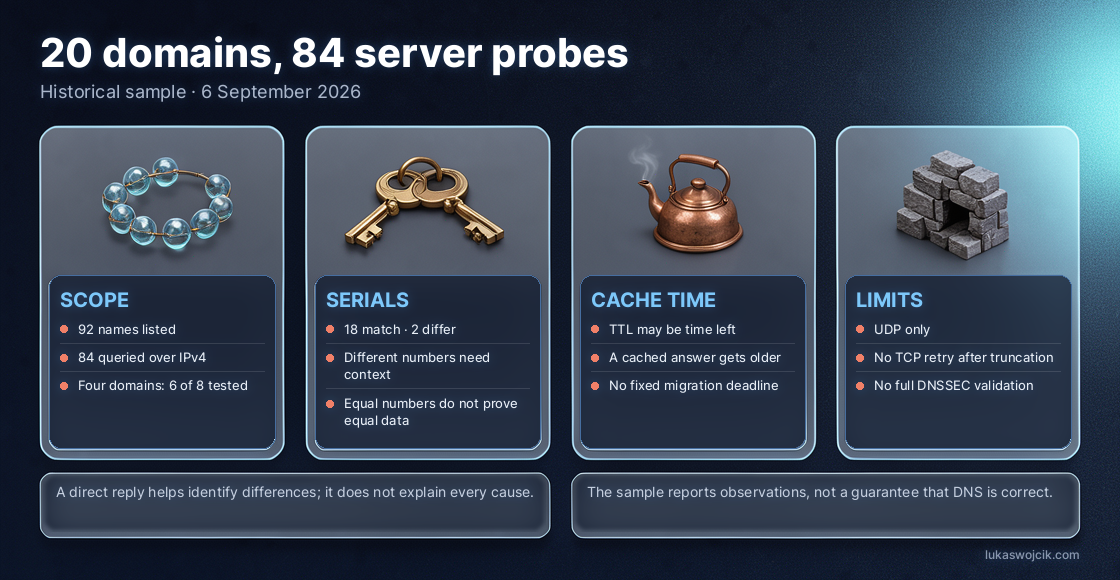
The saved run from 6 September 2026, 14:26:51 +02:00 covers twenty domains. A public resolver returned 92 nameserver entries across those domains. The checker contacted 84: at most six names per domain, sorted alphabetically, using the first returned IPv4 address for each.
Four domains had eight listed servers: GitHub, The New York Times, BBC and gov.uk. Two servers per domain were omitted. Every tested server’s SOA reply was recorded as reachable with the AA flag set. AA means that the server claims authority for the requested name; it is not a cryptographic proof or a test of every possible response.
The list itself needs checking
The initial server list came from a recursive resolver. It was not obtained by following the delegation from the parent zone, the part of DNS that points to the domain’s nameservers. A cached list can therefore hide a difference between parent and child.
All twenty results reported matching nameserver sets. That conclusion has a limit: the code leaves empty server answers out of the comparison. Agreement among available answers is useful, but does not prove that every lookup succeeded. Testing one IPv4 address also leaves other addresses, IPv6 and other network locations untested.
Different serial numbers need an explanation
The SOA record describes a DNS zone, the collection of records managed together. Its serial number marks updates in the usual primary-and-secondary setup. Eighteen sampled domains had matching serials among the tested servers. GitHub and The New York Times each had two serial values.
Separate providers may maintain their own numbers, but the capture does not prove that this was harmless. An incomplete update is another possibility. Equal serials likewise do not prove equal records. The next step is to compare the intended records with the provider configuration and change history; rotating addresses can be deliberate. Serial numbers can wrap around, so ordinary subtraction is not a reliable age comparison.
A short TTL does not promise a fast move
TTL is the time an answer may normally remain reusable in a cache. Here the recorded TTL came from the resolver and may be the time left on an older cached answer. The saved findings include one second for Google and nine for GitHub; these values do not establish the original settings.
For a move, a lower TTL normally needs to be published before the old TTL has run out. For example, changing a 24-hour TTL to five minutes does not shorten copies already cached with the old value. A lower TTL also does not cause a lookup on a fixed schedule: another request is needed. Serve-stale behaviour can retain expired answers during a DNS outage, so TTL alone is no completion guarantee.
DNSSEC, IPv6 and an unlisted primary
Three captures reported DS records and an AD flag: Cloudflare, gov.uk and bund.de. DNSSEC adds digital signatures to DNS data. A DS record in the parent zone identifies a key used by the child zone; its presence alone does not prove that the returned signatures are valid. The AD flag here belongs to the resolver’s nameserver answer and is meaningful only with trust in that resolver and the path to it. The other seventeen captures do not independently prove unsigned zones.
Ten results contained an IPv6 address at the queried domain name. That says nothing about every subdomain or IPv6 service reachability. Five SOA primary names were absent from the returned server list. A hidden primary is one possible design: public servers obtain updates from an unlisted server. Absence from the list does not prove that the primary is inaccessible from outside.
Where this checker stops
The checker sends UDP queries with a 1,232-byte advertised response size. It neither exposes the truncation flag nor retries over TCP. Large replies can therefore remain incomplete. A full DNS implementation needs TCP support; a packet larger than 1,232 bytes does not necessarily fragment on every network.
Eight local tests also showed that some failed or malformed replies can pass the parser without a clear error. A loop guard prevents endless pointer following but is not complete packet validation. The tool’s green results therefore need these limits alongside them; the tests did not remeasure the twenty domains.
DNS Delegation, Serial and TTL Auditor
Questions and answers
How can a specific server be checked?
The example below asks the selected server for the SOA record without requesting recursion. ns1.example.net is a placeholder for an actual nameserver name or address. The output retains the response status, flags and answering server; an empty answer alone is not a successful check.
dig @ns1.example.net example.com SOA +norecurse +comments +answer +statsWhat needs comparing before a DNS change is considered complete?
The parent delegation, answers from the relevant server addresses, intended record values and actual website or mail behaviour need to agree with the plan. Repeated checks from different networks can reveal differences missed by a single observation.
Related articles