

 English
 Deutsch
 Polski
Checking Web Fonts: Which Fonts Actually Load and What CSS Alone Cannot Show

Management Summary
Web fonts give a website a chosen typeface instead of relying only on fonts already installed on a device. They shape the design, but downloading them can affect when text appears and whether the page shifts while loading. The article explains why font declarations in a site’s design instructions do not reveal every download or the final reading experience. Understanding the difference helps balance visual identity, readable text and data transfers to the services delivering the fonts.
Contents
Web fonts connect three different questions: which faces CSS declares, which font files a browser actually requests, and how text appears while those resources load. A static CSS audit answers only part of that picture. A historical check of twenty front pages on 6 September 2026 illustrates both useful findings and the limits of such an audit.
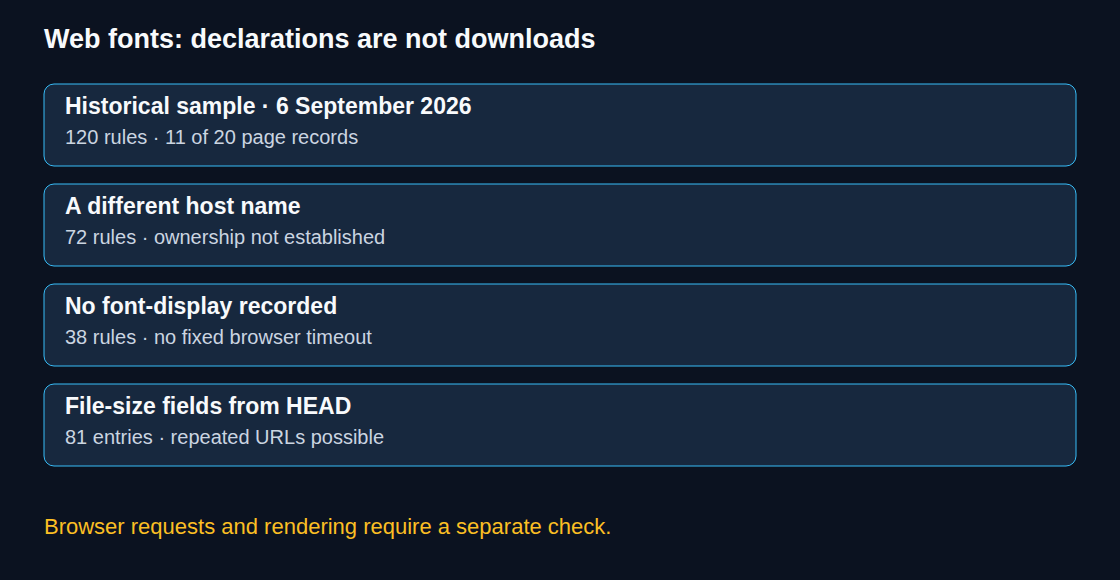
The saved report contains 120 font-face declarations across eleven page records. This does not mean 120 different files, 120 downloads or 120 faces used by visitors. A face is a declared combination such as a family, weight and style; several declarations can refer to the same file, and a variable font can cover several weights.
From a declaration to a real request
An @font-face rule can name local fonts and downloadable sources. Merely finding that rule does not establish a download. Ordinary font selection considers the text, styling, available sources and character coverage. A matching local font or a usable cached response can avoid a network transfer. Conversely, preload or the Font Loading API can initiate loading before ordinary text rendering requires the face.
The checker used here does not render the page. It reads inline CSS and at most four linked stylesheets, without recursively following imports. It chooses up to six distinct font URLs per page for HEAD requests. Those requests retrieve headers, not the font bodies, and do not establish which files a real browser would use.
What the historical numbers establish
The twenty records contain 120 declarations, including 72 whose recorded source host differs from the page host. Thirty-eight have no recorded font-display value; 108 have no recorded unicode-range. These are counts of parsed declarations, not counts of delayed text or unnecessary downloads.
Nine records contain no detected faces. Two of those are failed access attempts: Stack Overflow returned 429 and Allegro 403. Even the other seven do not prove that the sites use no web fonts. GitHub was limited to four of 26 stylesheets, the New York Times to four of 55, and a Cloudflare stylesheet was truncated at 512 KiB. Six page records reached the stylesheet sampling limit. Microsoft also had a DNS-related stylesheet failure, and an Apple stylesheet returned 404.
The original total of 25 declarations without WOFF2 needs qualification. Three have no recorded downloadable format. Among the other 22, two Heise declarations contain variation-related WOFF2 labels that the exact-string comparison fails to recognise. The stored rows therefore do not support a blanket verdict that 25 faces use obsolete formats.
Eighty-one declaration rows contain a size value. Adding their rounded values produces 2,490 KiB, but shared URLs can appear in several rows. These sizes came from Content-Length in HEAD responses. Neither that sum nor the roughly 31 KiB average is measured page traffic or a count of unique downloaded files.
A host name does not establish ownership
The recorded hosts include static subdomains and delivery domains such as static.files.bbci.co.uk, ocdn.eu and fonts.wpcdn.pl. Host-name differences alone do not establish who operates the infrastructure, which processors are involved or whether a service is public. The sample contains no recorded Google Fonts host, but incomplete CSS coverage cannot prove that all twenty pages avoid every public font service.
A network request exposes connection information, including an IP address, to the receiving infrastructure. The Referer value depends on policy; under strict-origin-when-cross-origin, a cross-origin request normally carries the origin rather than the full page path. A familiar domain name is therefore not a privacy assessment, and an unfamiliar one is not proof of a violation.
A different host can add connection work, but does not inevitably require a fresh DNS lookup and TLS handshake. Cached resolution, existing connections and HTTP/2 connection reuse can change the cost. A missing preconnect hint is consequently not proof of a fixed extra round trip. The checker also groups dns-prefetch with preconnect, although DNS prefetch alone does not establish a connection.
Choosing font-display deliberately
Missing font-display means auto, whose behaviour is browser-defined. A universal three-second period of invisible text cannot be inferred from the declaration alone. During the block period, affected text can remain invisible while the font loads. During the swap period, a fallback font is visible and can still be replaced by the downloaded font. If the downloaded font is still unavailable when that period ends, the fallback remains for that page view.
- swap: a very short block period followed by an unrestricted opportunity to swap in the loaded font. Swapping can affect layout; exactly one reflow is not guaranteed.
- fallback: a very short block period followed by a limited swap period. It does not permanently give up after 100 milliseconds. The specification recommends about three seconds for the swap period in most cases, but allows browser differences.
- optional: the browser may keep fallback and avoid or deprioritise a download when the font is not ready early enough. Late swapping should not disturb the already displayed text.
The choice depends on the role of the font. A readable text fallback matters especially for body copy; icon fonts also need a usable fallback strategy. No setting is universally the strictest or best option.

Subsets and formats
unicode-range helps limit a face to relevant code points. The actual glyphs in the font also matter. A matching character can make a subset necessary, but only if that face is selected and an external resource is needed. The descriptor does not extract individual characters from a file.
Missing ranges do not automatically download every declared file. Overlapping declarations, source order and glyph coverage affect selection. A German or Polish page does not have a fixed one-file or two-file requirement: punctuation, names and the actual subset boundaries matter.
WOFF2 is a useful compressed delivery format. The saving relative to WOFF depends on the font and encoding, so an automatic one-third reduction is not a reliable estimate. The comparison should use equivalent character coverage and styles. An unsupported parser label is also not evidence that the browser lacks WOFF2.
A practical check
For an actual page visit, the browser’s Network panel can show font requests, initiators, transfer sizes, cache use and timing. A separate rendering check reveals the chosen font, fallback behaviour and layout shifts. Different viewports, relevant text and cold versus warm cache conditions can change the result.
The following Bash example saves one stylesheet and one selected font file without cutting CSS to six lines after a match. It needs curl 8.4 or later and GNU coreutils. Both URLs are placeholders; the font URL must come from the relevant stylesheet, with relative addresses resolved against that stylesheet. Each HTTPS download is limited to 5 MiB and 30 seconds.
#!/usr/bin/env bash
set -euo pipefail
out=$(mktemp -d)
printf 'Output: %s\n' "$out"
for resource in stylesheet font; do
  if [ "$resource" = stylesheet ]; then
    url='https://example.com/style.css'
  else
    url='https://example.com/fonts/regular.woff2'
  fi
  curl --silent --show-error --fail --location \
    --proto '=https' --proto-redir '=https' --max-redirs 3 \
    --connect-timeout 10 --max-time 30 --max-filesize 5242880 \
    -D "$out/$resource.headers" -o "$out/$resource.body" \
    -w "$resource status=%{http_code} type=%{content_type} url=%{url_effective}\n" \
    "$url"
  wc -c < "$out/$resource.body"
done
printf 'Saved headers and bodies: %s\n' "$out"
The saved headers include redirect responses; the final response is the relevant one for status and cache assessment. A successful curl download does not test browser CORS, CSP, font decoding or actual usage. The full CSS still needs inspection for imports, conditions, duplicate rules and alternative sources.
The Web Font Loading and Privacy Auditor provides a preliminary inventory within the limits described above. Its labels describe parser results and header samples, not a complete network trace or a legal conclusion.
Questions and answers
What matters for fonts on another origin?
A subdomain can be another origin even under common ownership. Cross-origin font responses need appropriate CORS permission. CSP must also allow the resource through font-src, or through default-src when the former is absent. An origin includes scheme, host and port; matching the host alone is insufficient.
When do preconnect and preload help?
Preconnect can prepare a likely required origin; font connections need the appropriate crossorigin mode. Preload can start a critical font early, with as=”font”, a suitable type and crossorigin, including for same-origin fonts. A mismatched mode can prevent reuse. Neither hint guarantees a gain, and preloading unused faces wastes resources. The network trace should confirm the effect.
Can caching and fallback metrics remove all later costs?
A versioned file name and suitable Cache-Control can support long caching, but eviction, reload behaviour and cache partitioning can still cause later requests. Metrics such as size-adjust, ascent-override, descent-override and line-gap-override can reduce differences between a particular local fallback and the web font. Missing local fonts and differing glyph widths still require testing; zero layout shift is not guaranteed.
Sources
- W3C CSS Fonts Level 4 (Working Draft): Font resources, display and metrics
- W3C: WOFF File Format 2.0
- Google web.dev: Best practices for fonts
- Google web.dev: Optimize WebFont loading and rendering
- Google web.dev: Preload web fonts
- IETF RFC 9113: HTTP/2 connection reuse
- W3C: Referrer Policy — strict-origin-when-cross-origin
- W3C: Content Security Policy — font-src
- curl: Command-line reference
- Google web.dev: CSS size-adjust and font-metric overrides
Related articles


