Meta Marketing API v26.0: October 27 Breaks Your Version Pin
Contents
Meta shipped Graph API v26.0 on July 29, 2026. If you run ad automation, your reflex is the one that has worked for years: read the changelog, keep your integration pinned to whatever you are on today, and book the migration for a quiet week in spring. That reflex fails this time. On October 27, 2026 the central v26.0 changes take effect across every still-supported version. The pin buys you nothing after that date. You have about eleven weeks, and the work is an inventory problem, not a coding problem.
1. Why the version pin stops working on October 27
The usual contract with a versioned API is simple. A new version introduces breaking changes, the old version keeps its behaviour until end of life, and you decide when to move. Pinning is the whole point of the version number.
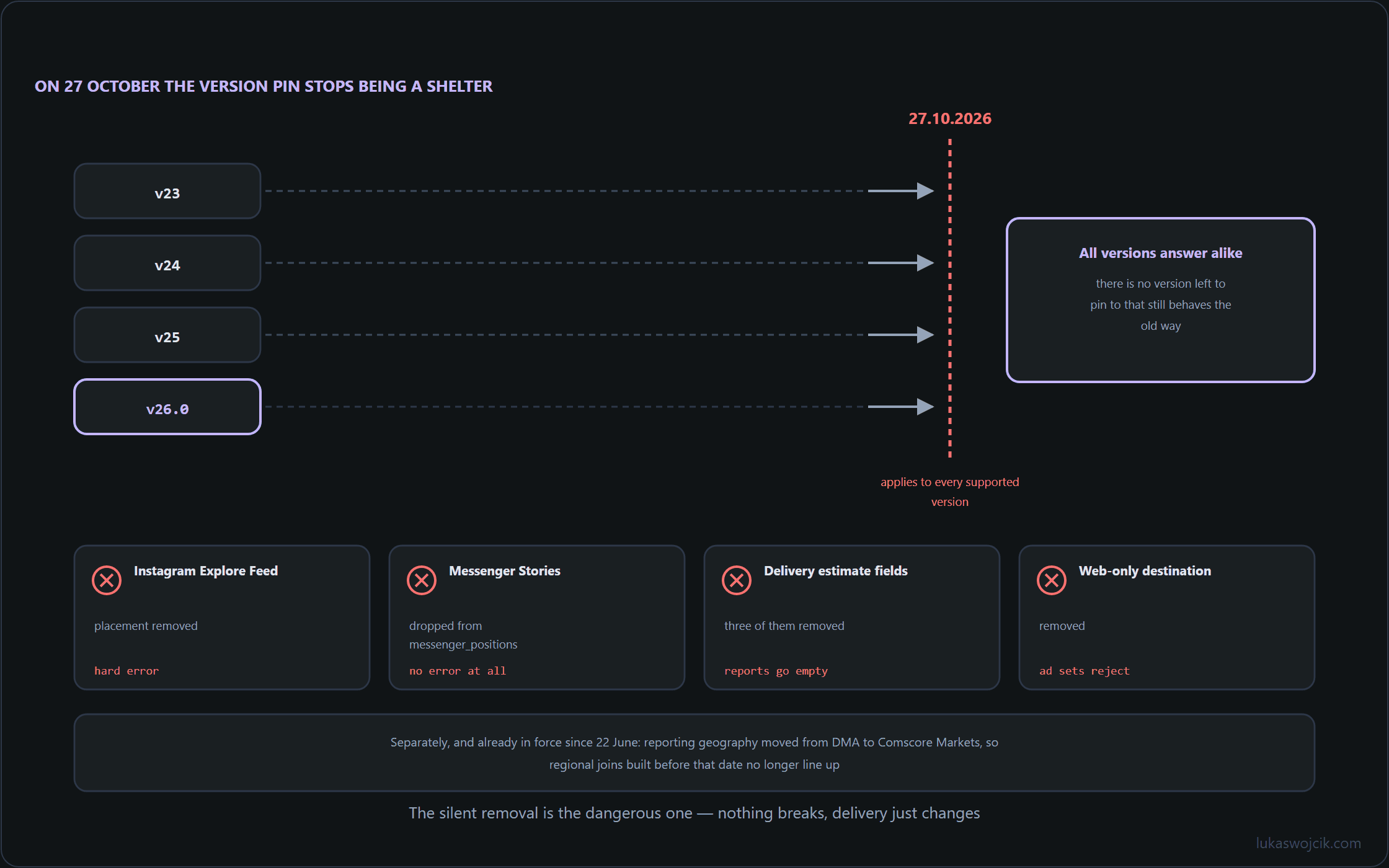
October 27 breaks that contract on purpose. The core v26.0 changes apply to all versions that are still supported on that day, not only to calls that carry v26.0 in the path. So the sentence you will hear in the next planning meeting, and read in half the posts about this release, is wrong: no, you are not safe because you are still on an older version. There is no version you can sit on that keeps the removed placements and fields alive. Treat the date as a platform change with a deadline, and treat the version number as irrelevant to your exposure.
2. What breaks loudly, and what breaks quietly
Six changes matter. Sort them by how they will reach you.
- Instagram Explore Feed placement: removed, and requests that still reference it produce a hard error. This one you will notice within minutes.
- Three delivery estimate fields: removed. Take the exact field names from the changelog and from nowhere else, including this article, and diff them against the field lists your code actually requests.
- Web-only destination: gone. Any ad set built around it needs a new destination decision, not a config tweak.
- Poll creatives: blocked. Creative creation fails.
- Special Ad Category: ad sets in the Housing, Employment and Financial categories must now set it explicitly. Implicit or inherited is no longer enough.
- Messenger Stories: silently dropped from
messenger_positions. No error, no warning, no changed status code.
The last item is the expensive one. Your alerting is almost certainly built on error rates and failed job counts, and the error rate for this change stays at zero. Your ad sets keep returning success, your delivery mix shifts, and the first signal reaches you weeks later as an unexplained bend in a performance chart. Anything that hard-fails is a Tuesday morning. A silent placement removal is a quarter of muddy attribution.
3. Audit your own configuration, not the API
Do not start by calling the API. Start with the configuration you already store, because that is where the offending strings live: exported ad set definitions, the templates your campaign generator renders, the field lists in your reporting extractor. Keep the vendor facts in one hand-maintained watchlist.json, copied once from the changelog, so nothing in the script is guessed. Everything else is yours.
#!/usr/bin/env python3
# audit_v26.py - scans YOUR stored ad set configuration for v26.0 exposure.
import json, pathlib, sys

WATCH = json.loads(pathlib.Path("watchlist.json").read_text())
CONFIG_DIR = pathlib.Path("/srv/adops/adset_configs")
REGULATED = {"housing", "employment", "financial"}

def flatten(node, path=""):
    if isinstance(node, dict):
        for k, v in node.items():
            yield from flatten(v, f"{path}.{k}" if path else k)
    elif isinstance(node, list):
        for i, v in enumerate(node):
            yield from flatten(v, f"{path}[{i}]")
    else:
        yield path, node

findings = []
for f in sorted(CONFIG_DIR.glob("*.json")):
    doc = json.loads(f.read_text())
    flat = dict(flatten(doc))
    for path, value in flat.items():
        if value in WATCH["hard_fail_placements"]:
            findings.append((f.name, "HARD_FAIL", path, value))
        elif "messenger_positions" in path and value in WATCH["silent_drops"]:
            findings.append((f.name, "SILENT", path, value))
        elif value in WATCH["blocked_creatives"]:
            findings.append((f.name, "BLOCKED", path, value))
    for field in WATCH["removed_fields"]:
        hits = [p for p in flat if p.endswith(field)]
        if hits:
            findings.append((f.name, "REMOVED_FIELD", hits[0], field))
    if doc.get("vertical") in REGULATED and not doc.get("special_ad_category"):
        findings.append((f.name, "MISSING_SAC", "special_ad_category", doc["vertical"]))

for row in findings:
    print("\t".join(str(c) for c in row))
sys.exit(1 if any(r[1] == "HARD_FAIL" for r in findings) else 0)
Run it weekly until the date, and wire the same exit code into the job that deploys campaign templates. A HARD_FAIL finding after October 27 is a broken deploy, so fail the build now rather than the campaign later.
# /etc/cron.d/meta-v26-audit
MAILTO=adops@example.com
15 6 * * 1 adops cd /srv/adops && python3 audit_v26.py > /var/log/adops/v26-$(date +\%F).tsv 2>&1 || echo "v26 audit found blockers"
4. The checklist per endpoint, and the Comscore switch nobody scheduled
- Ad set create and update: strip the Explore Feed placement, set
messenger_positionsexplicitly instead of relying on defaults, and set Special Ad Category for every Housing, Employment and Financial ad set. - Creative create: reject poll creatives in your own validation layer, and re-plan every ad set that used the web-only destination.
- Delivery estimate reads: remove the three fields from the request field list, then follow them downstream through your staging tables, transformation models and dashboard columns. The API stops sending them; your schema will happily keep a nullable column forever.
- Reporting: re-check the geography dimension, see below.
- Verification: replay the whole path against a low-budget test ad account you control, once before October 27 and once on the following morning.
The reporting item is separate from the October date and it is already live. On June 22, 2026 Meta changed the geographic resolution in reporting from DMA to Comscore Markets. If your warehouse joins Meta geo rows against a DMA dimension table, that join has been quietly losing rows for seven weeks, and any dashboard comparing this summer against last summer is comparing two different geographies. Find the damage first, then decide on the new mapping.
-- Rows that no longer resolve against the old DMA dimension.
SELECT f.report_date, f.geo_name, SUM(f.impressions) AS impressions
FROM meta_geo_daily f
LEFT JOIN dim_dma d ON d.dma_name = f.geo_name
WHERE f.report_date >= DATE '2026-06-01'
  AND d.dma_code IS NULL
GROUP BY 1, 2
ORDER BY impressions DESC
LIMIT 25;
5. Summary
You built two small things: an audit script that reads your own stored ad set configuration against a hand-copied watchlist and exits non-zero on anything that will hard-fail, and a checklist that maps each v26.0 change to the endpoint and the downstream table it touches. Neither depends on guessed API responses.
What it buys you is the difference between finding out on October 27 and knowing today. The loud changes would have found you anyway. The value is in the two that will not: Messenger Stories disappearing from messenger_positions without an error, and the DMA to Comscore switch that has been skewing your geo reporting since June. And it buys you the one correction worth repeating to whoever plans your quarter, that pinning to an older version is not a mitigation here. Verify every field name and placement string against the primary source before you change a line: Graph API Changelog, version 26.0.
Related articles