

SEO and GEO (Generative Engine Optimization): How AI Search Changes Optimisation

The digital landscape is undergoing its most profound structural shift since the inception of the commercial web. With the introduction and expansion of AI-driven search experiences—such as Google’s AI Overviews—the traditional mechanics of information retrieval have been fundamentally altered. Search engines are transitioning from indexing directories that point to external websites into autonomous answer engines.
This evolution has introduced a critical challenge for web architecture: zero-click searches. Instead of generating outbound traffic to publishers and content creators, the search engine synthesizes information dynamically, satisfying user intent directly within the search engine results page (SERP). As organic search real estate shrinks, technical optimization must adapt, pivoting from traditional Search Engine Optimization (SEO) toward Generative Engine Optimization (GEO).
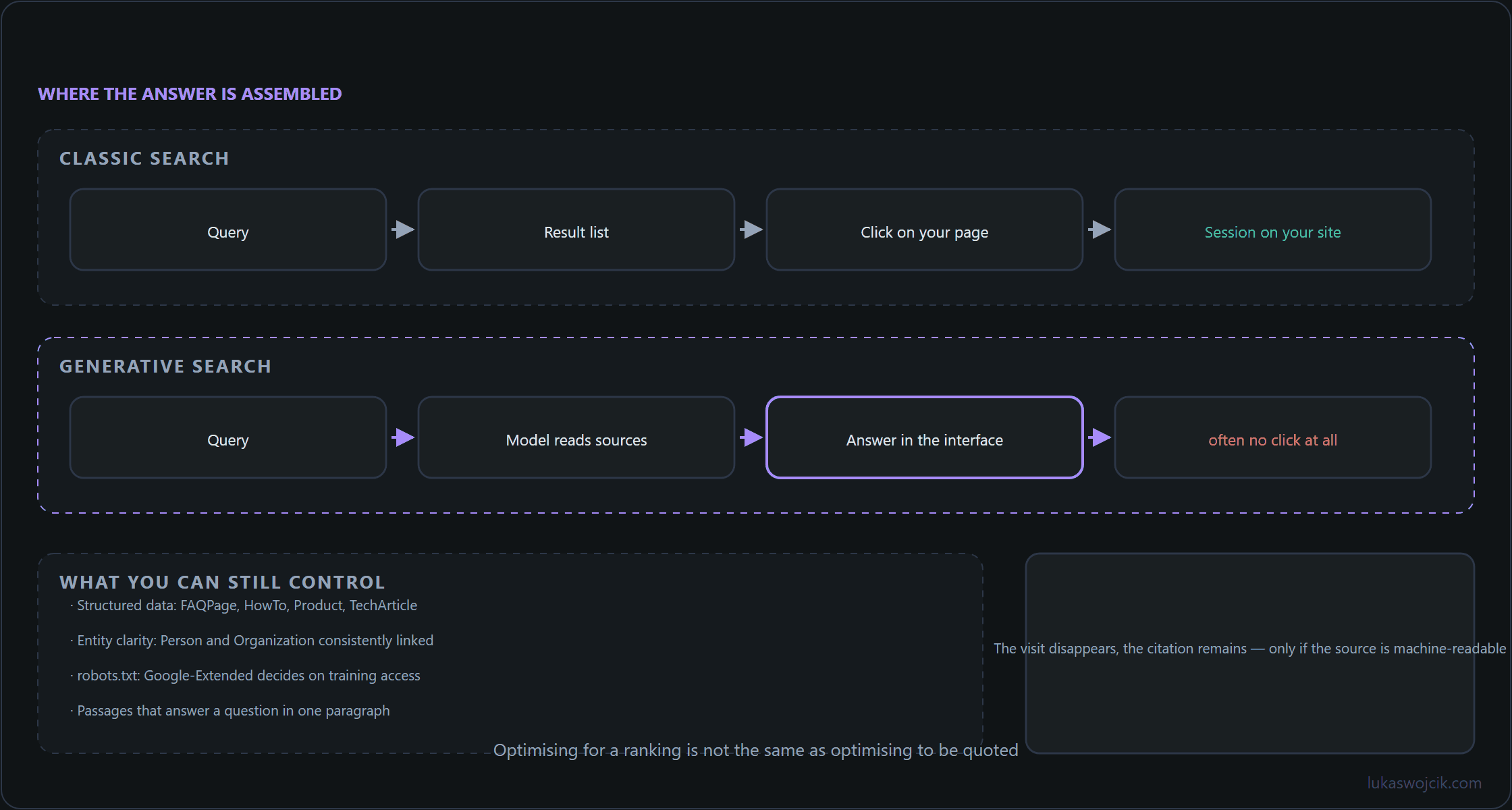
The New Paradigm: Zero-Click Exploitation
For decades, the unwritten contract of the web was simple: creators provided high-quality content, and search engines rewarded them with targeted visibility and traffic. AI Overviews break this contract. By scraping, aggregating, and summarizing text from multiple sources, the search engine provides a definitive answer instantly.
The consequences for organic traffic are severe:
- Information Cannibalization: Informational queries (e.g., definitions, how-to guides, and conceptual explanations) suffer the highest traffic drops, as the user no longer needs to click a link to read further.
- Reduced Visibility: Traditional blue links are pushed beneath a massive, resource-intensive AI response box, rendering top-three rankings significantly less valuable than before.
- High-Intent Filtering: The traffic that does escape the AI interface is highly specific and deeper in the funnel, changing the nature of user engagement on-site.
Because large language models (LLMs) value structure, authority, and synthesis over mere keyword density, websites must be engineered specifically to be digested by artificial intelligence. This is the core of GEO.
Tactical Blueprint: Engineering for GEO
Adapting to generative search engines requires a systematic restructuring of code, content, and schema architectures. To ensure data is accurately ingested, cited, and referenced by AI models, the following protocols must be implemented:
1. Advanced Semantic Schema Deployment (JSON-LD)
AI engines rely heavily on the structured metadata found within a site’s source code to verify facts and establish entities. Standard metadata is no longer sufficient.
- Action: Implement hyper-specific Schema.org markup. Utilize
FAQPage,HowTo,Product, andTechArticleschemas. - GEO Impact: Machine learning algorithms use these precise, machine-readable definitions to build knowledge graphs. Properly formatted JSON-LD directly increases the probability of a site being cited as a source link inside an AI overview.
2. The Synthesized Content Structure (The TL;DR Framework)
Generative models are designed to summarize. To be cited by an LLM, content must match the model’s target output format.
- Action: Integrate a concise, data-rich summary block (TL;DR) at the very top of long-form articles. Structure information using direct, declarative sentences (e.g., “X is a method used to achieve Y”).
- GEO Impact: AI crawlers can instantly parse this optimized text block for direct quote extraction, securing the site’s position as a foundational reference.
3. Rigorous E-E-A-T Hardening
Models are programmed to avoid hallucination by cross-referencing information with highly trusted nodes on the web.
- Action: Build robust
PersonandOrganizationschemas. Ensure every piece of technical or journalistic content is anchored to a verified author profile with links to third-party professional databases (e.g., LinkedIn, ORCID). Cite primary sources, official documentation, and raw data sets explicitly.
The Crisis for Publishers and News Organizations
Publishers, media outlets, and news organizations are on the front lines of this transformation. Because news sites rely on high-volume informational traffic to sustain ad impressions and subscription models, the zero-click landscape threatens their foundational monetization strategies.
To survive, newsrooms and digital publishers must execute a distinct set of operational and technical adjustments:
1. Capitalize on Real-Time Ingestion (News Sitemaps and IndexNow)
AI search models must remain current, yet training cycles take time. News organizations possess a distinct advantage: fresh, real-time data.
- Action: Accelerate discovery through the channels Google actually supports for news: a Google News sitemap, accurate
lastmodtimestamps in the XML sitemap, and a maintained Publisher Center profile. In addition, notify every publication and significant update to the engines that implement IndexNow (Bing, Yandex, Seznam and others). The Google Indexing API is not an option here: Google supports it only for pages carryingJobPostingmarkup or aBroadcastEventembedded in aVideoObject, and using it for news or blog URLs risks having API access revoked. - Impact: Generative engines often rely on live-web scraping for current events. Being among the first to provide verified, structured data on a breaking topic improves the chance of being cited in real-time AI summaries, but no submission channel guarantees indexing or citation.
2. Pivot to Proprietary Analysis and Original Reporting
Curation and rewriting are obsolete. AI can aggregate public facts faster than any human newsroom.
- Action: Shift editorial resources away from generic news aggregation and toward investigative journalism, exclusive interviews, proprietary market data, and expert commentary.
- Impact: AI models cannot synthesize data that does not exist in the public domain. Original reporting forces the LLM to attribute the source directly, as it remains the exclusive origin of that information.
3. Implement Strict Paywalls and Restrict Crawling (Robots.txt Strategy)
Publishers must evaluate whether the traffic returned by AI search engines justifies the data harvested by their bots.
- Action: Use
robots.txt, but keep two separate decisions apart. Opting out of model training runs throughGoogle-ExtendedandGPTBot; blocking those keeps content out of the respective training corpora.OAI-SearchBotis a different matter: it only feeds search results inside ChatGPT and is not used for training, so blocking it costs visibility without preventing anything. Concurrently, implement robust, user-friendly subscription models. - Impact: Protecting intellectual property forces an equilibrium: either the generative engine must negotiate licensing terms for the data, or users must visit the platform directly to access premium, un-summarized insights.
The era of passive traffic acquisition through generic keyword matching is over. By treating web infrastructure as a data supply chain for artificial intelligence, architectures can remain visible, authoritative, and resilient in a post-organic world.
Related articles



2 comments
The separation of training access from search access in the robots section is the most careful treatment of that I have read — those really are two decisions.
On the E-E-A-T section: linking an author profile to LinkedIn or ORCID is presented as a measure. Is there anything measurable behind that, or is it a reasonable hypothesis stated as a step?
Closer to the second, and the distinction is worth keeping in a report that someone will act on.
What is verifiable is whether the markup parses and whether the entity is recognised — the structured data test says the first, and a knowledge panel or an entity match says the second. Both are observations about the machine reading the page, not about a ranking effect.
What is not verifiable from outside is whether a citation in a generated answer followed from that link. No source publishes that mapping, so a claim of cause is inference. The honest formulation in a client report is therefore two lines instead of one: the markup is present and parses, and the working assumption is that verifiable authorship helps. Anyone who states the second as a measured result will be asked for the measurement eventually.