Vertex AI in E-commerce: The Ultimate Recommendation Engine
Contents
In the highly competitive e-commerce landscape, offering a personalized shopping experience is no longer optional; it is a necessity. Google Cloud’s Vertex AI stands out as a powerful Recommendation Engine that leverages machine learning to deliver highly relevant product suggestions, primarily benefiting online stores by increasing conversion rates and Average Order Value (AOV).
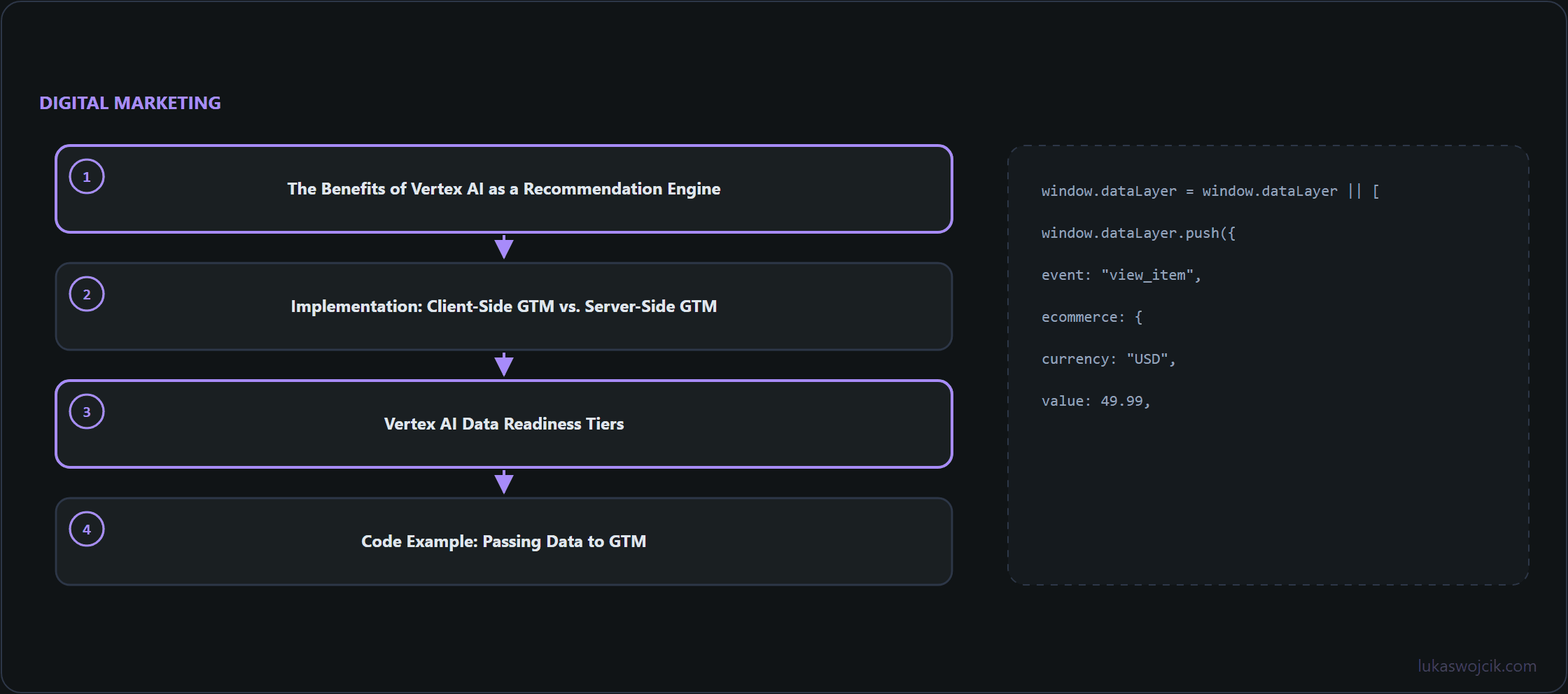
The Benefits of Vertex AI as a Recommendation Engine
Vertex AI (specifically the Retail API, marketed since June 2026 as AI Commerce Search in Gemini Enterprise for Customer Experience, previously Vertex AI Search for commerce) allows e-commerce businesses to deploy Google-quality search and recommendations on their own websites.
- Deep Personalization: It analyzes user behavior in real-time to suggest products they are most likely to buy.
- Increased Revenue: Better recommendations lead to higher click-through rates (CTR) and conversions.
- Automated Model Training: It automatically adapts to seasonality, trends, and inventory changes without manual rule-setting.
Implementation: Client-Side GTM vs. Server-Side GTM
Sending data to Vertex AI requires passing user events (like product views or add-to-carts). The way this is implemented matters significantly.
| Feature | Client-Side GTM | Server-Side GTM (ssGTM) |
| Data Quality | Vulnerable to ad blockers, ITP, and browser restrictions. | Highly reliable. Data is processed securely on the server, bypassing browser blocks. |
| Performance | Heavier page load due to executing scripts in the user’s browser. | Faster page load times as processing is offloaded to the server. |
| Security | API keys and business logic are exposed in the browser. | Secure. API keys and direct connections to Google Cloud/Vertex AI remain hidden. |
Vertex AI Data Readiness Tiers
To unlock the full potential of custom recommendation models in Vertex AI, the data must reach certain maturity “tiers”. Getting to the highest tier requires feeding the system high-quality data.
- Tier 1: Cold Start / Baseline: Only the product catalog goes in. Recommendations are generic (e.g., “Popular items”).
- Tier 2: Standard Personalization: Requires continuous real-time event streaming (views, clicks, purchases). Unlocks basic personalized recommendations.
- Tier 3: Advanced / Custom Models: This requires a robust history (usually 90+ days of clean user event data) and a high volume of traffic. This unlocks highly specialized models like “Frequently Bought Together” or deep personalization.How to get there? Implement a flawless tracking architecture via Server-Side GTM to ensure every user interaction is accurately recorded and sent to Google Cloud.
Code Example: Passing Data to GTM
Here is a simple dataLayer push for a product view. This data is picked up by the Client GTM and forwarded to the Server-Side GTM, which then securely routes it to Vertex AI.
// Pushing Product Information to the Data Layer (Client-Side)
window.dataLayer = window.dataLayer || [];
window.dataLayer.push({
  event: "view_item",
  ecommerce: {
    currency: "USD",
    value: 49.99,
    items: [
      {
        item_id: "SKU_98765",
        item_name: "Running Shoes XYZ",
        item_category: "Footwear",
        price: 49.99,
        quantity: 1
      }
    ]
  }
});
Note: In Server-Side GTM, an HTTP request (via a custom tag or Google Cloud API integration) sends this normalized e-commerce data directly to the Vertex AI Retail project.
Sources
Related articles