

Tag Management Systems: From Hardcoding to Server-Side, and How to Choose One

Contents
Anyone working in digital marketing or data analytics today probably uses a Tag Management System (TMS) daily. But it wasn’t always this easy. To truly understand the power of modern platforms like Google Tag Manager, Tealium, or Jentis, we have to look back at how data collection began.
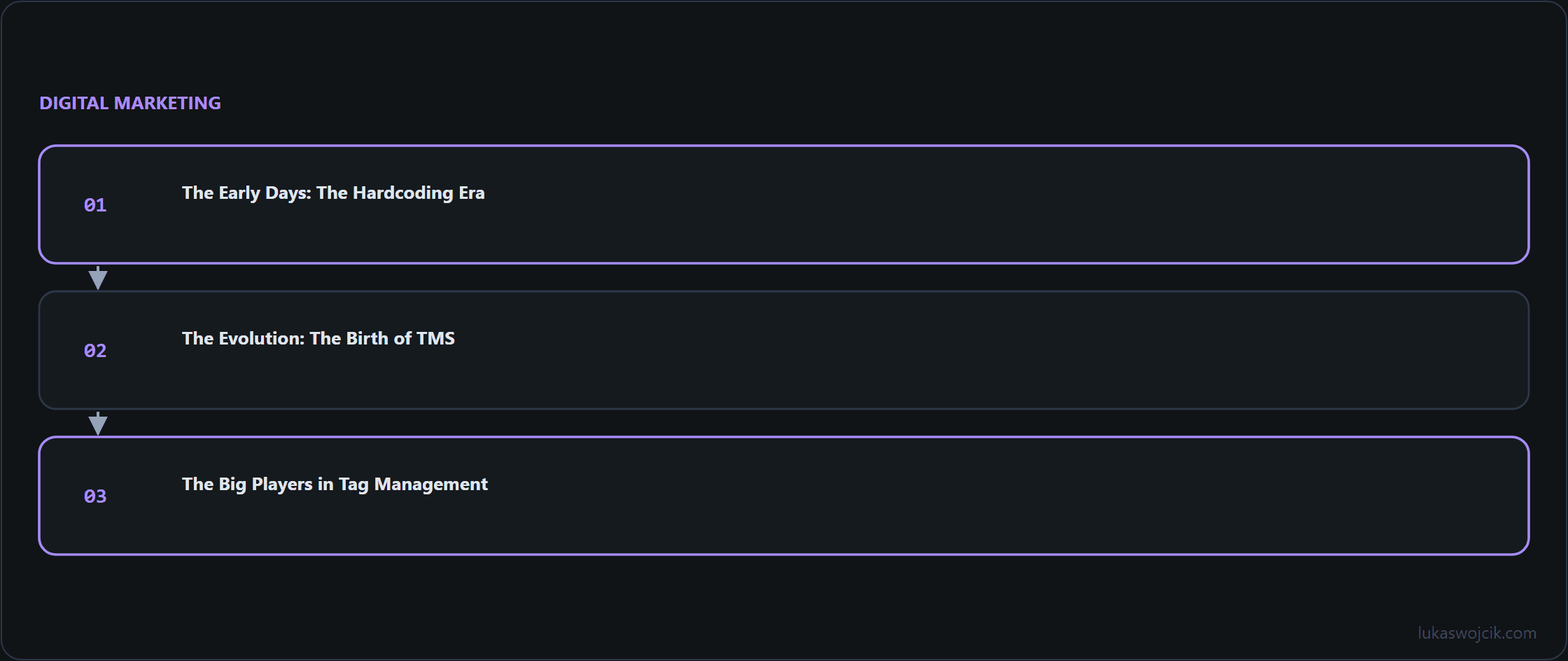
The Early Days: The Hardcoding Era
In the early 2000s, whenever a marketing team wanted to add a tracking pixel (like Google Analytics, Facebook, or an affiliate script) to a website, they had to write a ticket to the IT department. Developers had to manually “hardcode” these JavaScript snippets directly into the website’s source code.
This process was slow, prone to errors, and heavily dependent on IT release cycles. As digital marketing exploded, websites became bloated with dozens of third-party scripts, drastically slowing down page load times and creating a data governance nightmare.
The Evolution: The Birth of TMS
Between 2008 and 2012, the first Tag Management Systems emerged (Tealium was founded in 2008, Google Tag Manager launched in 2012). A TMS provided a single “container” code placed on the website once. From then on, marketers could deploy, modify, and manage tags through a user-friendly web interface without touching the site’s code.
Today, the industry is undergoing another massive shift: Server-Side Tracking (SST). Due to ad blockers, privacy laws (GDPR), and Intelligent Tracking Prevention (ITP) in browsers, client-side tracking (in the user’s browser) is losing data. TMS platforms are evolving to route data through a first-party server before sending it to vendors.
Let’s break down the biggest players on the market, their pros and cons, and their Server-Side capabilities.
The Big Players in Tag Management
1. Google Tag Manager (GTM)
The undisputed king of market share, primarily because its standard version is completely free and seamlessly integrates with the Google ecosystem.
- PROs: Free, massive community, endless tutorials, incredibly user-friendly for beginners.
- CONs: The free version lacks enterprise-level SLAs and advanced data governance. Data goes directly into the Google ecosystem, which raises privacy concerns for some enterprises.
- Server-Side Tracking: Available (Server-Side GTM). Setup is relatively easy on Google Cloud, but it requires technical knowledge to map client-side data to the server container.
- When to choose: When the marketing stack relies heavily on Google (GA4, Google Ads) and the requirement is a fast, cost-effective solution.
2. Tealium (Tealium iQ)
A pioneer and enterprise heavyweight. Tealium is designed for massive corporations with complex, multi-brand data architectures.
- PROs: Incredible tag marketplace (over 1000 native integrations), stellar data governance, privacy controls, and a highly stable environment.
- CONs: Very expensive. The interface is highly technical, and the learning curve is steep.
- Server-Side Tracking: Excellent. Tealium EventStream handles server-side data routing flawlessly, but it requires architecture planning and developer skills to deploy.
- When to choose: For a large enterprise with a huge budget, complex data routing needs, and a requirement to send data to hundreds of non-Google vendors.
3. Adobe Experience Platform (Tags / formerly Adobe Launch)
Adobe’s answer to tag management, deeply integrated into the Adobe Experience Cloud.
- PROs: Deep, native integration with Adobe Analytics, Adobe Target, and AEM. Highly customizable through extensions.
- CONs: Clunky interface compared to GTM. It is absolute overkill without other Adobe products in play.
- Server-Side Tracking: Achieved via Adobe Experience Platform Edge Network (Event Forwarding). It is highly powerful but very complex to implement.
- When to choose: Exclusively when the company’s digital ecosystem is built around the Adobe Experience Cloud.
4. Commanders Act (formerly TagCommander)
A European powerhouse, highly focused on GDPR compliance and consent management.
- PROs: Built with European privacy laws in mind. It seamlessly combines consent management (CMP) with tag management.
- CONs: Smaller global footprint, meaning a smaller community and fewer third-party tutorials.
- Server-Side Tracking: Solid native server-side capabilities designed around strict EU privacy requirements. Implementation is moderate in difficulty.
- When to choose: For a European enterprise where GDPR compliance, data sovereignty, and strict consent management are the absolute top priorities.
5. Jentis (The Innovator)
Jentis is an Austrian tech company that approached tag management differently. Instead of taking a client-side TMS and adding server-side features later, Jentis was built from the ground up as a native Server-Side Tracking platform.
- PROs: Ultimate data quality, built-in legal compliance, and extreme performance benefits since almost no JavaScript is executed in the user’s browser.
- CONs: It requires a complete paradigm shift. It is a premium product with a higher entry cost, and it means unlearning “client-side” habits.
- Server-Side Tracking: It is the core of the product. Implementation is highly streamlined compared to setting up custom Google Cloud servers for GTM.
The “Synthetic Users” Feature by Jentis: This is where Jentis truly innovates. When a user denies cookies in the consent banner, traditional systems stop tracking entirely, leaving huge gaps in the analytics (sometimes up to 30-40% of traffic). Jentis solves this with Synthetic Users. Instead of dropping a cookie in the browser, the Jentis server uses advanced statistical modeling and anonymized server-side data to generate a “synthetic” session identifier. This allows businesses to retain critical data regarding traffic volume, user journeys, and conversions, fully anonymized and 100% compliant with GDPR, without ever relying on client-side cookies.
- When to choose: When data quality is the highest priority, consent banners are swallowing massive amounts of data, and a turnkey, highly advanced server-side solution is what is needed.
Conclusion: How to Choose?
There is no “best” TMS—only the best TMS for a given ecosystem. A Google-centric stack calls for GTM, an Adobe-centric one for Adobe Tags. Enterprise flexibility points to Tealium. Where privacy and restoring lost consent data are the main goals, Jentis is the future.
Related articles




2 comments
Useful comparison, and the historical framing helps — it is easy to forget that the container model is barely fifteen years old.
The Synthetic Users description is the part I am unsure about. From the outside it sounds close to what Google calls conversion modelling. Is the difference technical, or is it mainly that one happens at the vendor and the other in a first-party server?
Both descriptions cover two separate steps, and the confusion comes from treating them as one.
The first step is identification: whether anything is written to or read from the visitor’s device. The second is estimation: filling gaps in reporting from aggregate patterns. Conversion modelling is purely the second — no identifier is created, missing conversions are estimated from observed ones. A synthetic session identifier belongs to the first: the server assigns something that stands in for a session, without asking the browser to keep it.
That distinction is also where the questions belong. Accuracy is a property of the estimation step and is answered with a holdout comparison, not with a vendor claim. Whether consent is required is a property of the storage step, because European rules attach to storing or reading information on the device rather than to inference made on a server afterwards. Any evaluation that keeps those two questions separate will get useful answers; one that asks "is this compliant" about the whole feature will not.