

 English
 Deutsch
 Polski
Detecting Presence Without Movement: Radar Sensors for Lighting Control
Part 3 of 6 in the series Home Assistant without the cloud

Management Summary
Automatic lighting should stay on while a room is occupied, even during quiet activities such as reading. Ordinary motion sensors can miss this, so radar-based presence detection can complement them by noticing smaller movements. The article compares the roles of the LD2410 presence sensor and LD2450 moving-target tracker. Their usefulness depends on the room, placement and sensitivity, since nearby movement can also trigger detection. Manual control remains valuable when an automatic reading is missing or wrong.
Contents
Detecting Presence Without Movement: Radar Sensors for Lighting Control
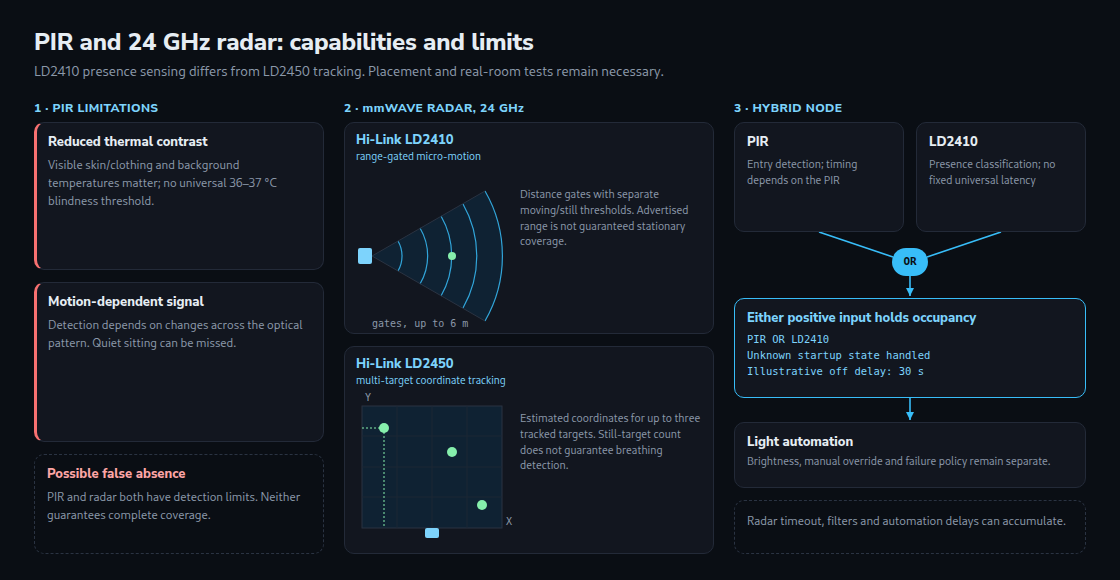
A light that switches off during reading usually exposes a mismatch between motion detection and occupancy detection. PIR means passive infrared: the sensor receives heat radiation rather than transmitting a measuring signal. PIR sensors respond to changing infrared patterns; radar transmits radio waves and can detect smaller movements from the returned signal. Combining both can improve lighting control, but neither technology guarantees complete coverage. The LD2410 and LD2450 also serve different purposes.
PIR: movement and thermal contrast
A PIR sensor detects changes in infrared radiation across its optical detection pattern. Walking across that pattern is often easier to detect than sitting still or approaching directly. Lens design, mounting height, movement and the temperature difference between visible surfaces and the background affect detection.
The relevant contrast is not simply room temperature versus a universal body-core temperature of 36–37 °C. Clothing and exposed skin have different surface temperatures. Reduced contrast can reduce sensitivity; no universal “thermal blindness” temperature follows. A PIR output also has sensor-specific timing, so immediate or zero-latency switching is not guaranteed.
LD2410 and LD2450: different detection tasks
Both families use 24 GHz radar, often marketed as mmWave. At 24 GHz the wavelength is about 12.5 mm; strictly, the conventional millimeter-wave band starts at 30 GHz. The practical choice depends more on the sensor’s processing and firmware than on that label.
LD2410: the presence sensor distinguishes moving and still targets using distance gates, which divide the detection area into bands of distance from the sensor. A threshold specifies how strong the reported signal must be to count as detection. Separate thresholds can reduce unwanted detections in particular distance ranges. The advertised range of up to roughly six metres does not guarantee detection of a nearly motionless person at every distance or angle. Still-target output is a presence classification, not a medical breathing measurement.
LD2450: the tracking module reports estimated coordinates and speeds for up to three targets. Coordinates support zones, but are neither exact positions nor persistent personal identities. The module is primarily designed for moving-target tracking. ESPHome exposes still-target counts too; that label does not establish reliable detection of breathing or complete immobility. Firmware and actual seating positions need testing before choosing the module to keep desk lighting on.
An ESPHome example with the missing connections included
ESPHome is firmware configured with a text file to connect devices such as sensors to home automation. GPIO pins are configurable electrical inputs or outputs; UART is a serial data connection with transmit (TX) and receive (RX) lines. This fragment is for an ESP32 board with GPIO16/17 available for UART and GPIO14 available for PIR. Board selection, network/API configuration and the light automation belong in the surrounding ESPHome configuration. Radar TX connects to ESP RX, radar RX to ESP TX, with a common ground. Supply voltage, current capacity and logic levels must match the exact module; a 5 V output must not connect directly to a 3.3 V GPIO.
uart:
id: radar_uart
tx_pin: GPIO17
rx_pin: GPIO16
baud_rate: 256000
parity: NONE
stop_bits: 1
ld2410:
id: room_radar
uart_id: radar_uart
binary_sensor:
- platform: gpio
pin: GPIO14
name: "Room PIR Motion"
id: pir_motion
- platform: ld2410
ld2410_id: room_radar
has_target:
name: "Room Radar Presence"
id: radar_presence
- platform: template
name: "Room Unified Occupancy"
device_class: occupancy
lambda:
if (id(pir_motion).has_state() && id(pir_motion).state)
return true;
if (id(radar_presence).has_state() && id(radar_presence).state)
return true;
if (!id(pir_motion).has_state() || !id(radar_presence).has_state())
return {};
return false;
filters:
- delayed_off: 30sThe LD2410’s standard UART setting is 256000 baud, no parity and one stop bit. Baud describes the transmission rate; parity and stop bits define how each transmitted character is framed. Both ends must use matching settings. A previously changed module baud rate must match the configuration. The two inputs are combined with OR; either positive reading maintains occupancy. Before both inputs have a known state, an absent reading does not automatically become “empty”. The lambda is the small block of code that combines the readings. Its empty return retains the last state; it is not a communication watchdog.
The illustrative 30-second off delay begins when both inputs have known readings and neither reports detection. Radar timeout and PIR hold time are periods during which a sensor keeps reporting detection after the last qualifying signal. These times, this filter and any Home Assistant delay can accumulate. The example creates an occupancy sensor only; brightness thresholds, manual override and the actual light action remain separate.
Questions and answers
Does an off delay solve a moving curtain?
No. A continuously positive radar keeps OR true, so the off-delay countdown never completes. Placement, maximum detection distance, gate thresholds or coordinate zones must address the unwanted target. A distance gate cannot distinguish a curtain from a chair at the same range.
Can radar miss occupants or detect through walls?
Both are possible. Orientation, shielding, reflections and motion influence detection. Some materials allow signals to reach adjacent areas; wall penetration is not guaranteed. Fans, plants, pets and moving fabric may produce unwanted returns, without the sensor necessarily identifying the source as breathing.
How does commissioning work?
Tests should include an empty room with ventilation running, entry from several directions, prolonged quiet sitting, neighboring-room movement and sensor or network failure. A stale UART value can remain available despite has_state(); production automation therefore needs a tested rule for readings that are too old or no longer arriving, such as retaining manual light control instead of interpreting the failure as an empty room. Neither the fragment nor the modules constitute a safety or medical monitoring system.
Home Assistant without the cloud
- Zigbee2MQTT and ZHA: Planning a Reliable Zigbee Network
- ESPHome and ESP32 in Practice: Building Cloud-Free Environmental Sensors
- Detecting Presence Without Movement: Radar Sensors for Lighting Control
- Local Voice Control in Home Assistant with Whisper & Piper
- WireGuard & Tailscale DMZ: Secure External Access to Home Assistant and Self-Hosted Servers
- Local Energy Management: Integrating PV Inverters and Battery Storage via Modbus TCP
Related articles


