Three Analytics Deadlines in August 2026: BigQuery, Adobe, Shopify
Contents
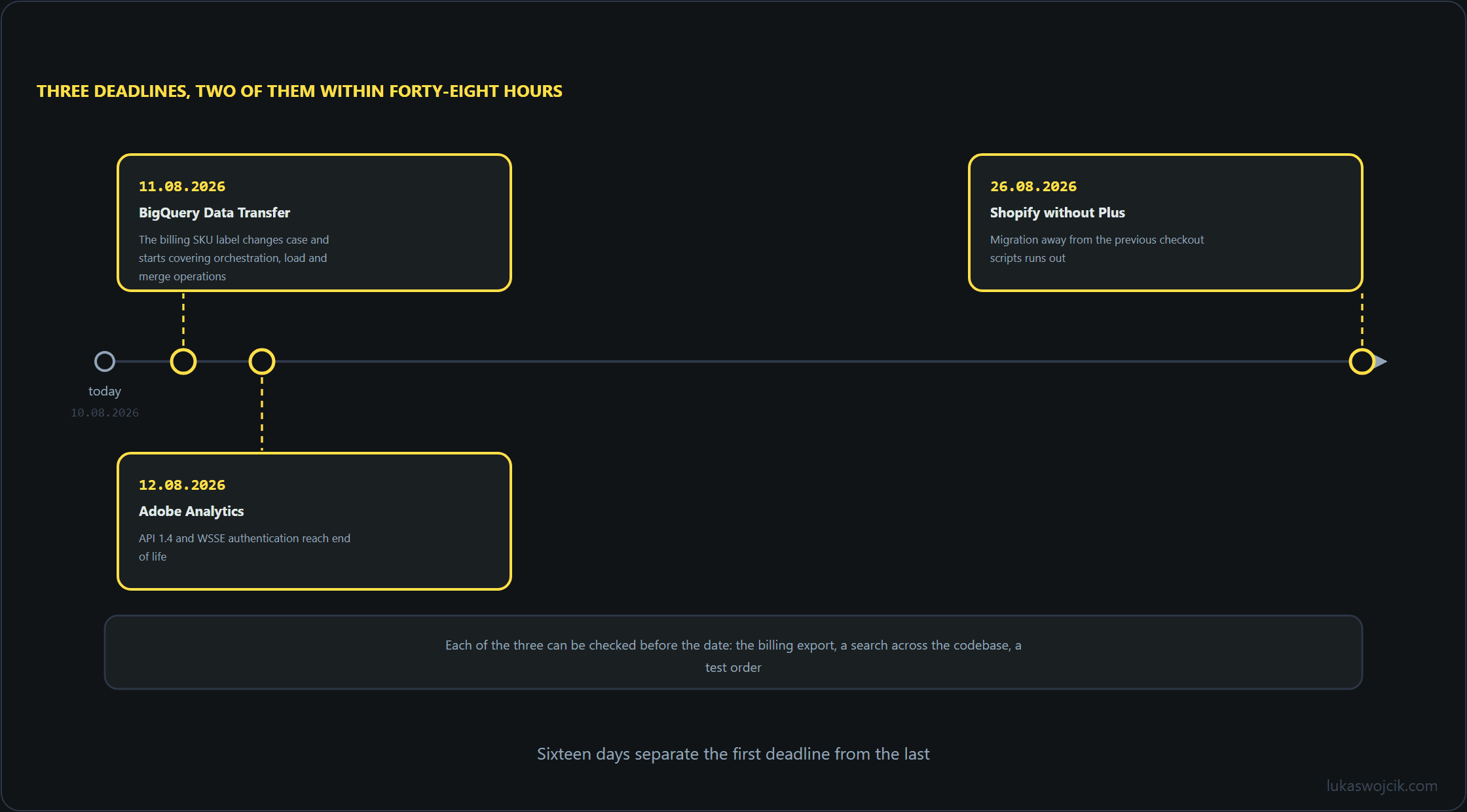
Three deadlines fall within a little more than two weeks. On 11 August 2026 a billing label in the BigQuery Data Transfer Service changes, on 12 August 2026 the Adobe Analytics API 1.4 reaches its end of life together with WSSE authentication, and on 26 August 2026 the Shopify checkout migration closes for shops without Plus. Technically the three have nothing in common. What connects them is the window: a before-and-after comparison is only possible where the before side was recorded while it still existed.
1. 11 August: a billing label in the BigQuery Data Transfer Service
The BigQuery release notes entry of 8 May 2026 announces two changes for 11 August 2026. The billing label of the SKU for the BigQuery Data Transfer Service moves from upper case to lower case, and the same SKU additionally covers orchestration, load operations and merge operations. Neither the exact previous nor the exact new SKU name appears in that entry, and no figure for a cost change is given. Both remain open until billing data after the date shows an effect.
Two consequences follow from the wording alone. Reports that match the label as a case-sensitive string stop matching, or split one series into two around the date. And a SKU whose scope grows makes a position-by-position comparison across the date ambiguous, because the same label can carry a different amount of work. A query against the billing export that places both phases side by side keeps that visible.
-- sku_label, usage_day and cost are placeholders for the
-- column names of the local billing export schema
SELECT
  LOWER(sku_label) AS sku_key,
  IF(usage_day < DATE '2026-08-11', 'before', 'after') AS phase,
  ROUND(SUM(cost), 2) AS cost_sum,
  COUNT(*) AS line_items
FROM `project.dataset.billing_export`   -- placeholder
WHERE usage_day BETWEEN DATE '2026-07-28' AND DATE '2026-08-25'
GROUP BY sku_key, phase
ORDER BY sku_key, phase;
Table and column names differ per setup; the names above stand in for whatever the local export uses. The before phase exists only as history, so a single run before the date and a stored result are what make the later comparison possible at all.
2. 12 August: Adobe Analytics API 1.4 and WSSE
On 12 August 2026 the Adobe Analytics API 1.4 and WSSE authentication reach end of life. The same release notes page states that the legacy Report Builder is withdrawn in June 2026 and phrases this in the future tense, although that month has passed. The contradiction sits in the source and is not resolved here. For AppMeasurement the page names no end date and refers only to the GitHub repository. An exception for the Data Insertion API circulates in secondary discussions; it is not documented at the primary source and is therefore not treated as given.
What remains is an inventory question: which local jobs still authenticate via WSSE, and which still address the 1.4 version. Both usually leave textual traces, a header name and a version fragment in a path or a client configuration.
# search paths are placeholders for the local repositories
grep -rniE "wsse|/1\.4/|api[-_ ]?1\.4" \
  ./src ./jobs ./etc/cron.d \
  --include="*.py" --include="*.js" --include="*.sh" --include="*.conf"
The pattern is a heuristic, not a proof. A wrapper library can hide both the header and the version string, so a job without a hit is not thereby cleared; it still has to be traced through the client it uses. After 12 August a failing job no longer separates a broken credential from a retired interface, which is what makes the inventory cheaper before that point.
3. 26 August: Shopify checkout migration without Plus
For Shopify shops without Plus, the migration away from the previous checkout scripts runs out on 26 August 2026. Plus shops passed the same point on 28 August 2025. Affected are checkout.liquid as a Plus feature and the additional scripts on the order status page. The documentation names limitations in the reach and effectiveness of campaigns and bidding strategies as the consequence. The deadline is set by Shopify, not by Google, which places it outside the advertising platform.
# theme export and tag configuration, paths are placeholders
grep -rn "checkout.liquid" ./theme_export

grep -rniE "order[-_ ]?status|additional scripts" \
  ./theme_export ./tag_config
Tags can also be delivered from a tag manager container instead of the theme, in which case the theme export shows nothing and the container configuration holds the answer.
4. What can be established beforehand
The three checks share one property: they are inexpensive before the respective date and incomplete afterwards.
- BigQuery: the billing query needs a before phase that is only readable until 11 August; a stored result is the reference point.
- Adobe: the code search can run at any time, but its diagnostic value drops once error messages become ambiguous after 12 August.
- Shopify: the theme lookup keeps its value longest, since the state of a shop remains readable after 26 August.
Two points stay out of reach in advance. The size of the BigQuery cost effect is not documented, so any estimate before the date would be a guess, and only billing data afterwards settles it. And the Report Builder date in the Adobe notes cannot be reconciled from that page alone. Where a plan depends on either, it depends on an open question, and recording that openly is more useful than filling it.
Summary
Fifteen days separate the first of the three dates from the last. On 11 August a SKU label changes case and gains scope, on 12 August an Adobe API and its authentication method end, and on 26 August the Shopify checkout migration closes for shops without Plus. Each date has a short check attached to it: a billing query, a code search, a theme lookup. The one with a hard expiry is the billing query, because its comparison value disappears with the date it measures.
Related articles