English
 Deutsch
 Polski
The Evolution of Web Tracking: From Log Files to the Server-Side Future
Part 1 of 6 in the series From pixel to server: tracking that holds

Contents
- The Dawn of Analytics: Log File Analysis and Urchin
- The Golden Age of Client-Side Tracking: Universal Analytics
- The Alternative Ecosystem: Adobe, Webtrekk, eTracker, and Matomo
- The Privacy Shift: GA4 and Intelligent Tracking Prevention
- The Future: Server-Side Tracking and the Death of the Pixel
- Questions and answers
- Sources
The landscape of digital analytics has undergone a radical transformation over the past three decades. What began as a highly technical, infrastructure-heavy process has evolved into a sophisticated discipline balancing data accuracy with stringent privacy regulations. The trajectory of web tracking reveals a clear pattern: a shift from raw server data to client-side cookies, and now, a definitive return to the server.
The Dawn of Analytics: Log File Analysis and Urchin
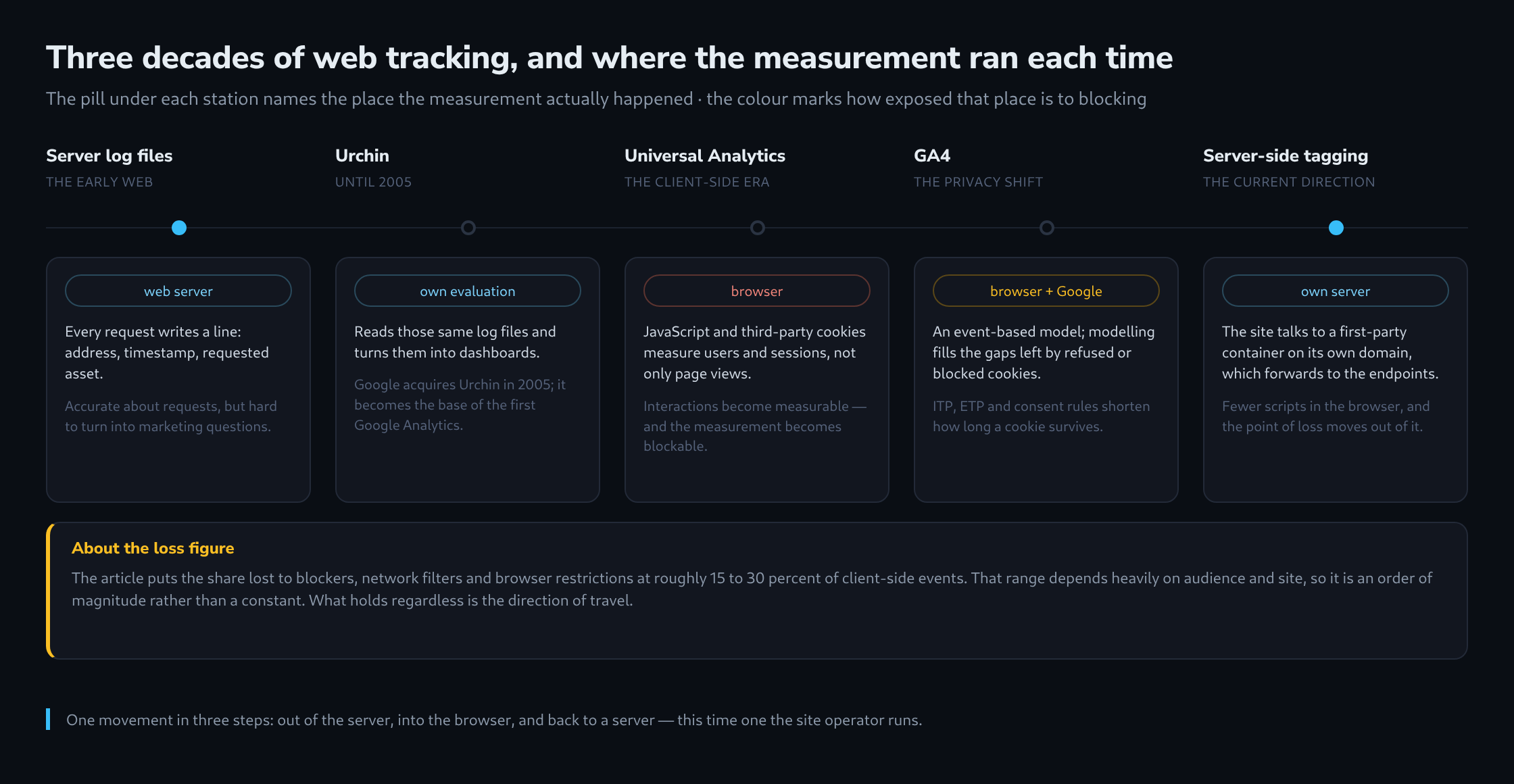
In the early days of the World Wide Web, tracking user behavior was not accomplished through pixels or JavaScript. Instead, it relied entirely on Server Log File Analysis. Every time a browser requested a web page, an image, or a document, the web server recorded a line of text containing the IP address, timestamp, and the requested asset. While accurate, extracting meaningful marketing data from these massive text files was incredibly complex and resource-intensive.
A major paradigm shift occurred with the introduction of Urchin Software. Urchin revolutionized the industry by processing these raw log files and transforming them into visual, accessible dashboards. Its success was so profound that Google acquired Urchin in 2005, using its core technology as the foundation for what would become the first iteration of Google Analytics.
The Golden Age of Client-Side Tracking: Universal Analytics
As the internet matured, log files proved insufficient for tracking complex user interactions like video views or dynamic e-commerce events. The industry transitioned to client-side tracking, utilizing JavaScript “pixels” and third-party cookies executed directly in the user’s browser. Google introduced Universal Analytics (UA), which shifted the measurement model from “pageviews” to “users” and “sessions,” enabling cross-device tracking and deep behavioral segmentation.
The Alternative Ecosystem: Adobe, Webtrekk, eTracker, and Matomo
While Google dominated the mainstream market, a robust ecosystem of alternative platforms evolved to serve enterprise and privacy-conscious sectors:
- Adobe Analytics: Evolving from its origins as Omniture, Adobe Analytics established itself as the premier enterprise solution, offering unparalleled customization and deep integration with enterprise marketing stacks.
- Webtrekk & eTracker: In Europe, strict privacy laws fueled the rise of Germany-based solutions like Webtrekk (now Mapp) and eTracker. These platforms prioritized GDPR compliance from the start, pioneering cookieless tracking capabilities and strict data localization.
- Matomo: Formerly known as Piwik, Matomo emerged as the leading open-source alternative. By allowing organizations to host the analytics engine on their own infrastructure, Matomo championed the philosophy of complete, uncompromised data ownership.
The Privacy Shift: GA4 and Intelligent Tracking Prevention
The unchecked proliferation of client-side tracking eventually triggered a massive privacy backlash. Legislative frameworks like the GDPR and CCPA, combined with browser-level restrictions such as Apple’s Intelligent Tracking Prevention (ITP) and Mozilla’s Enhanced Tracking Protection (ETP), severely degraded the lifespan and reliability of cookies.
Google Analytics 4 (GA4) was built specifically for this new, fragmented reality. By moving to a flexible, event-based data model and utilizing machine learning to fill in the gaps left by blocked cookies, GA4 represents an adaptation to a privacy-first web.
The Future: Server-Side Tracking and the Death of the Pixel
Despite the advancements in platforms like GA4, client-side tracking is fundamentally broken. Ad-blockers, network firewalls, and modern browsers routinely block tracking scripts, resulting in data loss ranging from 15% to 30%. The solution to this crisis is Server-Side Tracking (SST).
With SST, a website communicates exclusively with a first-party server container (such as Server-Side GTM) located on the same primary domain. This server then acts as a secure proxy, filtering, enriching, and distributing the data to third-party endpoints (Google, Meta, TikTok) behind the scenes.
The digital analytics industry is now accelerating towards the complete elimination of traditional web pixels. The ultimate destination is a pure backend architecture. In the near future, tracking will occur entirely server-to-server via APIs. This approach eliminates the heavy burden of executing dozens of JavaScript files in the browser, vastly improving website performance, eradicating the vulnerabilities of client-side data leakage, and ensuring absolute control over data privacy.
Questions and answers
Are cookieless tracking and Google’s modeling two names for one idea, or genuinely different mechanisms?
Genuinely different mechanisms, and the distinction decides what the resulting numbers mean.
Cookieless tracking is a collection method: instead of storing an identifier on the device, the server derives a short-lived session key from properties of the request, often a salted hash of address and user agent that is discarded at the end of the day. Everything counted is observed; nothing is estimated. The price is that a visitor returning on another day is genuinely unrecognizable, so returning-visitor metrics stop existing rather than becoming approximate.
Modeling is an estimation layer on top of missing data: the collection that would have identified the visitor did not happen, and a model fills the gap from observed patterns. Nothing about the collection changes.
Hence the practical consequence when the two are compared: a cookieless installation needs no modeling and does not produce any, while a modeled report contains figures that no raw export will ever reproduce. Neither is wrong, but a report that mixes both without saying which is which is unreadable a year later.
Sources
From pixel to server: tracking that holds
- The Evolution of Web Tracking: From Log Files to the Server-Side Future
- How to Implement Google Tag Gateway
- GA4 & Server-Side GTM: The “Migrate from JavaScript Managed Client ID” Feature Explained
- Server-Side GTM on GCP Cloud Run: Architecture, Auto-Scaling, and Cost Optimization
- GA4 Measurement Protocol: Server-Side CRM Offline Conversion Integration
- Meta Conversions API: Maximizing Event Match Quality (EMQ) and Deduplication
Related articles