English
 Deutsch
 Polski
GA4 Conversion Windows: Attribution and Fair Comparisons

Contents
Google expanded conversion-window settings on 11 August 2026. Click-through conversions now accept whole numbers from 1 to 90 days, and engaged-view conversions from 1 to 30 days. The change allows a closer fit to a business cycle, but it also changes the definition behind a reported result.
A longer window does not create a purchase. It changes which earlier interactions can qualify for credit, and can change the conversions reported for an advertising action. The purchase event and the shop’s order record are separate measurements.
Which setting changed?
| Conversion type | Previous options | New options |
|---|---|---|
| Click-through | 1, 7, 14, 30, 60 or 90 days | Any whole number from 1 to 90 days |
| Engaged-view | Fixed at 3 days in this Analytics setting | Any whole number from 1 to 30 days |
The release concerns conversion management under Advertising → Conversion management → more options → Settings, with corresponding management in a linked Google Ads account. It must not be treated as a statement that every key-event setting under Admin has become an arbitrary integer field. Google distinguishes conversions used for advertising measurement from key events used for site and app analysis.
Engaged-view means a qualifying video engagement followed by a conversion; an impression or any brief video view is not automatically sufficient. View-through conversions are another category and need their own settings.
A concrete example of eligibility
An ad interaction on day 0 is followed by a purchase on day 45. In a simplified path containing only that interaction, a 30-day window excludes its credit while a 60-day window includes it. With another eligible interaction on day 40, the same purchase may already qualify under the shorter window. A longer window can then change eligible touchpoints without adding another purchase.
A purchase outside one advertising window does not become a sale with no origin everywhere. Correctly collected event data and the order database can still contain it, and other eligible interactions may receive credit. The relevant report, conversion action and attribution model determine the reported result.
Model curves are not market measurements
The example below deliberately assumes an exponential distribution of delays. With mean delay m and window w, its cumulative share is F(w) = 1 − exp(−w / m). The population consists of hypothetical eventual purchases after a selected interaction, with one interaction per path and no missing observations. The formula is not Google’s attribution model.
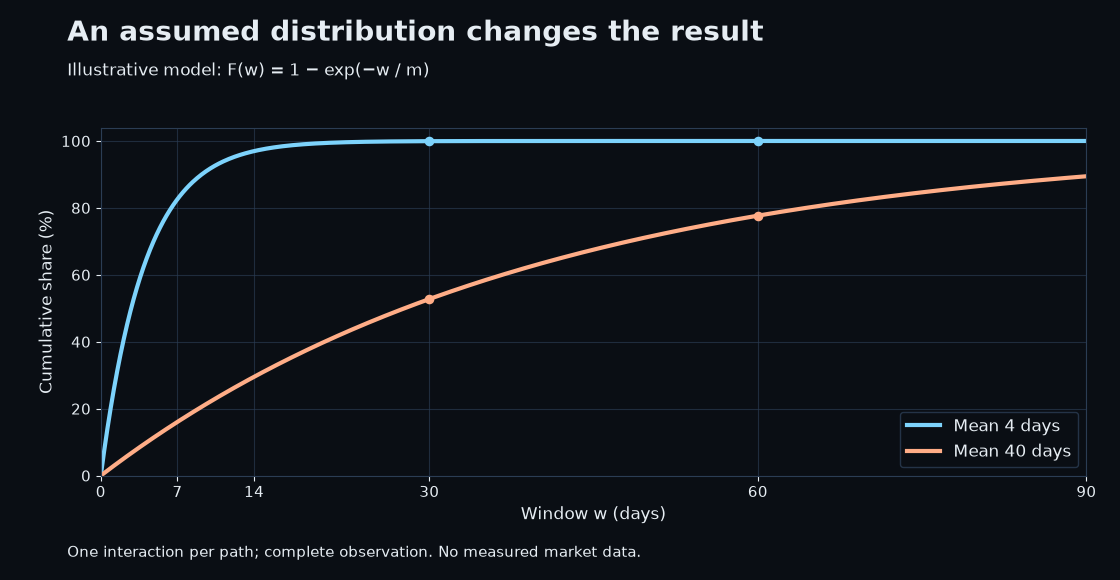
| Window (days) | Model: mean 4 days | Model: mean 40 days |
|---|---|---|
| 7 | 82.62 % | 16.05 % |
| 14 | 96.98 % | 29.53 % |
| 30 | 99.94 % | 52.76 % |
| 60 | 100.00 % | 77.69 % |
| 90 | 100.00 % | 89.46 % |
In the 40-day model, extending 30 days to 60 raises the share from about 52.8% to 77.7%: an increase of 24.9 percentage points, or about 47.2% relative to the earlier share. In the 4-day model the increase is only about 0.055 percentage points. Rounded values near 100% do not mean every purchase has already arrived.
The average alone does not determine a curve. A population that always purchases on day 40 and a population split equally between days 1 and 79 both have a 40-day average. At day 30 their cumulative shares are 0% and 50%. Real delays may contain peaks, seasonal changes or several customer groups. A steadily diminishing daily gain is therefore an assumption of this example, not a law applying to every market.
Comparisons need a stable definition
For Google Ads conversion windows, Google documents prospective changes: newly recorded conversions use the new setting, including conversions after an earlier interaction. Previously excluded conversions are not automatically restored. A change therefore need not appear as an immediate, uniform step in every time series.
Comparisons also depend on the date basis. A report grouped by interaction date can acquire later conversions for earlier dates. Conversion-date reporting answers a different timing question. Recent cohorts have had less time to mature than older ones, even with an unchanged window.
A change log should record the conversion action, old and new click/view windows, effective time, attribution settings and the reason. Product change histories provide additional evidence. Google’s help pages currently differ on whether particular conversion changes appear in Analytics or Ads history; both available histories deserve a check. An explicit report annotation remains useful, but is not the only possible record.
How to choose and evaluate a window
- The measurement objective determines the relevant action, interaction type and acceptable decision delay.
- Observed delays provide evidence only within their collection and reporting limits. A short current window can hide the long tail that needs investigation.
- Comparisons use consistent settings and sufficiently mature cohorts. A longer window helps capture later eligible outcomes but does not prove additional causal impact.
- A change is documented once and evaluated after enough observation time. No universal rule requires every business to leave every setting untouched for exactly the longest window.
- If Smart Bidding uses the affected conversions, a setting change can also alter optimization signals and later campaign delivery. The practical effect is not necessarily confined to reporting.
Questions and answers
Does a larger window always improve measurement?
No. It can include relevant delayed outcomes, but also associate more outcomes with earlier interactions without establishing that the advertising caused them. The objective and available evidence determine the useful window.
Can the window alter data-driven attribution?
It can change which interactions qualify and which conversions are represented in the selected advertising measure. That can change campaign credit. It does not follow that a particular change retrains Google’s model in a known way, or that the new totals reveal the model’s internal training population.
Can delay data alone repair a before/after comparison?
No. Observed delays can be truncated by the current window and can change with campaigns, customer mix and seasonality. A consistent definition, documented configuration and mature observation periods remain necessary. A separate order cohort can help assess business outcomes, but does not by itself reconstruct advertising attribution.
Related articles