English
Subscription, Credits or Payment per Outcome: Pricing an AI SaaS

Contents
AI features do not cost the same every month. Long inputs, retries and extra tools change consumption. A flat subscription can appear simple while subsidising heavy users; pure usage pricing makes customer budgets less predictable.
One application, four models
The hypothetical product checks documents and delivers an accepted report. Completion requires the agreed checks and a saved result. A model call alone does not constitute delivery to the customer. Stripe documents usage billing, but the meaningful unit remains a product decision. [1]
| Model | Benefit | Tension |
|---|---|---|
| Flat subscription | Predictable budget | Heavy users change costs |
| Credits | Bounded consumption | Conversion must stay understandable |
| Per outcome | Closer to customer value | Success and disputes need definitions |
| Base fee plus usage | Separate base and variable work | More explanation and billing logic |
An explicitly assumed example
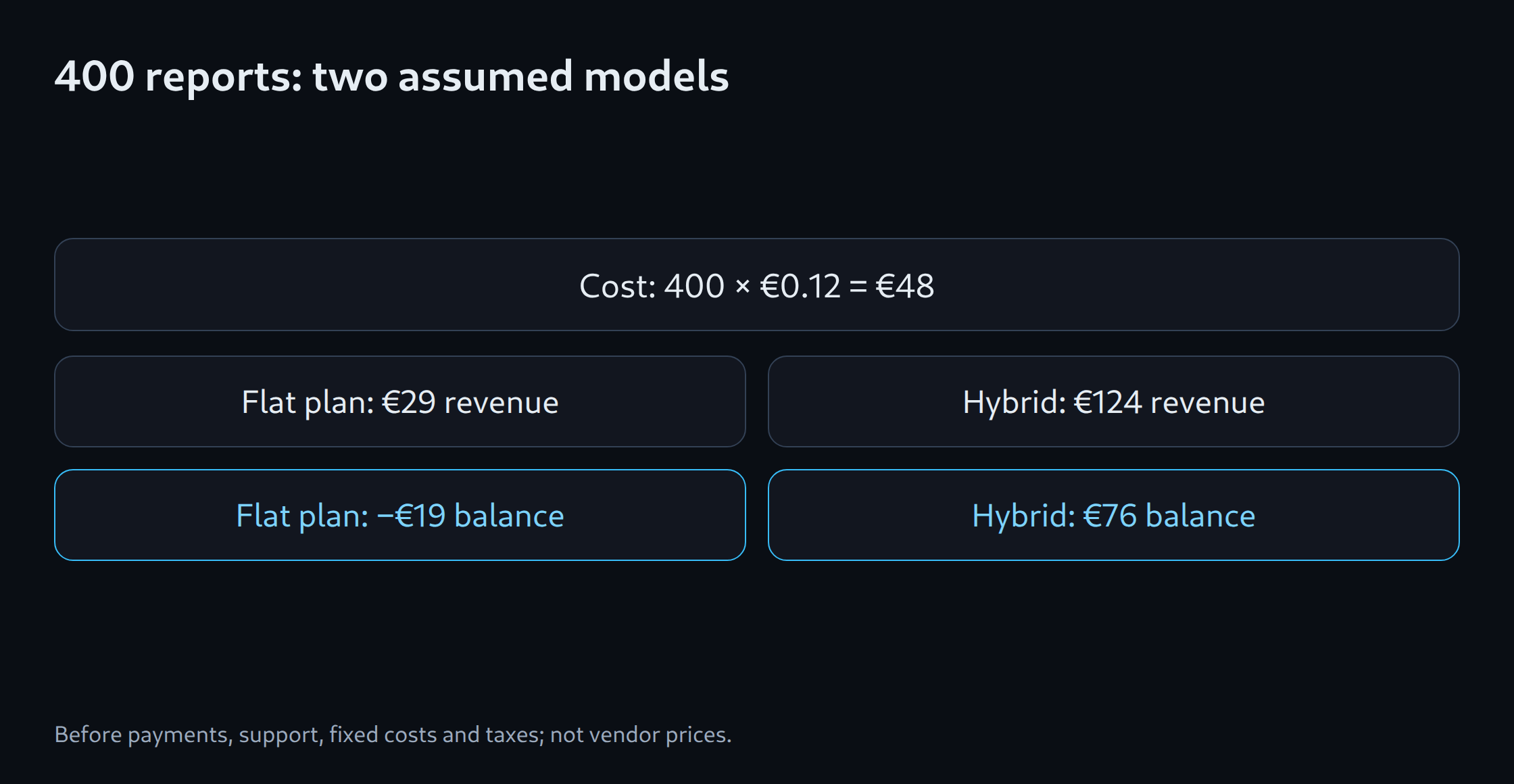
All amounts are net assumptions, not vendor prices. A report costs €0.12 in variable resources; a flat plan costs €29. At 50 reports, €23 remains before payments, support and fixed costs. At 400 reports, variable costs are €48, producing a −€19 balance before other costs.
An assumed hybrid costs €19 including 50 reports, then €0.30 for each additional report. At 400 reports, revenue is €124 and variable costs €48, leaving €76 before other costs. This is not a recommendation for that price: it demonstrates the consumption a model must carry.
Credits without surprises
Credits should describe an understandable scope before work begins. Different weights for pages, file size or extra checks need visible calculation. Retries, abandoned jobs and disputes require consistent rules. Consuming a credit without delivery needs explanation.
An outcome is not business success
A delivered report is controllable. Increased customer revenue also depends on data, implementation and market conditions. Outcome prices need a deliverable that can be attributed and verified. Pricing patterns described by Stripe do not solve the quality definition. [2]
Introducing the model
A pilot records costs per accepted task and customer, including failed attempts and manual correction. Distribution matters as well as averages: a few large users can change economics. Warnings, limits and hard budgets need defined behaviour when reached. A model becomes credible when the bill matches the service customers received.
Related tools
Questions and answers
Are credits always cheaper than subscriptions?
No. Price depends on usage, conversion and included service. Credits are initially a billing unit.
Is the hybrid price a recommendation?
No. Every example price is assumed solely to illustrate cost behaviour.
Sources
Sources checked: 5 October 2026.
Related articles