English
The Best VST Plugins for EDM, House, Pop, Hip-Hop, Rap, Drum & Bass and Dubstep in 2026

Contents
- What a genre demands from its plugins
- Synthesizers: Serum 2, Vital, Phase Plant, Pigments and Omnisphere
- Drums and groove: Kick 3, ShaperBox 3 and Kickstart 2
- Effects: OTT, Decapitator, Valhalla and RC-20
- Mixing and mastering: Pro-Q 4, soothe3, Pro-L 2 and Ozone 12
- Vocals: AutoTune and Melodyne
- The genres one by one
- Plugin formats in 2026: VST3, CLAP and the end of VST2
- What free plugins already cover
- Conclusion: few plugins, known well
- Questions and answers
- Sources
The DAW provides the framework, but the plugins inside it shape the sound of a genre: the synthesizer for the lead in the drop, the compressor that pushes the kick against the bass, the pitch correction on the rap vocal. This overview maps the most widely used instruments and effects of 2026 to seven genres – EDM, house, pop, hip-hop, rap, drum & bass and dubstep – and explains why a plugin is standard equipment in one genre and barely appears in the next.
Versions, release dates and prices were checked on 23 September 2026 in the manufacturers’ shops, in the release notes and at KVR Audio, Sound On Sound and MusicRadar. Prices are given in the currency the manufacturer sells in; where the shop shows no price, it comes from the trade press. “VST” in the title stands for all plugin formats, because almost every plugin mentioned here also ships as VST3, Audio Unit and AAX.
What a genre demands from its plugins
The seven genres differ less in technique than in focus. EDM in the sense of big room and festival electro lives on wide, bright leads and a drop that carries on large sound systems; the usual tempo is 126 to 130 BPM. House runs at 120 to 128 BPM and above all demands groove: a kick that sits and a bass that breathes in time with it. Pop is built around the vocal; clarity of the voice counts for more there than any sound design.
Hip-hop works with samples, drums and the 808, mostly between 80 and 100 BPM, and rap puts the voice even further forward: in 2026 many productions run on trap beats at 130 to 150 BPM with a half-time feel, and the vocal track carrying the lyrics has to stay intelligible above everything else. Drum & bass sits at 170 to 176 BPM with chopped breaks and the Reese bass, two detuned saw waves drifting against each other. Dubstep runs at 140 BPM but feels half as fast and turns the bass itself into the lead instrument.
These priorities lead to two broad groups of plugins. EDM, drum & bass and dubstep need synthesizers with extensive modulation and aggressive effects, while pop, hip-hop and rap need good sound libraries, saturation and vocal tools. House combines needs from both groups, and every genre benefits from a clean EQ.
Synthesizers: Serum 2, Vital, Phase Plant, Pigments and Omnisphere
Xfer Serum 2 was released on 18 March 2025 and is free for every owner of Serum 1; Xfer kept its promise of lifetime updates. New, Serum 2 costs USD 249. The pure wavetable synthesizer became an instrument with three oscillators, each of which loads wavetables, multisamples, samples, granular or spectral synthesis, plus an arpeggiator and a clip sequencer. Serum has been the standard for EDM leads, dubstep growls and drum & bass basses for years, and almost every preset pack in these genres is built for Serum first. Serum 2 is available as VST3, AU and AAX, not as CLAP.
Vital is the free answer to it. The Basic version is the complete synthesizer with 75 presets and 25 wavetables; the Plus and Pro tiers only add more presets, more wavetables and text-to-wavetable conversion. According to Dubspot, Plus costs USD 25 and Pro USD 80. Vital also runs on Linux. Anyone starting out with wavetable synthesis learns the same concepts on Vital as on Serum without paying anything.
Kilohearts Phase Plant (USD 199) has a semi-modular design: oscillators, modulators and three effect lanes are combined freely, and every effect module of the Kilohearts range can be used directly inside the synthesizer. For dubstep sound design, where a single bass is built from distortion, filter movement and resampling, this freedom is the real advantage. Phase Plant is also included in the Kilohearts subscription at USD 9.99 per month.
Arturia Pigments 7 arrived on 15 December 2025 as a free update and costs USD 199 new. Six sound engines – wavetable, virtual analogue, sample, granular, harmonic and modal – cover almost everything from a pop pad to a drum & bass bass; the colour-coded display of modulation makes the instrument more approachable than Serum. A free edition called Pigments Play comes with 100 presets.
Spectrasonics Omnisphere 3 came out on 21 October 2025, ten years after version 2, for USD 499 or EUR 399; the upgrade costs USD 199. With 18 new libraries and around 26,000 patches, Omnisphere is less a synthesizer for one particular sound than a treasury of pads, keys and textures, and that is exactly what makes it a regular in pop, hip-hop and rap. Many trap and rap beats start with an Omnisphere pad or a bell from its library.
LennarDigital Sylenth1 (EUR 139) received its first update since 2022 on 14 April 2026 with version 3.075. The virtual analogue synthesizer with four oscillators was the defining instrument of the EDM wave around 2012 and remains widespread in house and EDM because of its low CPU load and direct operation. New features are not to be expected; the sound is the reason to keep it.
For pop and hip-hop, the Kontakt 8 sampler from Native Instruments also belongs on the list, since a large share of commercial piano, string and guitar libraries runs on it. The free Kontakt Player plays NI libraries and licensed libraries from other makers; the full version costs USD 299. After insolvency proceedings, Native Instruments has belonged to inMusic since 30 June 2026. Development continues: Kontakt 8.13 appeared on 4 September 2026, Massive X 1.7 back in March.
Drums and groove: Kick 3, ShaperBox 3 and Kickstart 2
In house and EDM, the relationship between kick and bass decides the groove. Sonic Academy Kick 3 (GBP 79.95, released on 25 October 2024) builds kicks from five layers and analyses imported samples to rebuild them as editable presets. Pitch, envelope and click can thus be shaped separately, and the key of the kick then matches the track.
Cableguys ShaperBox 3 (EUR 99 for all eleven modules) shapes volume, filter, stereo width, distortion and, since version 3.6, pitch with drawn curves. The typical house pump, in which bass and pads duck briefly on every kick, is created without sidechain routing, and in dubstep the same curves produce rhythmic wobbles. For the pump alone, Nicky Romero Kickstart 2 at EUR 14 with 16 ready-made curves is enough.
In hip-hop and rap, the 808 carries bass and kick at the same time. It has to be tuned to the key of the beat, otherwise it clashes with the sample. The frequency of a root note and how many cents a detuning amounts to are shown by the Note to Frequency and MIDI Converter; an F1, for example, sits at 43.65 Hz, a G1 at 49.00 Hz.
Effects: OTT, Decapitator, Valhalla and RC-20
Xfer OTT is free and has probably been the most-used effect plugin of the bass genres for more than ten years. The multiband compressor compresses three bands upwards and downwards at once, brings quiet overtones forward and makes a synth bass dense and bright. In EDM, drum & bass and dubstep, OTT sits on almost every lead and bass, often at a mix of only 20 to 40 per cent. The current version is 1.37.
Soundtoys Decapitator (USD 199, version 5.5) saturates with five models of analogue hardware. In hip-hop and rap it makes drums rougher and samples warmer; on the 808 it adds overtones that stay audible on small speakers. FabFilter Saturn 2 (EUR 129) is the alternative for bass genres: 28 distortion styles in up to six frequency bands, so the sub bass stays clean while the mids are driven.
Valhalla Supermassive is free and delivers very long reverbs and delays in 22 modes; KVR readers voted it their favourite free effect every year from 2021 to 2025. In EDM breakdowns and pop ballads it carries pads and vocals. Valhalla VintageVerb (USD 50) is the more classic reverb, with 20 algorithms and three colour modes from the 1970s to today.
XLN Audio RC-20 Retro Color (EUR 99, or EUR 4.99 per month over 20 months) adds noise, wow and flutter, bit reduction and tape saturation. Lo-fi hip-hop, boom bap and many rap beats get the sound of an old record without any sample coming from one.
Mixing and mastering: Pro-Q 4, soothe3, Pro-L 2 and Ozone 12
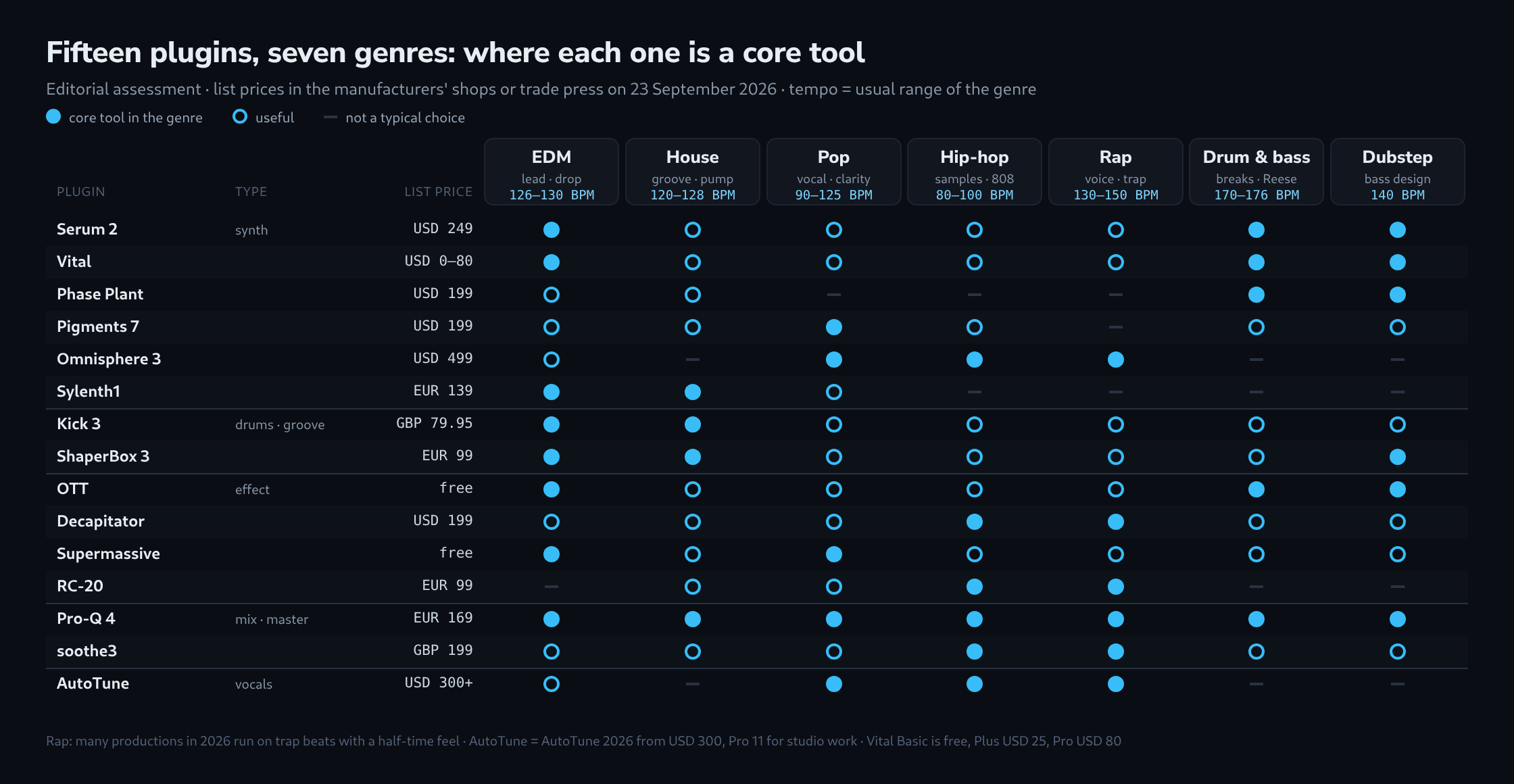
FabFilter Pro-Q 4 (EUR 169) was released on 12 December 2024 and is current with version 4.10 from 15 January 2026. Up to 24 bands, dynamic and spectral dynamic bands, linear-phase and zero-latency operation: it is the EQ needed in every one of the seven genres, and therefore the only row in the diagram with seven filled dots. On the same day as Pro-Q 4.10, FabFilter released Pro-C 3, its first new compressor in more than ten years, with 14 styles at the same price.
oeksound soothe3 replaced soothe2 on 19 May 2026 and costs GBP 199, the upgrade GBP 45. The plugin looks for resonances and harsh frequencies and attenuates them only at the moment they occur. On pop and rap vocals it tames sibilance and hard mids without making the voice dull. soothe3 runs as VST3, AU and AAX, without VST2 and without CLAP.
For the final step there are FabFilter Pro-L 2 (EUR 169) with true-peak limiting and loudness metering to EBU R128, and iZotope Ozone 12, released on 2 September 2025, in three editions from USD 55 to USD 499. Ozone 12 added a Stem EQ that equalises vocals, bass and drums separately within a finished stereo mix. iZotope has belonged to Boris FX since 2 July 2026.
Vocals: AutoTune and Melodyne
Modern pop, hip-hop and rap are hardly conceivable without pitch correction, both as inaudible correction and as an audible effect. Antares reorganised its range on 21 October 2025 and has spelled the name AutoTune ever since: AutoTune 2026 replaces Artist and Access and costs USD 300 as a perpetual licence, while AutoTune Pro 11 from October 2024 remains the tool for studio work, with a Harmony Player that turns a MIDI track into four-part harmonies. Every version delivers the typical trap sound with hard jumps between notes when the retune speed is set to zero.
Celemony Melodyne 5 is the counterpart for subtle editing after recording. It displays each note of a vocal take as a blob whose pitch, length and level can be adjusted. There is no Melodyne 6; the current version is 5.4.2. ARA lets Melodyne integrate directly into most DAWs.
The genres one by one
| Genre | Tempo | Core tools | Free starting point |
|---|---|---|---|
| EDM | 126–130 BPM | Serum 2, Sylenth1, OTT, Kick 3, ShaperBox 3, Supermassive, Pro-Q 4 | Vital, OTT, Supermassive |
| House | 120–128 BPM | Sylenth1, Kick 3, ShaperBox 3 or Kickstart 2, Pro-Q 4 | Vital, Supermassive |
| Pop | 90–125 BPM | Pigments 7, Omnisphere 3, Supermassive, soothe3, AutoTune, Pro-Q 4 | Pigments Play, Supermassive |
| Hip-hop | 80–100 BPM | Omnisphere 3, Decapitator, RC-20, AutoTune, Pro-Q 4 | Kontakt Player, Vital |
| Rap | 130–150 BPM (trap, half time) | Omnisphere 3, Decapitator, RC-20, soothe3, AutoTune, Pro-Q 4 | Vital, OTT |
| Drum & bass | 170–176 BPM | Serum 2, Vital, Phase Plant, OTT, Pro-Q 4 | Vital, OTT |
| Dubstep | 140 BPM (half time) | Serum 2, Vital, Phase Plant, OTT, ShaperBox 3, Pro-Q 4 | Vital, OTT |
EDM and house share the basic kit and differ in degree: EDM calls for bigger leads and longer reverb tails, house for a dry kick and a bass that pumps cleanly. Pop is the only genre in which the voice sets the list; synthesizers serve as a bed beneath the vocal. Hip-hop and rap differ mainly in the vocal: rap needs more work on intelligibility and sibilance, hip-hop more work on samples and tone. Drum & bass and dubstep are the sound design genres; there a synthesizer whose modulation can be controlled down to every detail counts for more than any library.
Plugin formats in 2026: VST3, CLAP and the end of VST2
The format decides whether a plugin shows up in a DAW at all. VST3 is the common denominator; with version 3.8 at the end of October 2025, Steinberg placed the VST 3 SDK under the MIT licence, so developers can use the format without a separate agreement. VST2 is being phased out: Cubase has disabled it by default since version 14, and plugins such as soothe3 no longer appear in this format at all. Logic Pro only loads Audio Units, Pro Tools only AAX.
CLAP, introduced by u-he and Bitwig in 2022, is loaded by Bitwig Studio, Reaper, FL Studio and Fender Studio Pro, but not by Ableton Live, Logic Pro and Pro Tools. Among the plugins in this overview, only the FabFilter range and u-he Diva offer CLAP. For the selection this means: as long as a plugin is available as VST3 or AU, it runs in every common DAW; CLAP is an advantage, but not yet a criterion.
What free plugins already cover
A complete setup for electronic genres can be put together without a single purchase: Vital as the synthesizer, OTT as the compressor, Valhalla Supermassive as the reverb, Kontakt Player and Massive X Player for libraries and presets, Pigments Play for pads. Add the instruments and effects every DAW ships with; the EQ and limiter of FL Studio, Ableton Live or Logic Pro are enough for a clean mix.
Paid plugins pay off where they save time or do something the free ones cannot: Serum 2 for its preset selection and the granular and spectral oscillators, Pro-Q 4 for its dynamic bands, soothe3 for vocals, Omnisphere 3 for a treasury that no free library replaces.
Conclusion: few plugins, known well
The plugins that shape the sound of a genre in 2026 are the same as five years ago, only in new major versions: Serum 2, Omnisphere 3, Pigments 7, Pro-Q 4 with Pro-C 3 and soothe3 have all been released since early 2025. What is new is mainly the market behind them, with Native Instruments at inMusic and iZotope at Boris FX, and the format question, in which VST2 is fading out and CLAP has not yet arrived everywhere.
Three tools from the table are enough to get started in a genre: a synthesizer or library, an effect for character and an EQ. Anyone who masters Vital, OTT and Supermassive thoroughly sounds better in EDM, drum & bass and dubstep than with a collection of twenty plugins that were opened only once.
Questions and answers
Which formats are needed for a setup that switches between Logic Pro on a Mac and FL Studio on Windows?
Audio Unit for Logic Pro, which loads only that format, and VST3 for FL Studio on Windows, because Audio Units exist only on macOS. For most plugins in this overview that is no obstacle, since they ship in both formats; before buying, it is still worth checking that both operating systems are supported.
OTT sits on almost every lead and bass in the bass genres. What side effect does that have in the mix?
OTT compresses not only downwards but upwards as well: quiet parts are raised until they come close to the loud ones. That makes a synth bass dense and bright, but it also lifts everything quiet in the signal, including noise, the decay of reverb and delay, and the sibilance of a voice. On a single track that is often exactly the effect wanted.
On many tracks at once it adds up. Every track loses part of the difference between loud and soft, and the mix feels denser and louder but loses depth, because nothing can recede behind anything else any more. That is why OTT in these genres often sits on a track at a mix of only 20 to 40 per cent: the original keeps its dynamics, and the compressed version lies underneath.
A second consequence concerns the order. Reverb after OTT stays untouched; reverb before it is lifted along with everything else and fills the gaps. When OTT sits on a bus that carries reverb, the decay is worth a careful listen.
Sources
- Xfer Records – Serum 2
- Spectrasonics Omnisphere 3 arrives
- Arturia announces Pigments 7
- FabFilter releases FabFilter Pro-C 3 and updates FabFilter Pro-Q 4
- oeksound soothe 3 released
- Antares release AutoTune 2026
- iZotope Ozone 12 has arrived
- Native Instruments updates Kontakt to v8.13
- Xfer Records – Freeware (OTT)
- Steinberg moves VST 3 SDK to MIT open source license
- CLAP – Hosts and Plug-ins
Related articles