English
 Deutsch
 Polski
Checking a Consent Banner: Which Tracking Scripts Load Before Anyone Clicks

Management Summary
A consent banner is meant to connect a visitor's privacy choice with what the website actually does. Its presence alone does not mean advertising or analytics services wait for a decision. Data may already be sent before a click, and some measurement can occur without cookies. This matters because a visible choice is useful only when refusal, acceptance and withdrawal have the intended effect. Looking at real browser behaviour reveals whether the banner's promises and the website's actions agree.
Contents
A visible consent banner does not prove that tracking waits. The relevant questions concern scripts and requests before a choice, information stored in the browser and changes after acceptance or rejection.
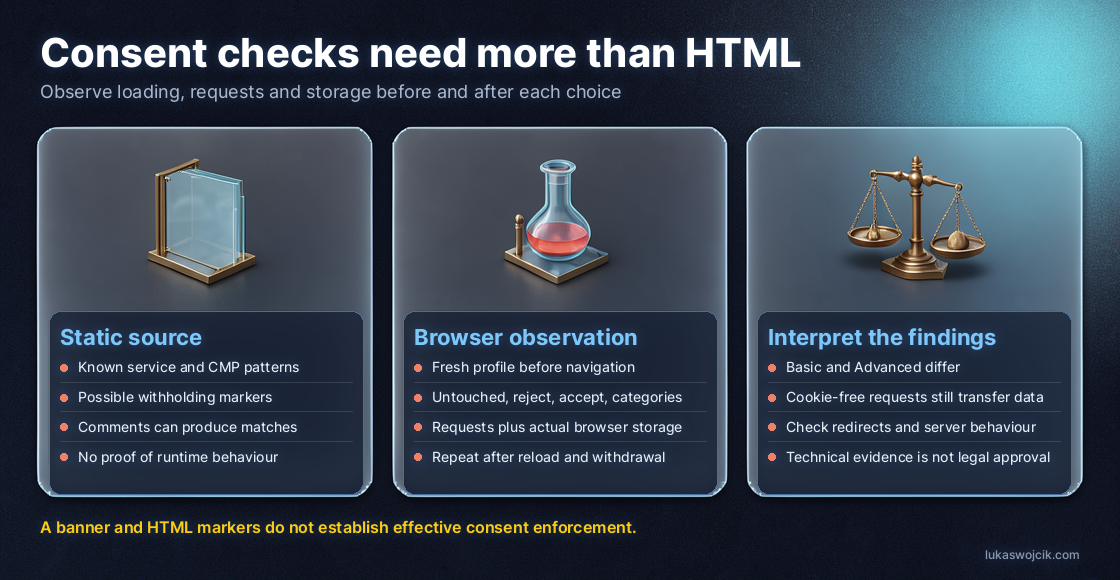
A reliable review combines three layers: clues in delivered HTML, browser observations of network activity and storage, and the configuration of the banner, tag manager and server. A single source fetch provides a starting point, not a complete verdict.
Why HTML position is not enough
The banner is initially a user interface. Covering the screen does not stop network connections. A consent management platform, or CMP, needs a working integration with the relevant services and tags.
Script execution does not follow a simple “top first, bottom later” rule. Classic scripts, async, defer, modules and dynamically inserted scripts follow different schedules. Content Security Policy, loading errors or browser blockers can also prevent a resource. A visible src reference therefore identifies an intended resource, not a successfully completed transfer.
Typical ways to hold scripts back
Several technical approaches exist; the following examples are not an exhaustive list of exactly three possibilities:
- Inactive data block:
type="text/plain"initially prevents JavaScript execution. Later activation requires an appropriate loading procedure, often involving a newly created script element. Merely changing the existingtypeattribute does not guarantee execution. - Withheld address: The browser does not load an address in
data-srcas asrcresource. CMP code can initiate the actual request later. An arbitrarydata-*attribute beside an already activesrcdoes not block anything by itself. - Conditional loading or firing: Application code, a CMP integration or a tag manager activates a service only after the appropriate permission. An already loaded library and a measurement event that has not fired are different states.
Permission must match the purpose. Rejection must not start a service requiring consent merely because a banner button was pressed. Browser observation establishes whether the configuration implements the intended behaviour.
Consent Mode: basic and advanced implementations
Google distinguishes two implementations. In Basic Consent Mode, the relevant Google tags remain blocked until consent; without consent, even consent-status data is not sent to Google. In Advanced Consent Mode, tags can load with consent denied and send measurements without cookies. A loaded Google tag therefore proves neither consent nor an implementation fault by itself.
The relevant states include analytics_storage, ad_storage, ad_user_data and ad_personalization. Storage permission, sending advertising user data and personalised advertising are separate settings. Consent Mode does not obtain consent or replace a legal assessment.
For gtag.js, the appropriate default belongs before commands that send measurement data. In GTM, Consent Initialization and the template’s consent APIs are relevant. The absence of a visible gtag('consent', 'default', …) call in HTML therefore does not establish a missing default. A visible granted value also needs context: default or update, applicable region and a potentially stored valid choice.
wait_for_update can specify a limited wait for an asynchronous CMP. A period such as 500 milliseconds does not promise to wait for a human decision. Tags without built-in consent checks need appropriate additional firing conditions.

Cookies can arrive in HTTP responses
A server can request storage through Set-Cookie before a banner appears. Browser policies and cookie attributes also determine whether storage actually occurs. A header line alone is therefore not proof of a stored cookie.
A banner running later cannot retroactively prevent a response already processed. Server logic can nevertheless decide whether to set an optional cookie before sending the response, for example based on a previously stored choice. Intermediate redirect responses can contain cookies too. A review therefore needs the relevant response chain and the resulting browser storage.
In Germany, Section 25 TDDDG generally requires consent for storage or access, subject to narrow exceptions. A cookie strictly necessary for an explicitly requested shopping basket can qualify; the label “session cookie” alone does not suffice. Other data-protection requirements need separate consideration.
What the tracking and consent scanner contributes
The tracking and consent scanner examines server-fetched HTML using known patterns. Examples include certain service IDs, CMP references, consent expressions and signs of potentially withheld scripts. Detection does not execute the target code or read GTM container configuration.
A match can also originate from a comment or sample code. Missing matches do not exclude unknown, obfuscated or subsequently loaded services. A consent string proves neither execution nor order nor the effective state. HTML clues alone cannot establish which individual services are actually blocked.
The scan is also not a complete cookie inventory. Redirects and repeated Set-Cookie headers require direct comparison with browser data. Private destinations, access controls, fetch limits or bot protection can prevent or restrict results. A request from the scanner’s location does not automatically represent other regions, browsers or stored choices.
A reproducible test procedure
- Baseline record: The record includes the address, time, region, browser and intended rules. The test uses a fresh profile without an old consent choice or unexpected extensions. Browser tracking protection is explicitly noted.
- Recording before navigation: Network recording starts before navigation, with log preservation and cache disabled for the test. The initial page load occurs without a banner choice. Relevant resources include scripts, fetch/XHR requests, images, frames and beacons; tracking is not limited to JavaScript files.
- Separate state comparisons: Separate reproducible runs cover the untouched banner, rejection, acceptance and selected categories. Further observation follows relevant interactions and page navigation.
- Request and storage inspection: Request inspection covers destination host, timing, the script or document that started the request, and transmitted fields. Storage comparison covers cookies, local storage and other storage in use. The absence of a newly written cookie does not establish that existing information was never read.
- Return visits and withdrawal: The return-visit test checks the saved choice after reload; the withdrawal test reverses previous consent and examines subsequent behaviour. For Google, Tag Assistant supplements the comparison of consent states and tags.
The record should distinguish observation from conclusion. “A request to service X appeared before a choice” is a verifiable finding. “No measurement exists” is too strong without sufficient coverage. Network exports can contain confidential data and require protected storage.
Questions and answers
Do async or defer wait for consent?
No. These attributes control execution scheduling and contain no consent decision. Waiting requires a separate integration. Actual timing also depends on script type and loading conditions.
Is a request without cookies automatically harmless?
No. Information can be transmitted without cookies. Purpose, contents, technical access and legal basis require separate assessment. A static scan or Consent Mode state does not establish overall legal compliance.
Is an uneventful initial load sufficient?
No. Later interactions, navigation that changes the displayed content without reloading the whole page, regional variants, stored choices and server-to-server transfers can trigger additional processing. A browser log also cannot reveal every downstream operation on external servers.
Related articles