English
RSS and Atom: Finding and Checking Feeds

Management Summary
RSS and Atom are standard formats that let reader applications collect new publications from websites. They provide a way to follow blogs or news without repeatedly opening each site, and suitable local readers need no account with the publisher. A useful feed must be discoverable and retain enough entries between visits by the reader application. Missing results at guessed addresses do not establish that a site has no feed. What matters is whether new publications actually arrive correctly in a reader.
Contents
An RSS or Atom feed makes publications available in a machine-readable format. A public feed can be subscribed to in a suitable local reader without an account with the publisher. This is useful, but is neither the only account-free approach nor a guarantee about every reader app.
Machine-readable declarations and visible links
HTML autodiscovery uses link with rel="alternate" and the appropriate type. A simple example for the page head:
<link rel="alternate" type="application/rss+xml" title="Feed" href="/feed/">Atom uses application/atom+xml. The address must match the actual feed; /feed/ is not a universal requirement. A visible feed link or a feed directory also helps. Entering a known feed URL directly works without HTML discovery. Handling of an ordinary page URL depends on the reader.
Not found does not mean nonexistent
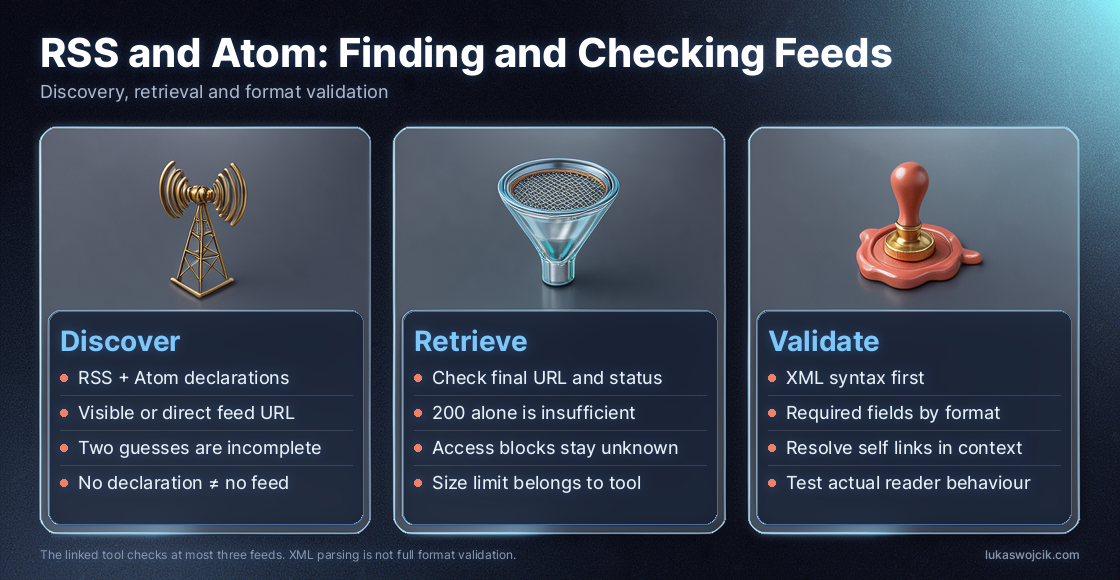
A homepage without a declaration may still have a feed linked from another page, available at another address or requiring authentication. Two unsuccessful guesses at /feed/ and /rss.xml do not prove absence. Searching only for the RSS media type also misses Atom.
A guessed URL returning status 200 and HTML is not evidence of a broken feed. The same response from a URL explicitly advertised as a feed is a concrete finding. Redirects, final URL, access restrictions and media type belong in the inspection record. Status 403 or 429 prevents assessment of the underlying content; status 200 alone does not establish a feed. HTML might come from a login page, a blocking page or a generic fallback.
XML syntax and feed conformance are separate checks
Well-formed XML is the first step. Format, namespaces and required fields come next. RSS 2.0 requires a channel title, link and description, among other structural rules; dates and links are not universally required on individual items. Atom requires id, title and updated on feeds and entries, among other requirements. An Atom entry without content needs an alternate link.
A missing date therefore means different things in different formats. Nor is “older than 180 days” a universal error: publication frequency and purpose matter. Future timestamps deserve separate inspection instead of automatic classification as fresh.
Self links need context
An Atom feed should contain a link with rel="self". RSS can use that Atom link as an extension. A different host in a self link is initially a discrepancy, not proof of an invalid feed: redirects and preferred retrieval addresses need consideration.
In atom:link, the element belongs to the Atom namespace, while an unprefixed attribute such as rel belongs to no namespace. Relative Atom addresses require resolution with xml:base and the retrieval address taken into account. A raw string comparison is insufficient.
Size and update behaviour
Twenty or thirty entries do not suit every publication rate. Feed length needs to cover the expected maximum interval between polls, otherwise entries disappear before the next retrieval. For example, ten new entries a day require room for at least thirty entries if a reader checks only every three days. Feeds can also represent complete collections, pages or archives. A one-MiB cutoff is a tool limit, not a standards violation or proof of an archive.
With supported conditional GET requests, a previously received ETag is sent as If-None-Match; alternatively, Last-Modified supplies a value for If-Modified-Since. A matching unchanged response can return 304 without a body. HEAD only exposes headers and does not test that behaviour. A shorter feed also reduces a full response even without validators.
What the linked checker covers
The RSS and Atom Feed Checker offers an initial inspection. The implementation checked on 25 October 2026 examines at most the first three discovered declarations and limits each feed to 1,048,576 bytes. Without a declaration, two fixed paths are tried.
HTML discovery uses patterns rather than a complete parser: comments can count as declarations and base is ignored. XML processing is not a complete RSS/Atom validator; even an incorrect Atom namespace is accepted. Nor are xml:base, normalized relative paths and the final feed URL after redirects fully reflected in self-link comparison. A positive result therefore cannot replace format validation and a reader test.
Questions and answers
Where should the declaration appear?
A relevant feed link helps on pages whose URLs might be used for subscription. A shared page head makes this easier; category pages can additionally offer dedicated feeds.
What needs checking in WordPress?
automatic-feed-links enables general output through feed_links(). The page head must execute the intended WordPress hooks; filters or removed hooks can suppress output. A missing declaration therefore does not establish missing theme support alone.
Does a feed replace a sitemap?
A feed supplies published entries to reader apps or other services, while a sitemap communicates URLs to search engines. These purposes partly overlap but are not identical. Both formats can be useful together.
Related articles