

 English
 Deutsch
 Polski
How to Wire and Weatherproof Smart Home Lighting

Management Summary
Smart lighting combines electric lights with automatic or remote control, including outdoors. For gardens and exposed installations, reliable operation depends on the whole setup: lights, cables and connections must suit moisture and weather together. Separate circuits can limit the effect of a fault. The article explains why professional electrical planning provides the foundation for convenient automation and why a waterproof label on one component is not enough.
Contents
Reliable smart lighting starts with the electrical installation. Separate circuits can limit an outage; suitable luminaires, cables and connections reduce weather damage. Automation then adds control, not electrical protection.
Work on mains wiring and distribution boards belongs with qualified electrical professionals. The following points support planning and inspection; the protective devices, cable sizing and installation method depend on the site and applicable local requirements.
RCBOs can limit the affected area
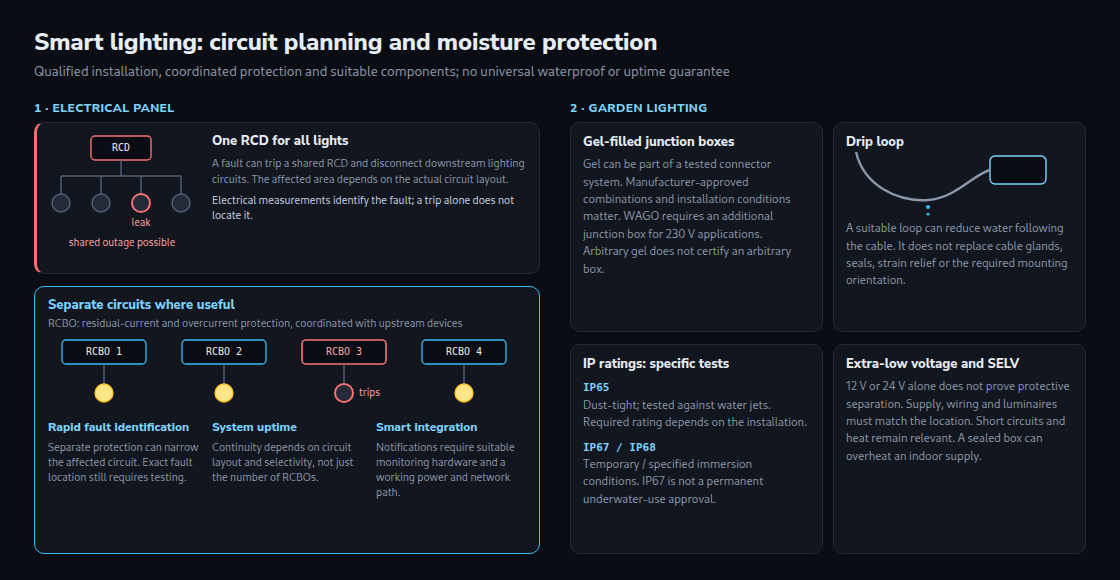
An RCBO combines residual-current and overcurrent protection. A shared residual-current device can disconnect all circuits downstream when a relevant fault causes a trip. Separate RCBOs can reduce that affected group and help identify the circuit needing investigation.
That benefit requires coordinated protection, including any upstream devices. A dedicated RCBO does not guarantee that no other protective device will operate. Nor does a trip identify the exact failed light. Fault diagnosis still needs electrical tests.
A useful planning question is which functions must remain available together: indoor lighting, outdoor lighting and the network may warrant separate circuits. The design determines the division; “one breaker per cable” is not a universal rule. Home Assistant reporting needs suitable auxiliary contacts or monitoring hardware and a working power/network path.
Moisture protection is a complete system
A suitable connector, enclosure, cable entry and installation method must work together. Gel can form part of a tested system. Pouring arbitrary material into an arbitrary box does not establish a waterproof rating or safe electrical installation.
For example, WAGO specifies compatible connector/Gelbox combinations and an additional junction box for 230 V applications. Manufacturer instructions determine the permitted combination and conditions. Existing moisture, damaged insulation or unsuitable cables need correction rather than concealment under gel.
A drip loop is a downward bend in the cable before the cable enters the enclosure. This bend can reduce water running along a cable into an entry where the mounting arrangement permits it. The loop does not replace a correctly fitted cable gland, seal, strain relief or the specified mounting orientation. Cable bend-radius requirements still apply.
IP ratings describe particular tests
- IP65: dust-tight and tested against water jets.
- IP67: dust-tight and tested for temporary immersion.
- IP68: dust-tight and tested for immersion under the manufacturer’s stated conditions.
The required rating depends on actual exposure. IP65 is not a universal minimum for every outdoor wall light. IP67 does not establish suitability for permanent underwater lighting, and an immersion rating does not automatically include water-jet resistance. Pond equipment needs explicit suitability for that use.
An enclosure rating also does not select a cable for burial or prove resistance to UV, corrosion and mechanical damage. Cable type, routing, burial protection and drainage require separate assessment.
12 V or 24 V: consider the whole supply
An appropriately designed safety extra-low-voltage system (SELV) can reduce electric-shock risk. The voltage number alone does not prove protective separation. The supply, wiring separation, luminaire and location must form a suitable system; wet locations can have additional requirements.
Short circuits, heating, corrosion and voltage drop still matter at 12 V or 24 V. Power supplies need the manufacturer’s ventilation, temperature and enclosure conditions. Placing an ordinary indoor supply in a sealed IP68 box can create a thermal problem and is not a general solution.
Checks before operation
Commissioning combines the required electrical measurements, protective-device checks and a functional test. Circuit labels and documentation make later faults easier to investigate. After visible damage, water ingress or repeated trips, the affected installation needs isolation and assessment; repeated resetting is not a repair.
Questions and answers
Does water always trip an RCBO immediately?
No. Operation depends on the fault, current and protective device. A circuit remaining energized is not proof that a wet connection is safe.
Does a separate RCBO make troubleshooting effortless?
No. It can narrow the affected circuit. Whether only the intended protective device trips, whether other circuits retain power and where the fault actually lies still require separate checks.
Related articles


