English
 Deutsch
 Polski
How to Wire and Weatherproof Smart Home Lighting

Contents
When we design a smart home, it is easy to get caught up in the software—automations in Home Assistant, Zigbee mesh networks, and dynamic scenes. However, the most critical component of a reliable smart lighting system is the underlying physical electrical architecture.
A truly “smart” home requires a resilient electrical panel and a weather-proof physical layer. In this guide, we will explore why isolating the lighting circuits is non-negotiable and how to properly secure outdoor lighting against the elements.
1. The Golden Rule of the Electrical Panel: Isolate with RCBOs
In traditional electrical setups, it is common to wire an entire floor’s lighting—or sometimes even the whole house—to a single Residual Current Device (RCD, known in Poland as a różnicówka).
This is a critical architectural flaw for a smart home.
If moisture enters a single lightbulb socket, or a wire gets slightly nicked, a ground fault (current leak) occurs. If all the lights share one RCD, that single leak trips the breaker and plunges the entire house into darkness. Worse yet, identifying which specific cable or fixture caused the leak becomes an absolute nightmare, since every single fixture has to be disconnected manually to find the culprit.
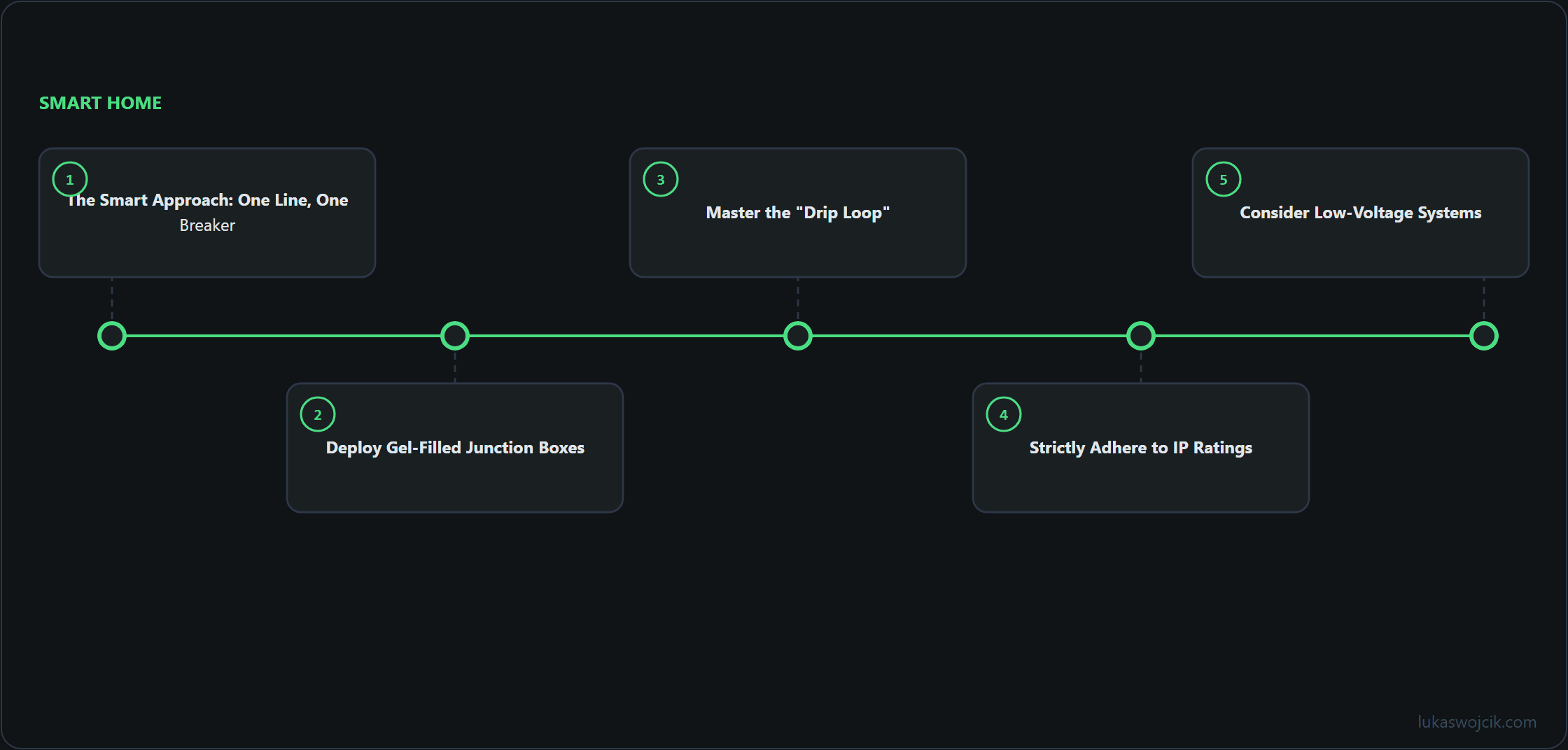
The Smart Approach: One Line, One Breaker
To build a resilient infrastructure, every individual lighting line should be connected to its own separate RCBO (Residual Current Breaker with Overcurrent protection—a combination of an RCD and an MCB).
- Rapid Fault Identification: If a leak occurs, only the specific RCBO for that exact lighting line will trip. That instantly reveals which room or zone has the problem, cutting troubleshooting time from hours to seconds.
- System Uptime: The rest of the house remains illuminated. Smart home hubs, routers, and other critical infrastructure do not go offline because of a faulty bathroom light.
- Smart Integration: Modern smart electrical panels can monitor individual RCBOs. If a circuit trips, a Home Assistant instance can instantly send a push notification detailing exactly which circuit failed.
2. Bulletproofing the Garden Lighting
Outdoor lighting is the most common source of electrical leaks. Rain, snow, condensation, and soil moisture are constantly trying to infiltrate the electrical joints. When water meets a 230V connection, the newly installed RCBOs trip instantly.
Here is how to properly secure garden lighting so that water never compromises the system:
Deploy Gel-Filled Junction Boxes
Standard IP-rated junction boxes are not enough for underground or highly exposed connections. Condensation can build up inside the box even if it is perfectly sealed from the rain.
- The Solution: Use potting gel (often sold as “magic gel” or electrical silicone resin). After making the wire connections (preferably with Wago connectors), fill the entire junction box with this liquid gel. It cures into a solid, rubbery state, completely displacing all air. Where there is no air, there can be no condensation, making the connection 100% waterproof.
Master the “Drip Loop”
Water follows the path of least resistance, and cables act like perfect highways for rainwater. If a cable runs straight down into a light fixture, water will travel down the cable jacket directly into the housing.
- The Solution: Always create a drip loop. Leave a small amount of slack in the cable so it dips below the entry point of the fixture before coming back up. Gravity will force the water to drip off the bottom of the loop rather than flowing into the electrical joint.
Strictly Adhere to IP Ratings
Never cut corners on the Ingress Protection (IP) ratings of the fixtures:
- IP65: Minimum requirement for wall sconces and above-ground lighting exposed to rain.
- IP67/IP68: Absolute necessity for any ground-level spotlights, buried cables, or underwater pond lighting.
Consider Low-Voltage Systems (12V/24V)
For maximum safety and easier weatherproofing, consider converting the outdoor smart lighting to a low-voltage system. With the 230V-to-24V transformer kept safely indoors (or in a large, highly protected IP68 enclosure), only 24V DC cables run through the garden. Low voltage is significantly safer for humans and pets, and minor moisture ingress is less likely to aggressively trip the main electrical panel’s safety breakers.
Summary
A reliable smart home is built from the ground up. An over-engineered electrical panel with individual RCBOs for every lighting line ensures maximum uptime and effortless troubleshooting. Paired with aggressively waterproofed garden joints using potting gel and drip loops, the result is a smart lighting system that is as physically resilient as it is digitally intelligent.
Questions and answers
At what scale is a separate RCBO for each lighting line worth it, given that the costs add up in the electrical panel?
The calculation rarely comes down to the price of the parts; it comes down to the outage. A single RCD for everything means that a damp outdoor outlet takes the fridge, the router and the heating control down with it, and keeps them down until someone is on site.
That is why the sensible limit is not a number but an assignment: whatever may fail together belongs together; whatever the rest of the house needs to keep running belongs on its own. Often a few additional RCBOs for the areas exposed to the outdoors, such as the garden, the terrace and the carport, already cover most of the risk, because that is where the moisture is.
Anything beyond that is convenience for troubleshooting, which is real but not urgent. More important than the count is that the house’s own infrastructure does not hang on the same breaker as the outdoor lighting: a network that goes down during a thunderstorm also takes away the ability to check remotely what is actually going on.
Sources
Related articles