English
The Evolution of DJing: From the Technics SL-1200 to the CDJ-3000X – What Stood in the Club Then and What Stands There Today

Contents
- Before 1970: records for dancing, still without transitions
- 1969 to 1979: beatmatching, breakbeats and the Technics SL-1200
- The clubs of the disco and house era: sound systems and rotary mixers
- 1992 to 2009: the CD enters the booth
- Timecode instead of music on the record
- 2009 to today: USB stick, rekordbox and the CDJ-3000
- Controllers, streaming and stems
- What stands in the club today
- What has stayed the same
- Conclusion: from platter to touchscreen, with the same moves
- Questions and answers
- Sources
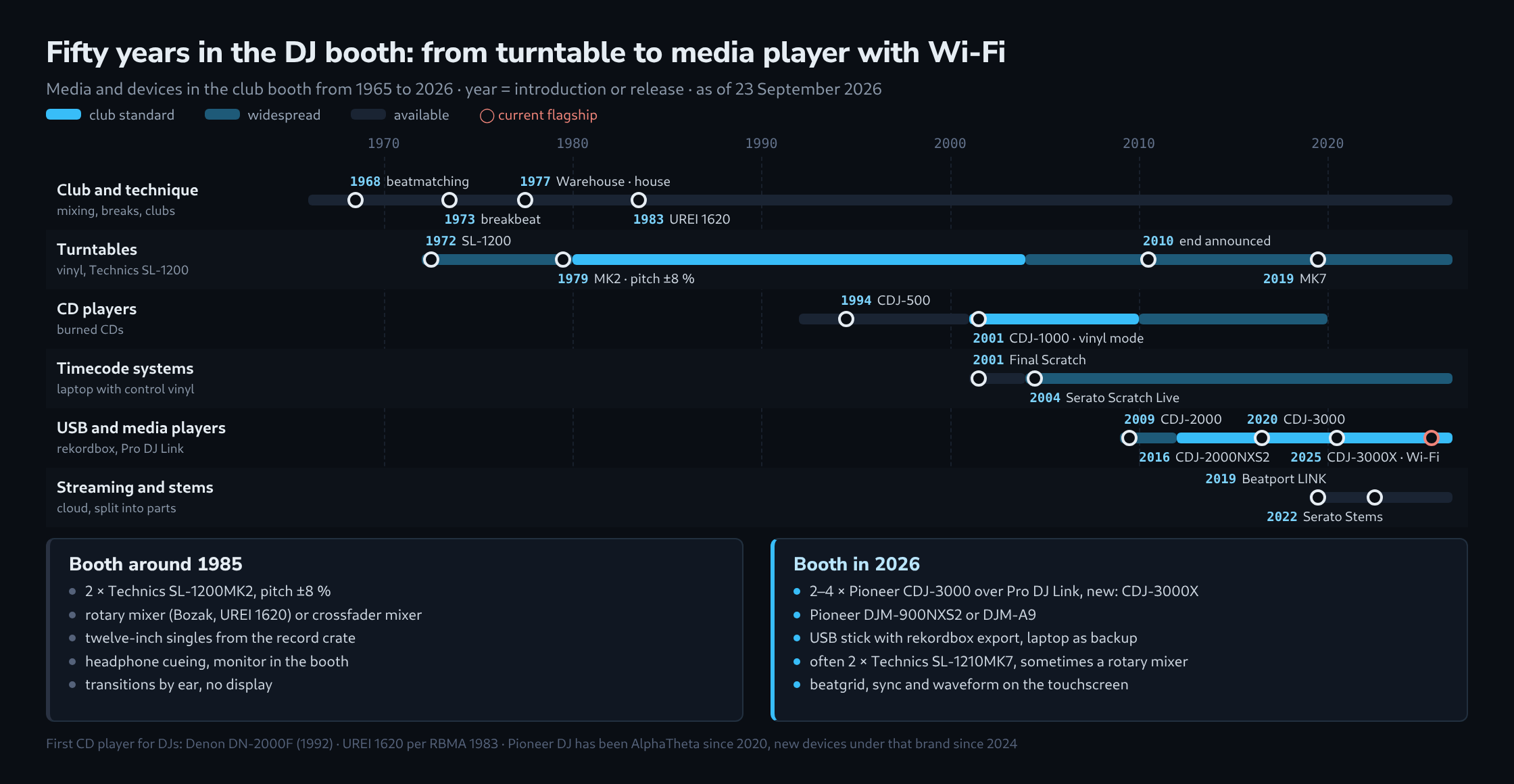
At first glance, a DJ booth from 1985 and one from 2026 have little in common. Back then there were two turntables, a mixer and a crate of twelve-inch singles; today there are media players with touchscreens that load music from a USB stick or over Wi-Fi from the cloud. The moves behind them have remained remarkably stable: cue in the headphones, match the tempo, blend at the right moment. This article traces how the DJ’s tools have changed over a good fifty years and what actually stands in the club in 2026.
Dates and model names were checked on 23 September 2026 against manufacturer pages, Resident Advisor, DJ TechTools, MusicRadar and the Red Bull Music Academy archive. Where sources contradict each other or a “first” is disputed, this is noted.
Before 1970: records for dancing, still without transitions
People danced to records before the profession existed. In occupied Paris, audiences danced to jazz records in hidden cellars because bands were unavailable, and in 1947 Le Whisky à Gogo opened there, often called the first discotheque. In 1953 Régine Zylberberg replaced its jukebox with two turntables so that the music continued without a break. In Germany, the Scotch-Club opened in Aachen on 19 October 1959, where Klaus Quirini, as “DJ Heinrich”, announced the records like a radio presenter.
Which place counts as the “first” depends on the criterion: people dancing to records, a person working specifically as a DJ, or a room built for that purpose. In all of these places, songs played one after another. Overlapping two records during a transition was not yet the aim.
1969 to 1979: beatmatching, breakbeats and the Technics SL-1200
That changed in New York at the end of the 1960s. From 1968, Francis Grasso played in clubs such as the Sanctuary and the Haven and brought two techniques together: slip-cueing from radio, in which the record is held on the spinning platter and released at the right moment, and beatmatching, in which the tempos of two records are aligned so that they lie on top of each other in the same beat. Alex Rosner built the mixer “Rosie” for him in 1971, with headphone cueing; it is considered the first mixer built specifically for DJs.
In October 1972 Technics introduced the SL-1200, a direct-drive turntable actually intended for hi-fi. Direct drive brought the platter up to speed within a fraction of a revolution and kept it stable. The SL-1200MK2, released in 1979, replaced the speed knob with a slider of ±8 per cent and quartz lock. This pitch fader became the core tool for decades: for a track at 128 BPM it covers 117.76 to 138.24 BPM. How a tempo converts into bar lengths and milliseconds is shown by the BPM to Delay Time Calculator, which includes tap tempo.
At the same time, a second school emerged in the Bronx. On 11 August 1973, at a party at 1520 Sedgwick Avenue, DJ Kool Herc put two copies of the same record on the turntables and switched between them, so the short instrumental break of a funk track kept running. This technique, which Herc called the “Merry-Go-Round”, is the seed of hip-hop. Grandmaster Flash refined it from 1975, and in the mid-1970s Grand Wizzard Theodore discovered scratching when he moved a record back and forth under his hand; he first performed it in public in 1977. It appeared on record in 1981 with “The Adventures of Grandmaster Flash on the Wheels of Steel”.
The clubs of the disco and house era: sound systems and rotary mixers
With the big clubs, sound moved to the centre. David Mancuso opened The Loft in Manhattan on 14 February 1970, with Klipschorn speakers and deliberately without beatmatching: every record played all the way through. The Paradise Garage, with Larry Levan as resident from 1978 to 1987, received a sound system by Richard Long around which the dance floor was planned; the term “garage” comes from there. In Chicago, Frankie Knuckles played at the Warehouse from 1977, and the club’s name became the name of a genre: house.
These clubs mixed on rotary mixers with knobs instead of faders. Rudy Bozak’s mixers, above all the CMA-10-2DL, set the standard in the 1970s; UREI released the 1620 in 1983, heavily based on the Bozak circuitry. The crossfader, which blends between two channels with a single slider, reached the market in 1977 with the Citronic SMP101 in the UK and the GLI PMX 7000 in the USA. Who invented it is disputed.
By around 1985, this had produced the booth that looked the same everywhere for two decades: two SL-1200MK2s, a mixer with headphone cueing, a monitor speaker and a crate of twelve-inch singles. The twelve-inch with a long intro and long outro was itself an answer to mixing, because it left time for the transition.
1992 to 2009: the CD enters the booth
The first CD player for DJs was the Denon DN-2000F, shown in 1991 and sold from 1992, a dual rack unit with pitch control. Pioneer followed in 1994 with the CDJ-500, which as the first “CDJ” gave its name to a whole class of device. The breakthrough in clubs came in 2001 with the CDJ-1000: in vinyl mode its large jog wheel behaved like a turntable platter, so moves from the turntable carried over.
This mainly changed how music was sourced. Promos no longer arrived as test pressings but as burned CDs, and a track could be played on the day it was finished. Pioneer added the DJM-500 (1995), DJM-600 (1998) and DJM-800 mixers to the players; in the 2000s the CDJ and DJM pair became a fixed part of the technical requirements DJs send with a booking.
Timecode instead of music on the record
Digital vinyl systems opened a second route into the digital world. In 2001, Final Scratch by the Dutch company N2IT came onto the market, co-developed with Richie Hawtin and John Acquaviva: the record carries no music but a timecode, and software on a laptop plays the file exactly as the needle moves the record. Serato Scratch Live followed with Rane in 2004, and Traktor Scratch by Native Instruments in 2007.
For DJs who wanted to keep the feel of vinyl, this was the solution: scratching and beatmatching worked as usual, but the record crate shrank to a hard drive. In the club it meant laptops entered the booth, and changeovers between two DJs involved re-plugging cables. Rane has belonged to inMusic since 6 July 2016 and, with the Seventy-Two, builds mixers for Serato on which battle DJs still play today.
2009 to today: USB stick, rekordbox and the CDJ-3000
In November 2009 the CDJ-2000 appeared with USB and SD slots and the rekordbox software, which analyses a music collection on the computer, sets beatgrids and cue points and exports everything to a stick. With Pro DJ Link, up to four players shared one source over network cables. A DJ now needed neither CDs nor a laptop: a USB stick in the pocket was enough. The CDJ-2000NXS2 and the DJM-900NXS2 mixer of 2016 made this combination the worldwide standard.
On 10 September 2020 the CDJ-3000 arrived without a CD drive, with a 9-inch touchscreen, eight hot cues and Pro DJ Link for up to six players over Gigabit Ethernet. Pioneer DJ has been called AlphaTheta as a company since 1 January 2020, and since 23 January 2024 new devices have appeared under that brand. The DJM-A9 mixer from 28 February 2023 replaced the DJM-900NXS2 as the flagship.
On 9 September 2025 the CDJ-3000X followed at USD 2,999: a 10.1-inch touchscreen, built-in Wi-Fi, login by NFC via phone, USB-C, and streaming and a cloud library through rekordbox. It no longer has an SD card slot. In July 2026 AlphaTheta added the more compact CDJ-1500X, with which the audience can send requests by QR code from a catalogue approved by the DJ.
Controllers, streaming and stems
Outside the clubs, development took a different course. Controllers with a laptop – such as the Traktor Kontrol S4 in 2010 or the Pioneer DDJ-SX in 2012 – and later devices combining players and mixer in one housing are the most common starting point. In the 2022 Digital DJ Tips census, just over half of the roughly 21,000 respondents used a controller with a laptop and about a quarter used CDJs or standalone units; the survey, however, reflects hobby and mobile DJs more than club DJs.
Streaming arrived in DJ software in 2019 with Beatport LINK. Apple Music followed on 25 March 2025 for rekordbox, Serato and Engine DJ, and since 24 September 2025 Spotify Premium is connected again after a five-year break, though only for personal, non-commercial use and therefore not for a paid club gig.
Stem separation splits a finished track into vocals, drums, bass and the rest while mixing. VirtualDJ introduced it on 18 June 2020, Serato on 6 December 2022, rekordbox in 2023 and Traktor Pro 4 on 17 July 2024. Two tracks thus become a spontaneous remix, for example the vocal of one over the drums of the other. Traktor’s future is open: after insolvency proceedings, Native Instruments went to inMusic, which also owns Denon DJ, Rane and Engine DJ, and there has been no statement on further development as of September 2026.
What stands in the club today
| Area | Around 1985 | 2026 |
|---|---|---|
| Players | 2 × Technics SL-1200MK2 | 2 to 4 × Pioneer CDJ-3000, occasionally CDJ-3000X; often also 2 × Technics SL-1210MK7 |
| Mixer | Rotary mixer by Bozak or UREI, crossfader mixer | Pioneer DJM-900NXS2 or DJM-A9, a rotary mixer as an addition |
| Music | Twelve-inch singles in the crate | USB stick with rekordbox export, laptop as backup |
| Tempo matching | Pitch fader ±8 %, by ear | Pitch fader ±6 to ±16 %, beatgrid and sync |
| Networking | none | Pro DJ Link over network cable, Wi-Fi on the CDJ-3000X |
The technical riders DJs send with a booking in 2025 and 2026 almost always list three or four CDJ-3000s connected by network cable, plus a DJM-900NXS2 or DJM-A9. The DJM-900NXS2 is described there as the mixer found in most clubs worldwide, the CDJ-3000 as the industry standard. The CDJ-3000X hardly appears in the templates yet. A club that buys one does not need to change anything else, as it works with existing mixers over Pro DJ Link.
The turntable has not disappeared. Panasonic announced the end of its analogue turntables on 1 November 2010, brought the series back in 2016 and, in 2019 with the SL-1200MK7, a DJ model again, whose pitch switches between ±8 and ±16 per cent. The MK7 is still being built. Vinyl is also a market again: in the USA, vinyl revenue passed the billion-dollar mark in 2025 for the first time since 1983, with 46.8 million units sold, and in the United Kingdom sales grew for the 18th year in a row in 2025, to 7.6 million LPs.
The rotary mixer is back too. Allen & Heath has offered the Xone:96 as the successor to the Xone:92 since 2018, and in March 2024 AlphaTheta launched the euphonia, a rotary mixer with an output transformer by Rupert Neve Designs, for USD 3,799 – the first device bearing the new brand logo. In house and techno clubs that care about sound, such a mixer now often stands next to the DJM.
What has stayed the same
For all the change in media, the controls are remarkably constant. The pitch fader on the CDJ-3000 sits in the same place as on the SL-1200MK2, the jog wheel imitates a platter, and headphone cueing has been mandatory since Rosie’s day. The sync function can match the tempo, but phrasing, selection and the moment of the transition remain handwork.
What has changed above all is logistics: a crate of 80 records became a stick with thousands of analysed tracks, and with Wi-Fi players the stick becomes a library in the cloud. The risk thus shifts from the weight of the crate to the availability of network and account. This is why almost every technical rider template still lists a USB stick as the main medium and a laptop as backup.
Conclusion: from platter to touchscreen, with the same moves
In a good fifty years, the DJ booth has gone through three media changes: from record to CD around 2001, from CD to USB stick from 2009, and from there towards streaming and the cloud from 2025. The club standard in 2026 is the pairing of CDJ-3000 with DJM-900NXS2 or DJM-A9, supplemented by turntables and a rotary mixer where the club values vinyl and sound. The CDJ-3000X is the new flagship; the riders have not yet caught up with it.
The techniques of Grasso, Herc and Knuckles are still relevant. Beatmatching, breaks, scratching and shaping a night over several hours require the same skills today as in 1977. The devices have reduced the weight of the music DJs carry and the time they spend finding it.
Questions and answers
What happens to the pitch when the pitch fader speeds a track up by 8 per cent?
On a turntable it rises with it. A higher platter speed raises tempo and pitch together, as with a tape played faster: +8 per cent corresponds to about 1.3 semitones up, −8 per cent to about 1.4 semitones down. At ±16 per cent on the SL-1200MK7 it is up to about 2.6 semitones up and 3.0 down.
For mixing, this means that if only one of two tracks in the same key is sped up by 8 per cent, the two end up more than a semitone apart, and vocals sound audibly altered at large deviations.
CDJs therefore offer a function that changes the tempo while holding the pitch; Pioneer calls it Master Tempo. It recalculates the signal digitally, which can leave audible traces in the sound at large deviations. A turntable offers no such choice: there, tempo and pitch always move together.
What does a pitch range of ±16 rather than ±8 per cent gain?
Room for tracks that are far apart: at 128 BPM, ±16 per cent reaches from 107.52 to 148.48 BPM. The price is precision, because the same fader travel covers twice the range, so each millimetre changes the tempo twice as much. For fine matching by ear, the narrower range is therefore usually the better setting.
What does the sync function rely on, and when does it fail?
On the beatgrid that rekordbox sets during analysis and exports to the USB stick along with the track. Sync matches tempo and beats according to that grid, not to what can be heard. If the grid is right, the transition lands; if it is off, the transition lands reliably wrong.
The difficult cases are mainly tracks without a fixed tempo, such as older recordings with live drums whose tempo drifts slightly. An evenly spaced grid gradually drifts out of step with the music there. Checking the beatgrids of such tracks in rekordbox before the export saves a surprise in the club. And even with a perfect grid, what the article calls handwork remains: phrasing, selection and the moment of the transition.
Sources
- Technics SL-1200
- DJ Kool Herc
- Rosie: The First Mixer Made Just For DJs
- The Evolution of DJ Mixers
- CDJ-3000 professional DJ multi player
- AlphaTheta’s next-generation professional DJ player CDJ-3000X
- We look back on 15 years of rekordbox
- A new era for DJing starts now with Serato Stems
- After 5 years, Spotify streaming returns to DJ software – but there’s a catch
- Technics introduces the limited edition SL-1200/1210G Master Edition turntables
- BPI – UK music consumption 2025
Related articles