English
 Deutsch
AI Agent or Traditional Automation: What Will Businesses Actually Pay For?

Contents
Start by defining the job before choosing an agent. A business needs the task to be completed reliably. A fixed rule may offer more value than allowing a model to decide freely. When documents are inconsistent, carefully limited AI extraction may instead help turn their contents into structured information.
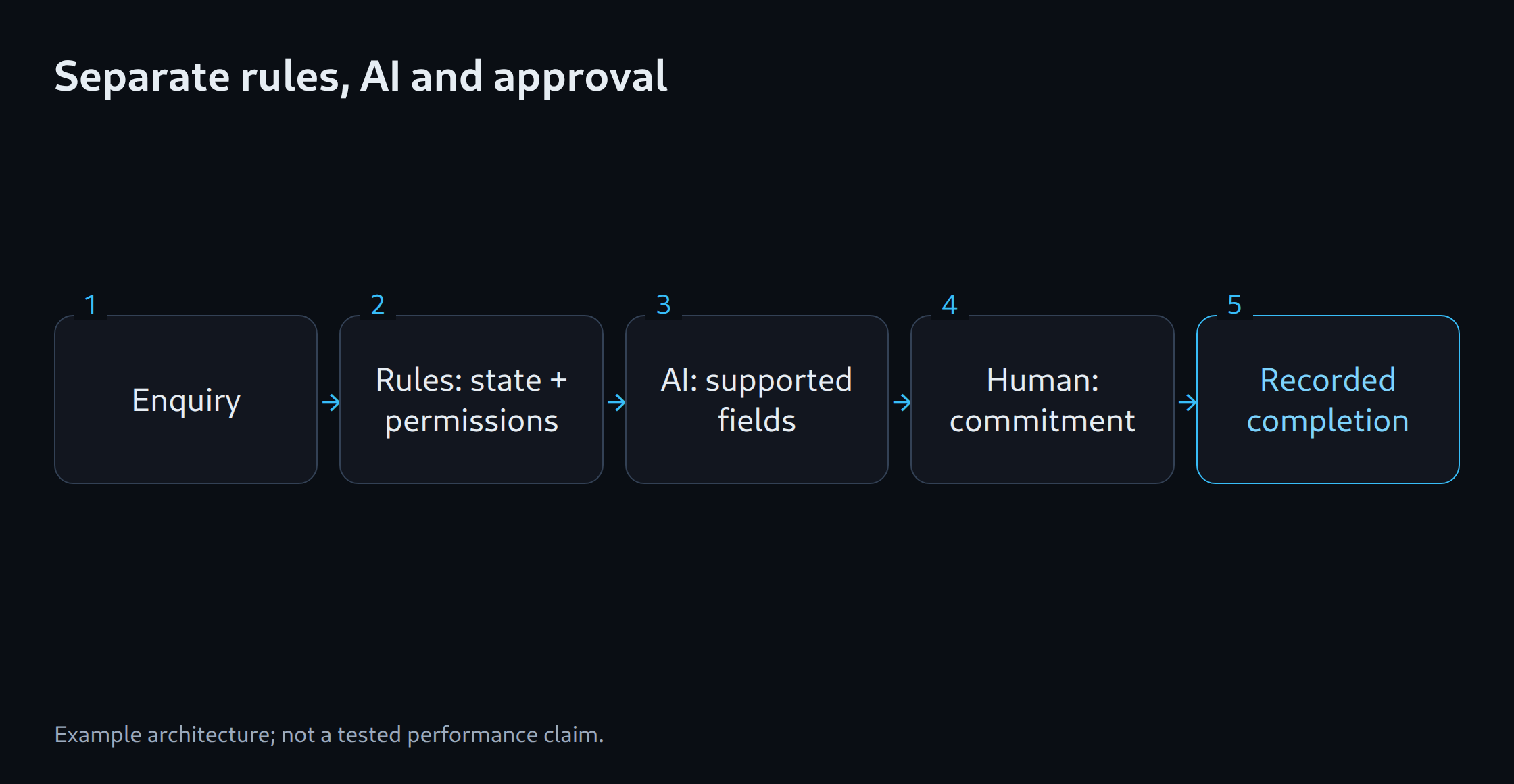
One task: an incoming enquiry
A hypothetical trade business receives enquiries with dates, addresses, product requirements and attachments. The workflow extracts information, identifies missing fields and prepares a reply. Prices, commitments and sending remain subject to human approval. This is a design example, not a tested agent.
| Approach | Suitable work | Weakness |
|---|---|---|
| Fixed rules | Required fields, state, deadlines | Inconsistent free text |
| AI extraction | Convert documents into fixed fields | Invented or misassigned values |
| Agent with tools | Bounded multi-step work with varying inputs | Extra decisions and loops |
| Human approval | Binding commitments and exceptions | Waiting and labour |
An outcome needs a contract
An accepted draft contains supported information only. Unknown fields remain unknown; important values link to their source. Attachments are input data and must not change permissions or system rules. Write actions need allowed destinations and separate approval.
Make provides AI agents alongside workflows. Availability establishes a technical option, not benefit for this business. Model consumption belongs in the cost per accepted job. [1]
A comparison protocol
Prepare a small set of anonymised test cases and assign the expected values before testing. Include complete, conflicting and incomplete enquiries, along with attachments containing misleading instructions. Give every approach the same cases and count successful cases separately from errors.
Records include missing fields, incorrect values, forbidden actions, correction time, latency and cost. A polished draft needing correction is not necessarily cheaper. Defined serious failures stop the pilot. Changed prompts require checking the same cases again.
What the customer buys
Shorter handling time can justify payment, but needs evidence. Outcome billing needs a definition of success and retries. Stripe describes pricing patterns, while quality criteria remain the provider’s responsibility. [2]
A hybrid is plausible for this starting point: rules control state and permissions, AI structures text, and people approve binding action. An autonomous agent deserves consideration only when it solves an additional task better and its failure costs are acceptable.
Related tools
Questions and answers
Does more autonomy automatically mean more value?
No. Accepted outcomes, correction work and failure costs determine usefulness.
Can the model commit to prices?
Not in this pilot. Prices, commitments and sending require human approval.
Sources
Sources checked: 5 October 2026.
Related articles