First-Party Cookie Restoration: Surviving ITP with Cloudflare Workers and ssGTM
Contents
First-Party Cookie Restoration: Surviving ITP with Cloudflare Workers and ssGTM
Safari’s Intelligent Tracking Prevention (ITP) and modern browser privacy engines severely restrict client-side cookie persistence. Identifiers set via JavaScript (using document.cookie) are capped at a maximum lifespan of 7 days—and frequently reduced to 24 hours when ad-click decoration parameters are detected in the URL. Even traditional CNAME cloaking setups are identified and mitigated by WebKit CNAME defense algorithms when DNS records resolve to third-party tracking providers.
To preserve data fidelity and attribution accuracy over longer conversion cycles, data architectures must move away from JavaScript-managed storage toward True First-Party Edge Routing using server-managed HTTP cookies.
1. The Architectural Blueprint: Server-Managed Edge Cookies
Bypassing ITP’s 7-day client-side cap requires generating identifiers directly at the network edge via HTTP response headers (Set-Cookie). Because browser restrictions differentiate between client-script cookies and legitimate server-generated session headers, cookies configured via Edge Workers remain intact for up to 365 days when compliant with regional consent regulations.
| Cookie Attribute | Required Value | Technical Justification |
|---|---|---|
HttpOnly | true | Prevents JavaScript access, immunizing the cookie against ITP script caps and XSS theft. |
Secure | true | Mandates HTTPS transmission across all endpoints. |
SameSite | Lax / Strict | Ensures the cookie is treated as a native first-party context. |
Domain | Apex Domain (e.g., example.com) | Prevents CNAME mismatch penalties across subdomains. |
2. Cookie Restoration via Cloudflare Workers and ssGTM
An enterprise-grade cookie restoration pipeline leverages Cloudflare Workers as a reverse proxy in front of a Server-Side Google Tag Manager (ssGTM) container. When an HTTP request is intercepted at the edge, the Worker evaluates whether a valid, server-managed identifier exists. If missing or expiring, the Worker injects an updated Set-Cookie header into the response.
// Cloudflare Worker Edge Script: Server-Managed Identifier Restoration
export default {
  async fetch(request, env) {
    const response = await fetch(request);
    const newResponse = new Response(response.body, response);

    // Read or generate anonymous first-party identifier
    let fpId = getCookieValue(request.headers.get("Cookie"), "fp_id");
    if (!fpId) {
      fpId = crypto.randomUUID();
    }

    // Enforce 1-year Server-Managed Set-Cookie header
    newResponse.headers.append(
      "Set-Cookie",
      `fp_id=${fpId}; Max-Age=31536000; Path=/; Domain=example.com; Secure; HttpOnly; SameSite=Lax`
    );

    return newResponse;
  }
};
Within ssGTM, this persistent edge identifier is mapped to the standard GA4 or Google Ads client ID, stabilizing multi-touch attribution reports across extended customer journeys.
3. Google Tag Gateway (GTG): The Perfect Edge Partner
The Google Tag Gateway (GTG) represents a specialized first-party routing mechanism that tunnels analytics traffic directly through the primary apex domain. Deploying GTG via Cloudflare Workers creates an optimal synergy with edge cookie restoration:
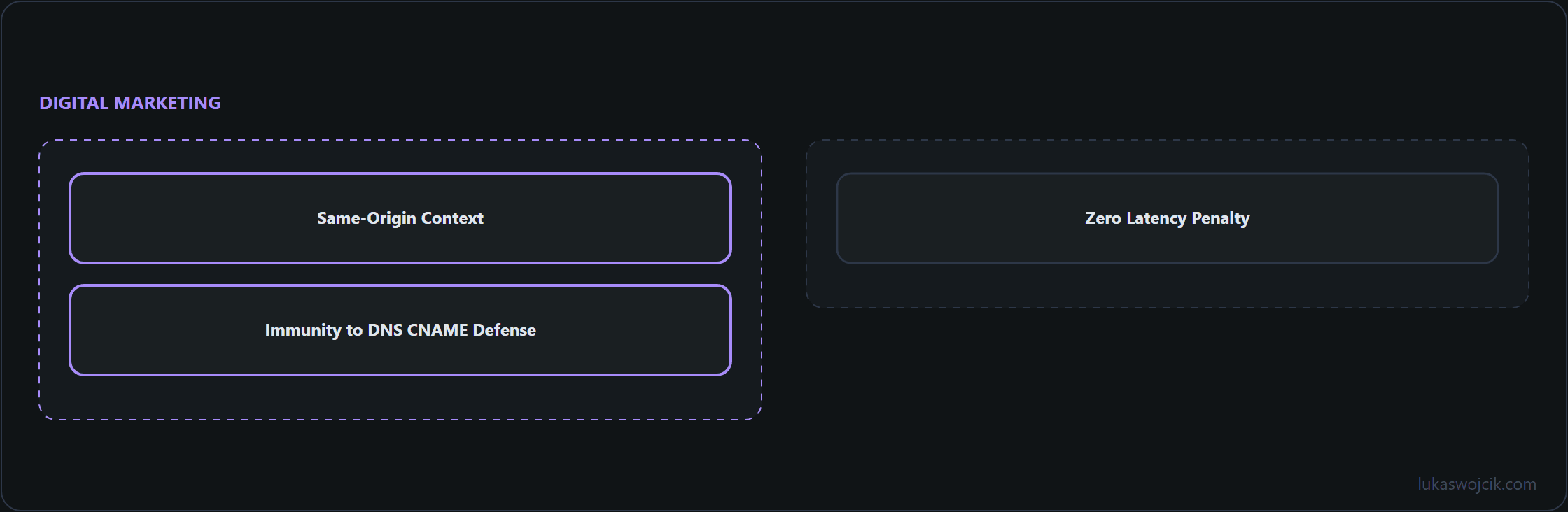
- Same-Origin Context: GTG routes script libraries (e.g.,
/gtg/gtm.js) and data payloads (/gtg/collect) through the identical IP address and Autonomous System Number (ASN) as the main web application. - Immunity to DNS CNAME Defense: Because GTG operates directly on the primary domain infrastructure via Edge Proxying rather than external DNS delegation, WebKit anti-tracking algorithms classify the traffic as native backend communication.
- Zero Latency Penalty: Executing GTG routing and cookie restoration within the same Cloudflare Edge Worker processes requests at network edge locations, eliminating extra TLS handshakes.
Summary
Overcoming ITP restrictions requires shifting identifier management from browser scripts to edge infrastructure. Combining server-managed HttpOnly cookies via Cloudflare Workers with the same-origin routing of Google Tag Gateway (GTG) delivers a compliant, privacy-centric, and technically resilient measurement architecture.
Related articles