English
 Deutsch
 Polski
Matomo vs. GA4 in Enterprise Environments: When to Choose Self-Hosted Analytics?

Contents
GA4 and Matomo On-Premise answer different operational needs. GA4 provides managed analytics with close Google advertising integrations. Matomo provides control over the installation and database, together with responsibility for maintenance, security and capacity. Self-hosting alone guarantees neither privacy compliance nor complete measurement.
Data access and location
GA4’s BigQuery export provides unsampled event records for separate SQL analysis. Exported records do not include every addition made to the GA4 interface, such as behavioural modelling. A Standard property’s daily export is limited to one million events; streaming has different completeness characteristics.
The BigQuery dataset location can be selected during setup, and table expiry can be configured. This controls the exported dataset, not every processing step inside GA4. Export schema, access permissions, cost controls and deletion procedures need an explicit operating plan.
Matomo On-Premise stores analytics data in a controlled MySQL/MariaDB environment. Database access enables custom data pipelines, but production schema changes and heavy queries can interfere with upgrades or collection. A read replica or separate analytical copy is often the safer design. Hosting providers, support access and off-site backups still belong in the data-flow inventory.
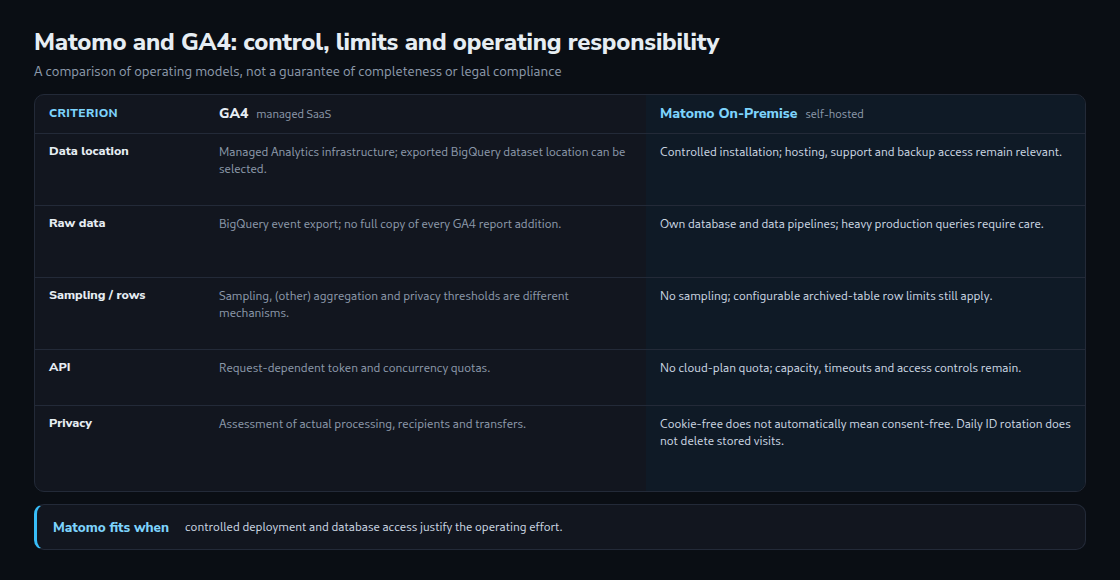
Four different kinds of limitation
- Sampling: a calculation uses a subset of the available records. In GA4 this depends on the request and processing limits.
- Cardinality: many distinct dimension values can exceed a report table’s row limit. GA4 then groups less common values into
(other). This is not the definition of sampling. - Privacy thresholds: some small groups are withheld to reduce identification risks. A threshold is another mechanism, separate from the previous two.
- API quotas: GA4 Data API requests consume request-dependent tokens and are subject to concurrency limits. Caching, smaller date ranges and quota monitoring help prevent dashboard failures.
Matomo does not sample reports, but archived tables have configurable row limits. Removing truncation increases processing and storage demands. Unsampled therefore does not mean that every collected value is individually visible, or that missing tracking requests can be recovered. On-Premise avoids a vendor-imposed cloud plan quota; timeouts, server capacity and access controls still limit real API workloads.
Cookie-free is a configuration, not a legal exemption
Disabling tracking cookies does not automatically remove consent requirements. Device access and subsequent personal-data processing need separate assessment. France’s CNIL describes a restricted audience-measurement exemption; the conditions cannot simply be applied throughout Europe. EU hosting and IP truncation alone are insufficient.
Matomo’s temporary config_id supports visit recognition within a limited window and rotates daily. This does not mean that stored visits or reports are deleted after 24 hours. Retention must be configured separately, and additional identifiers can change the privacy assessment.
A useful technical record includes tracking requests, browser storage attributable to the tracker, identifiers in stored visits, IP handling, user-ID/cross-domain settings, retention and third-party access. An empty cookie panel proves only one part of that record; unrelated functional site storage need not be empty.
Operating cost and a practical choice
A comparison should include infrastructure, updates, backup restoration, incident response, archive processing and any paid extensions. A representative load test needs both collection peaks and the reports actually used. Matomo fits requirements for controlled deployment and direct data access when operational capacity is available. GA4 may fit an existing Google advertising workflow with less analytics-server administration. Neither choice replaces a tracking specification and data-quality checks.
Questions and answers
When does archiving become a bottleneck?
Archive duration depends on traffic, segments, periods, plugins and database performance. Scheduled archiving generally avoids expensive processing during report viewing. Monitoring should cover report freshness, archive backlog, collection errors and storage latency. A run longer than its schedule interval is a warning, not a universal capacity limit. Disabling normal browser-triggered archiving does not automatically disable every custom-segment trigger.
Can historical GA4 reports be imported?
Yes. Matomo’s Google Analytics Importer supports GA4 report imports. The import creates a new Matomo website entry; planning the import before live tracking avoids an unsupported later merge. An import end date and tracking start date prevent overlap.
The imported data consists of aggregates, not reconstructed raw visitor paths. Visitor logs, segmentation of imported records and some metrics are unavailable. A short parallel collection period helps explain differences, but imported history and newly collected data must remain recognisable as different measurement systems.
Does an EU server remove the need for consent?
No. Server location is only one part of the assessment. Purpose, device access, identifiers, recipients and local legal requirements remain relevant. A documented restricted configuration is more useful than a blanket claim of compliance.
Sources
- Matomo Developer documentation
- Matomo and GDPR
- GA4 BigQuery Export
- BigQuery Export setup
- BigQuery table lifecycle
- GA4 storage and reporting limits
- GA4 data thresholds
- GA4 Data API quotas
- Matomo sampling and table truncation
- Matomo config_id
- Matomo data retention
- Matomo capacity planning
- Matomo scheduled archiving
- Google Analytics report import
- Import limitations
- CNIL audience measurement exemption
- EDPB: technical scope of ePrivacy Article 5(3)
Related articles