English
 Deutsch
 Polski
GA4 “(not set)” as Landing Page: Sessions Without a page_view

Summary
The landing page report in Google Analytics shows the first recorded page of a visit and helps explain where visits begin. The label “(not set)” means that this information is missing. A visit may contain actions such as scrolling without any recorded page display, even though a page was visible. Understanding this gap matters when judging entry pages and marketing results. Adding invented page views would hide the problem and distort the picture of actual website use.
Contents
The landing page is the path associated with the first page_view in a session. A page view is the event that records a displayed page. The first event of any kind is not necessarily that page view. Google identifies a session without a page_view as one reason for a landing page of (not set). [1, 2]
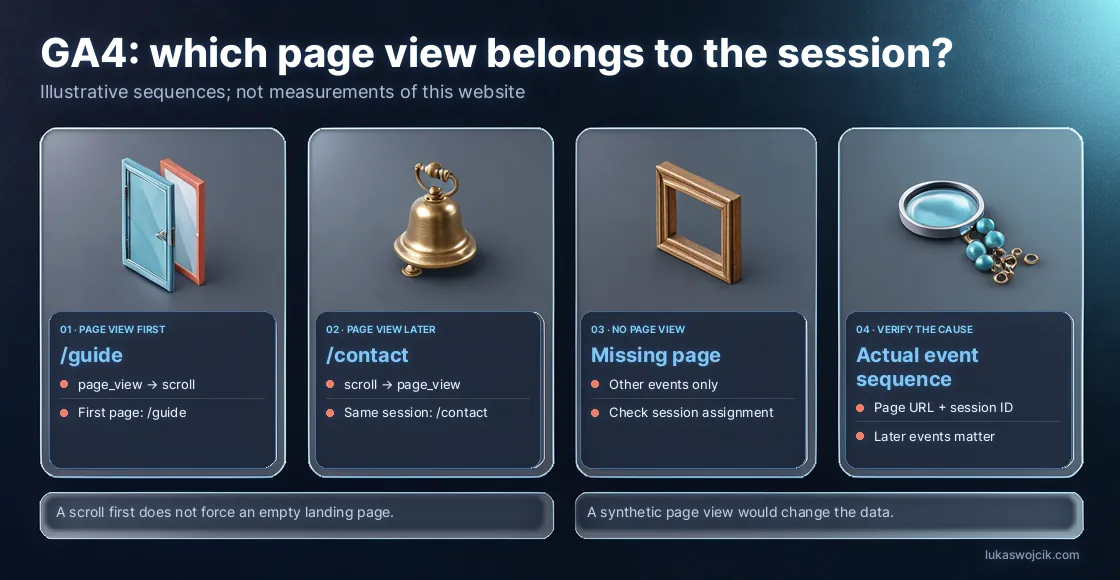
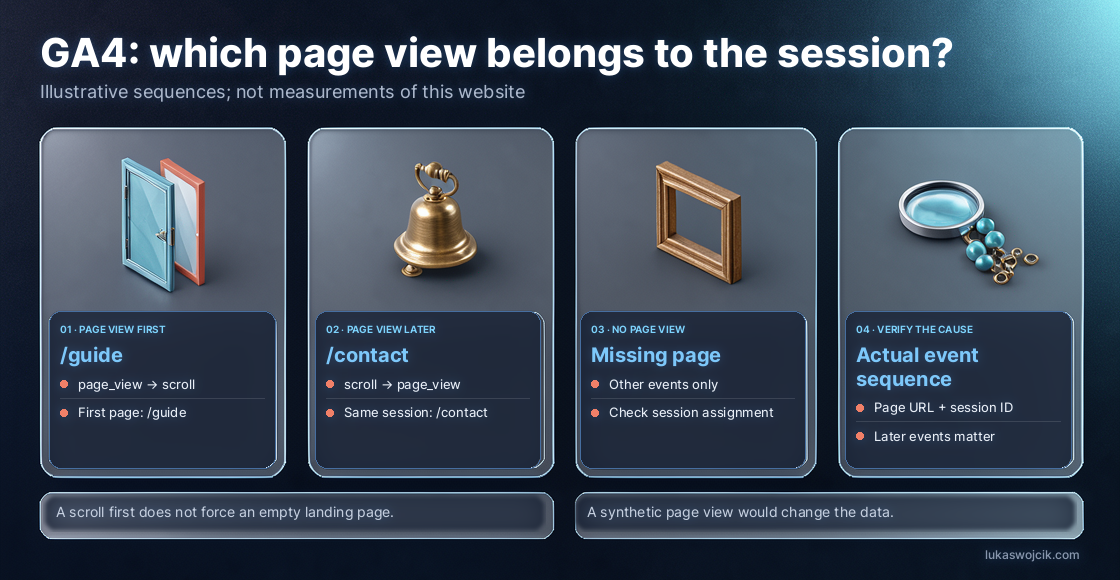
That distinction changes the diagnosis. An earlier scroll event does not by itself prove that the landing page must remain empty. A later page view belonging to the same session can supply the relevant page. The examples below illustrate the rule; no measurements of this website are claimed.
Three sequences with different meanings
page_view /guide, thenscroll: the first recorded page is /guide.scroll, thenpage_view /contactin the same session: /contact is the first page view, even though another event came first.- Events are recorded for a session, but no
page_viewbelongs to that session: the missing page view is a relevant explanation for an empty landing page.
These examples assume valid page information and correct session assignment. A page URL attached to a purchase or scroll event is not itself a page-view event. A missing landing page and a missing session source are also separate report problems.
Testing an open tab
A browser tab can remain open after the configured inactivity timeout. The default is 30 minutes. The next recorded interaction may occur without a navigation or reload. Whether a new session and a page-view event are recorded depends on the actual tagging and interaction. Returning to a tab is therefore a test scenario, not proof of the cause or its frequency. [3]
A controlled check records the event names, page URLs and session identifiers before and after the pause. It includes later navigation as well: stopping at the first scroll would miss a subsequent page view. The page visible on screen and the page views actually received by Analytics are different things.
Consent and page-view configuration
A setup can suppress the automatic page view and send one manually. If the manual call is missing or blocked while other events continue, the session may lack a page view. The check must establish whether each intended page display produces one permitted event; sending an extra event on every interaction would inflate page-view counts.
Google also documents consent implementation mistakes that can lose session information, including using default instead of update after a choice changes. That does not prove that every (not set) landing page has a consent cause. A report gap is no reason to override a refusal or invent a page visit. [2]
Server events need a real session association
The Measurement Protocol sends events from a server. A refund or recurring payment is not automatically a new page visit. For a web stream, association requires the appropriate client identifier and session identifier, rather than an invented identifier for each request. Session IDs are not added automatically by the Measurement Protocol. [3, 4]
Google’s session-attribution requirements include session_id and a request within 24 hours of the online session’s start. An explicitly supplied event timestamp must lie within that online session. This is not the same as the browser’s 30-minute inactivity timeout. These conditions do not justify changing the time of a later renewal to make an older session fit. [5]
A useful investigation has two levels
The report first establishes the affected period and number of sessions. Breaking events down by name can suggest where to investigate, but ten scroll events do not establish ten affected sessions or prove how a session began. A controlled browser test can inspect the actual sequence; historical investigation needs suitable retained event data.
In BigQuery, events can be grouped using the browser identifier user_pseudo_id together with ga_session_id. Missing identifiers must be reported separately. The selected dates must cover the relevant sequence; a session cut off at the query boundary can falsely appear to have no page view. Late arrivals can update daily tables for up to three days. Equal event timestamps also need care; available batch ordering fields can help. [3, 6]
The result should distinguish a confirmed missing page view, an incorrect session association and an unresolved case. A change is checked against the same scenario and a comparable period. Fewer sessions in the (not set) row are insufficient evidence of improvement if duplicate page views were introduced. No BigQuery query or property-specific test was executed for this article.
Questions and answers
Does a scroll as the first event force an empty landing page?
No. The relevant event is the first page view in that session. Later events and their session assignment need checking.
Should server events receive a synthetic page view?
Only a real page display should be represented as a page view. Adding a fictional view hides the gap and changes the meaning of the report.
Related articles