English
 Deutsch
 Polski
Micro-SaaS with n8n, Make or Custom Code: What Operation Really Costs

Contents
A workflow prototype becomes visible quickly. A sellable product also needs tenant separation, billing, failure handling and support. Comparing n8n, Make and custom code therefore requires the same customer task rather than a count of integrations.
One reference workflow
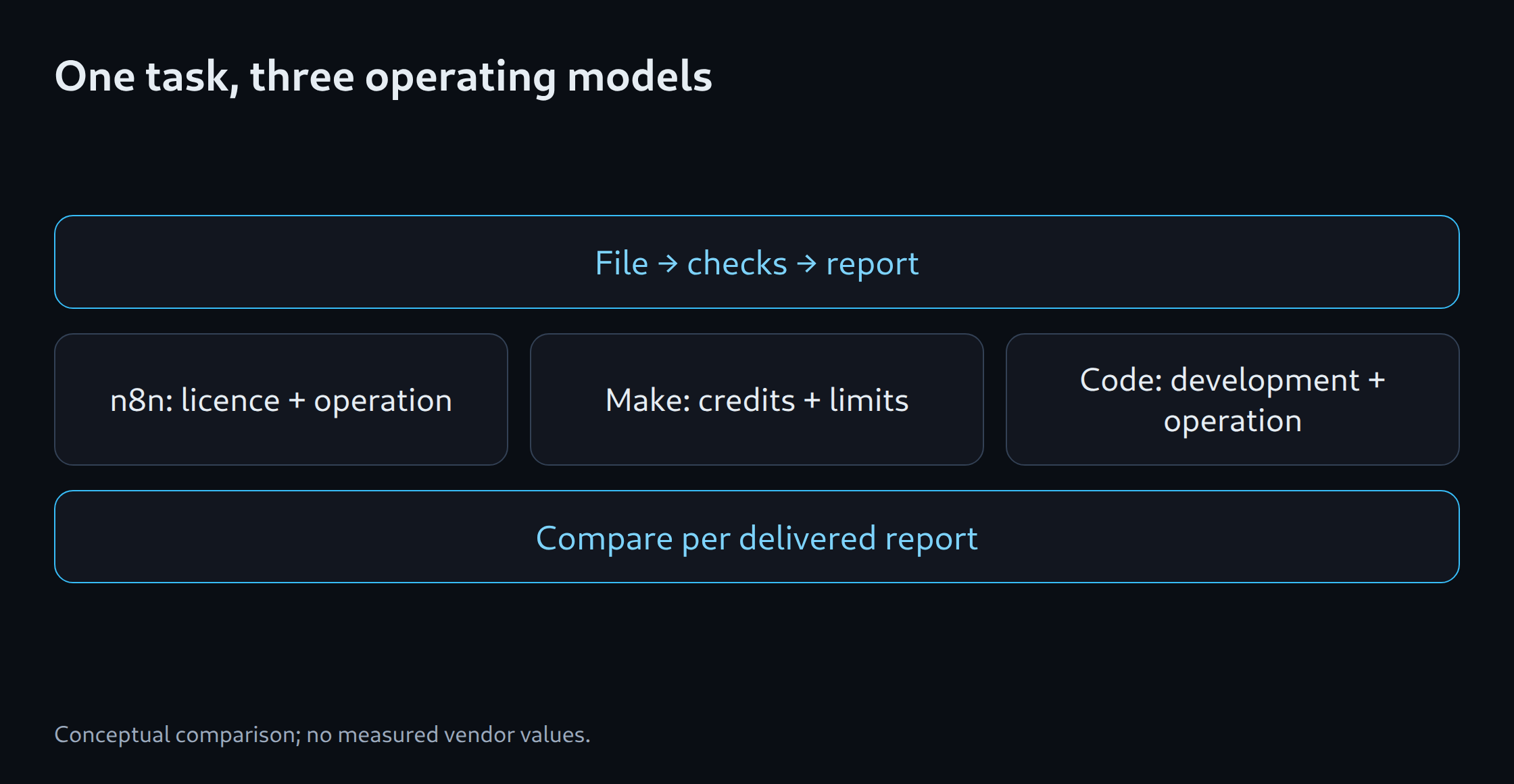
The assumed product accepts a product file, validates required fields, compares prices with a previous baseline and delivers a report. Every route uses identical sample files, expected results and size limits. Three completed implementations were not tested here; this is a design and evaluation protocol.
| Route | Strength | Check |
|---|---|---|
| n8n | Visible workflows, infrastructure control when self-hosted | Licensing, updates, credentials, isolation |
| Make | Managed platform and quick integrations | Credits, data volume, limits, exit |
| Custom code | Precisely defined processing and tests | Development, operation, dependencies, on-call work |
Licensing before architecture
n8n’s help distinguishes hosting client workflows and credentials from embedding with customer access, naming Enterprise and Embed respectively. Consulting on client-owned instances is treated separately. This is not blanket permission for every SaaS backend. The actual data and access routes must fit the agreed licence. [1]
Consumption per customer task
Make bills through credits. Consumption depends on the modules and processing; AI and code steps can count differently. A statement such as “ten steps” is not a cost forecast. [2]
Assuming eight billable actions per record across 500 records gives 4,000 actions before retries or branches. This is synthetic volume arithmetic, not a measured Make bill or a general rule for credit conversion.
Failure handling defines the service
Evaluation needs an empty file, missing fields, a timeout after saving a result, a duplicated job and revoked access. A stable job identifier helps avoid duplicate processing. Repeated delivery must not silently duplicate billing. Logs need customer attribution without unnecessary full raw data.
The protocol records development hours, successful jobs, retries, platform consumption, support and recovery time. Only a delivered complete report counts as service. Custom code also carries update, monitoring and on-call costs.
Choosing a route
A platform can simplify a bounded integration pilot. Specific validation rules, large datasets or strict isolation justify comparing custom code. A hybrid can keep customer jobs and billing in the backend while using a platform for selected integrations. The common reference task, rather than tool preference, supplies the decision.
Related tools
Questions and answers
Is self-hosted n8n automatically free for SaaS use?
No. Hosting capability and commercial licensing are separate questions. Customer workflows and access need specific review.
Was a speed winner measured?
No. The article defines a comparable evaluation protocol rather than reporting runtime tests.
Sources
Sources checked: 5 October 2026.
Related articles