English
 Deutsch
 Polski
Compare AI Model Costs: Cloud APIs or Local DeepSeek and Qwen?

Contents
The lowest token rate does not automatically produce the cheapest completed task. Retries, reasoning budgets, tools and editing change the calculation. This comparison, dated 6 October 2026, combines current API rates with a separate assessment of local DeepSeek and Qwen variants.
A transparent rate comparison
The example assumes one million uncached input tokens and 200,000 billable output tokens in total, distributed across short individual requests. Billable output must include reasoning tokens. Figures are USD before tax, tools, caching, batch or special discounts. OpenAI uses the standard short-context column. [10]
| Model | Input / output per million | Example total |
|---|---|---|
| GPT-6 Astra | 10 / 50 USD | 20 USD |
| GPT-6.1 Sol | 2 / 10 USD | 4 USD |
| Claude Opus 5.5 | 4 / 20 USD | 8 USD |
| Claude Sonnet 5.5 | 2 / 10 USD | 4 USD |
| Gemini 3.8 Flash | 0.75 / 3.75 USD | 1.50 USD |
| DeepSeek V4.1 Flash, peak | 0.30 / 1.20 USD | 0.54 USD |
| DeepSeek V4.1 Flash, off-peak | 0.15 / 0.60 USD | 0.27 USD |
Claude rates come from the model overview. Google’s listed standard rate applies through the end of 2026 according to its pricing page. DeepSeek distinguishes peak and off-peak; actual usage needs the applicable billing period. The calculation compares equal token quantities, rather than equal quality or measured speed. [3, 11, 13]
No universal rate for open weights
A local Qwen model has no fixed API token price. Its calculation includes allocated hardware cost, electricity, maintenance and possible downtime. DeepSeek weights are also available, but the complete model may require a different infrastructure class. A small active parameter count does not turn a downloadable MoE model into a small desktop model. [7, 8]
An explicitly assumed example uses 50 euros in monthly hardware cost, 20 euros in electricity and 30 euros in maintenance effort. At 1,000 accepted tasks this equals 0.10 euros per task. This euro figure is not directly comparable with the USD rate table without equal task and quality conditions.
Including quality in the calculation
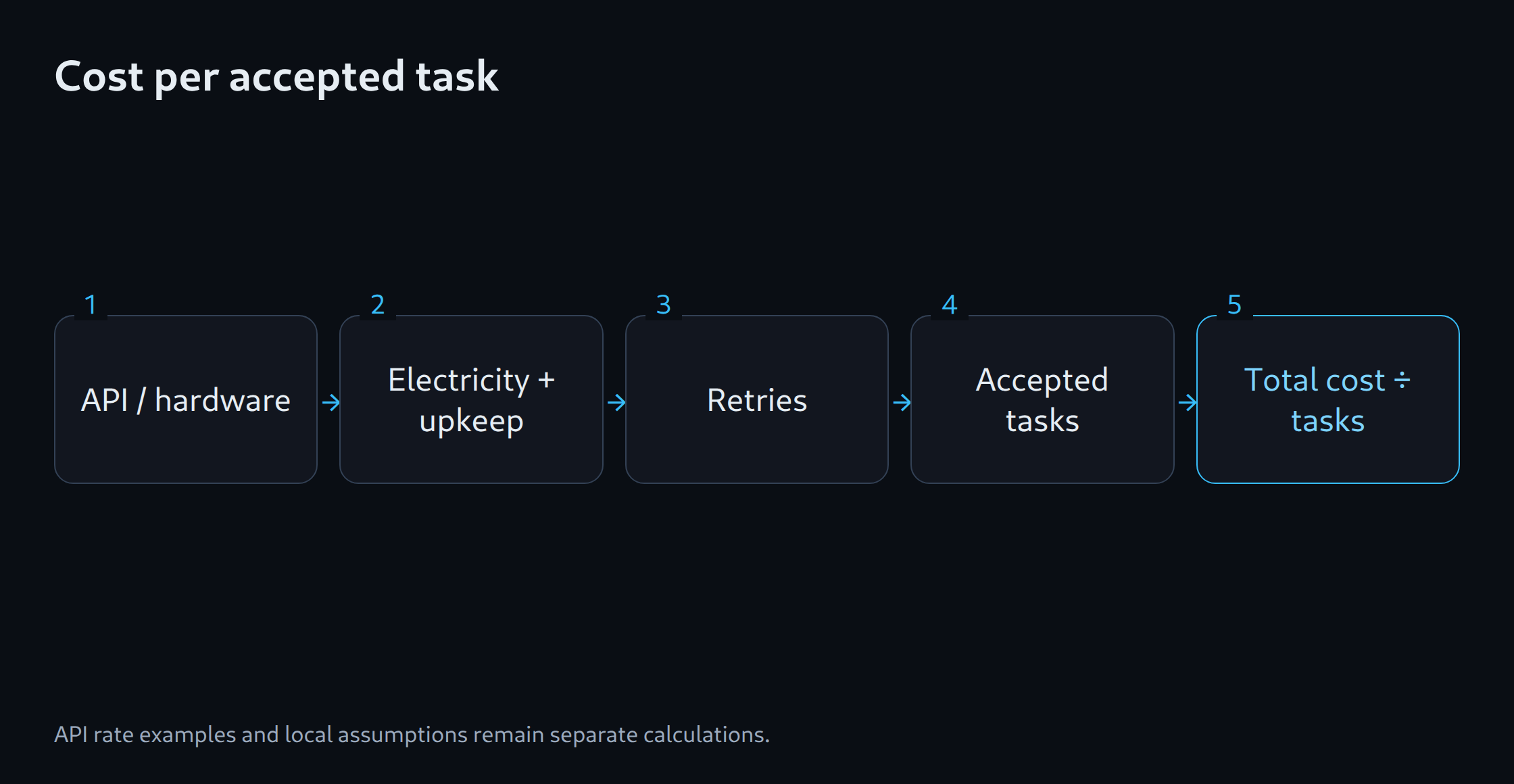
The metric is total cost divided by accepted tasks. Failed answers increase retries and correction time. A more expensive candidate may consequently be more economical. Conversely, a smaller local checkpoint may suffice for simple frequent tasks. This is an operating hypothesis to evaluate rather than a measured value-for-money ranking.
A mixed deployment
A pilot may handle routine tasks locally and route defined difficult cases to a cloud API. Routing belongs in the log. Ollama’s cloud features also demonstrate why runtime name and data location need separate checks. [9]
The existing cost calculator supports local assumptions, while the model test log records acceptance and errors. Together they enable an auditable decision. Rates and model versions need another check before later publication.
Related tools
Questions and answers
Are the example totals monthly subscription prices?
The totals describe assumed API token quantities under the specified rate conditions. Chat subscriptions and local operating costs use different calculations.
When is a local model cheaper?
Utilisation, allocated hardware cost, electricity, maintenance and accepted results determine the answer. A low electricity rate alone is insufficient.
Sources
- OpenAI: model catalogue
- OpenAI: GPT-6.1 Sol
- Anthropic: Claude model overview
- Anthropic: Claude Opus 5.5
- Anthropic: Claude Sonnet 5.5
- Google: Gemini 3.8 Flash
- DeepSeek: V4.1 Flash model card
- Qwen: Qwen3.8-27B model card
- Ollama: FAQ and local/cloud operation
- OpenAI: API pricing
- DeepSeek: models and pricing
- Google: document understanding
- Google: Gemini API pricing
Sources checked: 6 October 2026.
Related articles