English
 Deutsch
 Polski
Analytics Advisor in GA4: Two Names, Still Beta, and English-Only Properties

Contents
Google unveiled two conversational assistants at Marketing Live in May 2025 and switched them on for all English-language accounts in early December. The Analytics one answers questions about a property in natural language, runs on Gemini, and is described as agentic: it decides for itself which reports to consult before answering.
Nine months into general availability, the help page describing it is worth reading closely, because three of its sentences carry more weight than the feature description does.
Two names for one thing
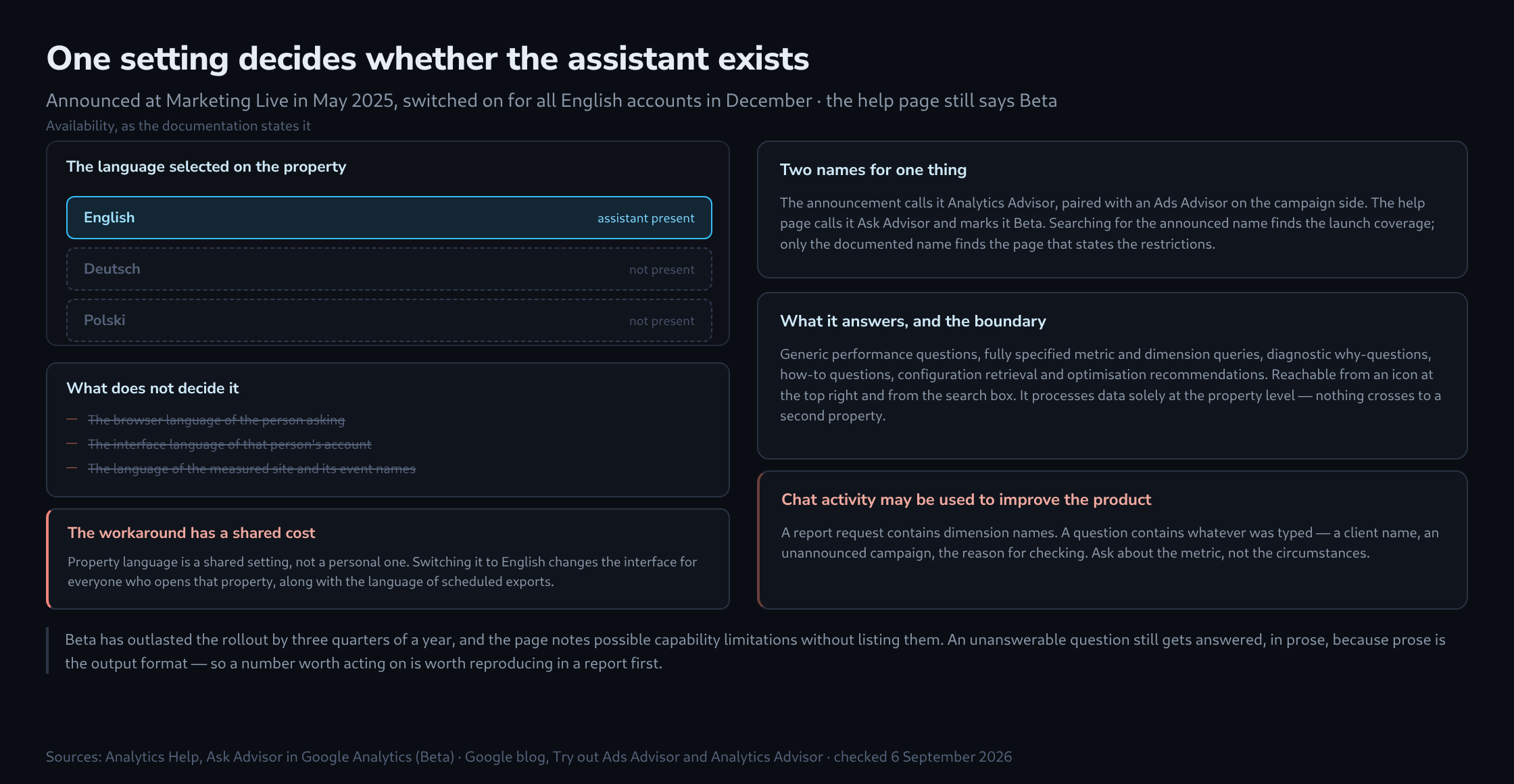
The announcement calls it Analytics Advisor, paired with an Ads Advisor on the campaign side. The help page calls it Ask Advisor and marks it Beta.
This is a small thing that costs real time. A search for the announced name finds blog coverage and the launch post; a search for the documented name finds the page that states the restrictions. Anyone trying to establish what the feature actually does, rather than what it was said to do at launch, needs the second name, and nothing in the first one points to it.
The setting that decides whether it exists
The documentation states that the assistant is available in properties with English as the selected language, with expansion to other languages planned. That single sentence is the whole availability rule, and its subject is worth reading twice.
It is not the browser language. It is not the interface language of the person asking. It is not the language of the site being measured or of the event names inside it. It is the language selected on the property.
For a property configured in German or Polish, the assistant is therefore not present at all — not empty, not limited, absent. And because the property language is a shared setting rather than a personal one, the obvious workaround has a shared cost: switching it to English to gain the assistant changes the interface for everyone who opens that property, along with the language of scheduled exports and anything else that follows the setting.
That trade is worth stating plainly rather than discovering. On a property with one owner it is a preference. On a property that several teams or several agencies work in, it is a change that belongs in a conversation before it happens.
What it answers where it exists
The documented range is broader than a query builder and narrower than an analyst.
Generic performance     "How is the site doing"

Fully specified         a named metric over a named
                        dimension and period

Diagnostic              "why" questions - what drove a
                        rise or a fall

How-to                  questions about the product's
                        own features

Configuration           retrieving how the property is
                        currently set up

Recommendations         optimisation suggestions
It is reachable from an icon in the top right of the property and from the search box, which means it sits alongside navigation rather than inside a report.
The boundary is the property
The documentation is explicit that the assistant processes data solely at the property level. Everything answerable is answerable from inside one property, and nothing crosses the boundary to another.
For a single-property setup this is invisible. For a group running one property per market or per brand, it is the limit that decides how much of the routine reporting it can absorb: any question of the form “which of our markets moved” has to be assembled outside it, in exactly the way it was before.
The sentence about chat activity
The page states that chat activity may be used to improve the product, and that use is subject to Google’s terms, AI use policy and privacy policy. This is a routine disclosure, but it applies to an interface that accepts typed prose rather than a dimension selection. That changes the kinds of information entered into it.
A report request contains dimension names. A question contains whatever was typed: a client’s name, an unannounced campaign, an internal target, the reason a figure is being checked. The data in the property is governed by the property’s own agreements. The question about that data is a separate artefact with a separate disclosure attached.
The habit that follows is simple and costs nothing: ask about the metric, not about the circumstances. Why did key events fall last week gets the same answer as the version that names the client and the reason for asking, and only one of the two puts those into a chat log.
What Beta means after nine months
The label has outlasted the rollout by three quarters of a year, which suggests it describes the state of the capability rather than the state of the release. The page says as much in its own way, noting that the assistant may have capability limitations without listing them.
An undocumented limitation set is the practical problem here, not the label. A question that cannot be answered will be answered anyway, in prose, because prose is the output format. The check is therefore the same one that applies to any generated figure: a number worth acting on is worth reproducing in a report before it is acted on. That is not distrust of the tool. It is what makes it usable at a point where nobody can say precisely where its edges are.
Questions and answers
Is an additional property set to English a workable way around the restriction?
Only for the future. A new property starts without data, the history of the existing one cannot be copied across, and because the assistant works solely inside one property, it sees nothing of the old one there. Then there is the double upkeep: key events, filters and links have to be set up in both properties and kept identical, or the assistant answers questions about a property that measures differently from the one being reported on.
Does it help if all markets sit in the same account?
No. In GA4 an account is an organisational container; the data lives in the properties, and the assistant stops at their boundary. Data merged from several properties exists only in a roll-up property, a feature of Analytics 360, and whether the assistant is available there would have to be checked before any planning.
How can an answer from the assistant be reproduced in a report?
Most easily if the question was already asked in the fully specified form: a named metric over a named dimension and a named period. Those three elements can be carried over one to one into an exploration or a standard report, and the figure should reappear there.
Diagnostic answers take more work. An answer to the question of what drove a fall names causes, such as a channel, a device or a page. Each of these is a claim about a dimension and can be checked on its own: the check is a comparison of the period with the previous one, split by the dimension named, to see whether the fall really sits there and how large it is.
If an answer names neither a metric nor a dimension nor a period, it cannot be reproduced, and that is a finding in itself. The question is then worth asking again in the fully specified form before anything is done on the strength of the answer.
Related articles