English
 Deutsch
 Polski
Laptop, Mini PC, GPU Tower or AI Workstation: Which Devices Suit Local LLMs?

Contents
The best device for a local LLM depends on its intended operation. A notebook for occasional summaries, a development GPU tower and a compact workstation for large models solve different problems. The largest memory figure alone does not settle the comparison.
This assessment uses documented hardware and backend properties without original device benchmarks. Response latency, noise and electricity consumption therefore need verification for the actual configuration.
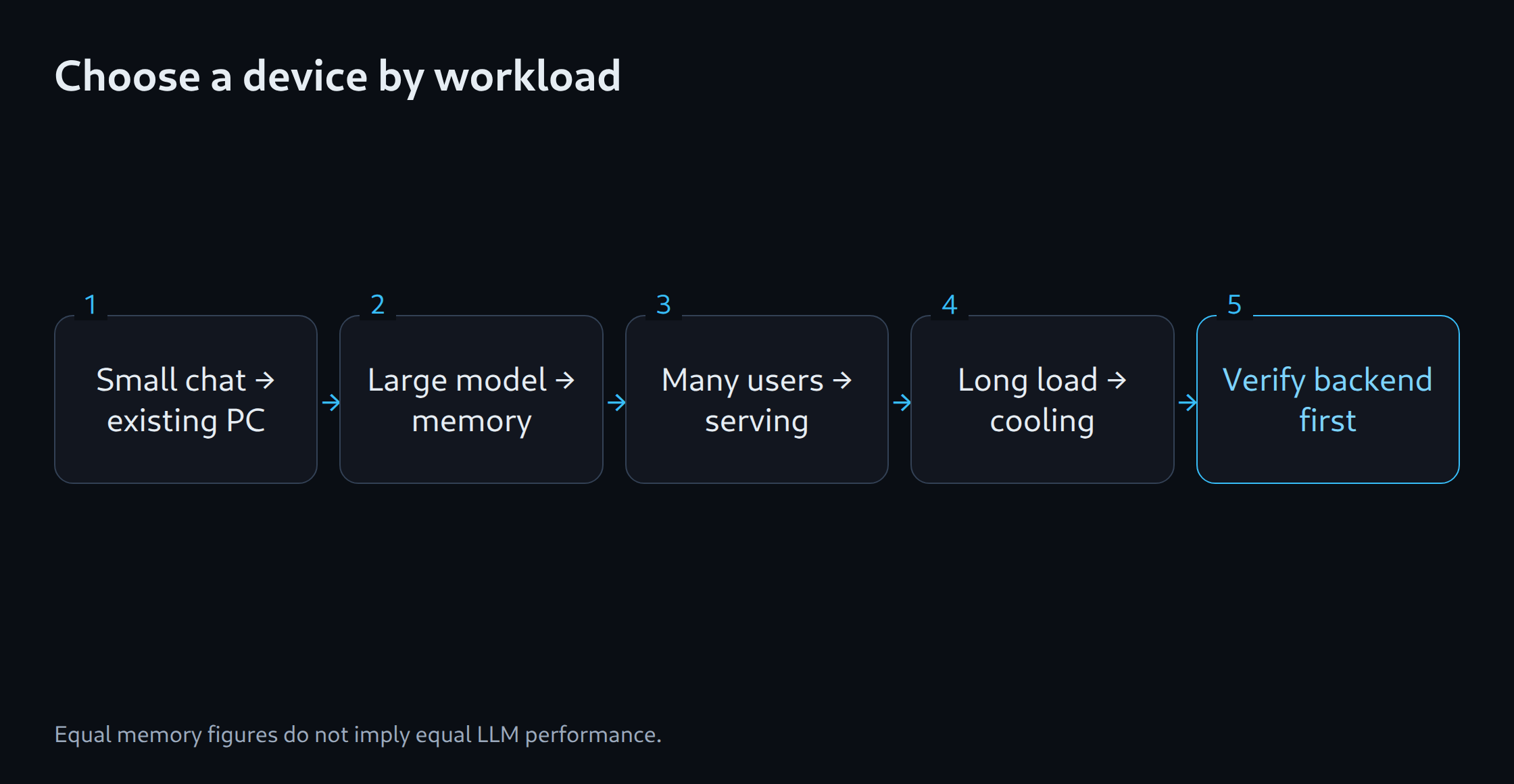
Device classes by workload
| Class | Suitable scenario | Common constraint |
|---|---|---|
| CPU laptop / mini PC | Introduction and small models | Response speed and RAM |
| Apple Mac mini / Studio | Compact unified-memory desktop | Configuration and later upgrades |
| AMD Ryzen AI Max+ system | Memory-rich compact computer | Device-specific backend path |
| GPU tower | Flexible development and expansion | VRAM, power supply and space |
| NVIDIA DGX Spark | Compact CUDA workstation | ARM software and throughput profile |
RAM, VRAM and unified memory
A discrete graphics card has its own memory pool. System RAM can supplement a large model without becoming equivalent local VRAM. Partial CPU execution remains a different workload. The runtime must support the intended split.
Unified memory is shared by CPU, GPU and other processes. Apple, AMD and DGX Spark have distinct platforms and software paths. Equal capacity does not mean equal bandwidth, free GPU capacity or speed. System and runtime headroom still belong in the budget.
Assess compact devices specifically
Apple documents Mac Studio with M5 Max or M5 Ultra; M6 currently belongs to Mac mini. Depending on configuration, Studio offers substantially more memory than small entry-level devices. Loading large models and generating answers quickly remain different properties.
AMD describes Ryzen AI Max+ 395 systems with up to 128 GB unified memory and configuration-dependent graphics allocation up to 96 GB. The actual computer, firmware and runtime matter. NVIDIA documents DGX Spark with 128 GB shared memory. Its ARM platform also needs compatible packages and containers.
A tower offers replaceable components
A GPU tower allows graphics cards, memory, cooling and power supplies to change within platform limits. This helps when requirements evolve. Total cost nevertheless includes chassis, power provision and possible noise rather than the GPU price alone.
Multiple GPUs provide deliberate expansion rather than automatic memory pooling. Distribution and interconnects must match the runtime. A suitable single GPU can be simpler for one session than an ill-matched multi-GPU system.
A workload decides more than a brand
For occasional chat, testing a small model on existing hardware is the most useful starting point. Long documents raise state and cache requirements. Multi-user operation adds queue and latency checks. Coding also requires answer-quality assessment alongside speed.
A Raspberry Pi can support small experiments or act as a gateway when memory and response time fit. Larger interactive models should not be assumed to reach desktop performance. The memory estimator supplies an initial shortlist; a representative task test determines actual suitability. A hardware purchase follows an identified limit of the existing device.
Memory planning for model selection: LLM VRAM estimator.
Related tools
Questions and answers
Is a Raspberry Pi suitable for local LLMs?
Small models can support learning and experimentation on a Pi. Larger models and sustained interactive workloads require a separate assessment of memory and response speed.
Is an AI mini PC with plenty of RAM automatically better than a GPU?
Memory capacity determines only part of suitability. Bandwidth, supported backends, model architecture and sustained load affect practical performance. A comparable workload is necessary for a defensible choice.
Sources
- Apple: Mac Studio M5 Max / M5 Ultra – technische Daten
- Apple: Mac mini M6 und Mac Studio M5 verfügbar
- NVIDIA: DGX Spark Hardware Overview
- Ollama: Hardware support
- llama.cpp: Projekt und Backends
- AMD: Ryzen AI Max+ 395 und Unified Memory
Sources checked: 5 October 2026.
Related articles