English
 Deutsch
 Polski
What Can Gemini 4 Argon Do? Practical Uses and Limits

Gemini 4 Argon is Google’s model for work that needs more than a short answer: examining extensive documents, changing software across several steps, or bringing together information from text, images, audio and video. Google’s model card also names mathematical and scientific problems. None of these capabilities guarantees a correct result. Practical value depends on the task, the available tools and an output that can be checked. [1][3]
This overview reflects the documentation available on 20 October 2026. It does not claim independent comparative benchmarks or completed client projects with Argon.
Where Gemini 4 Argon is available
Google says Argon has been available in the Gemini app for Google AI Pro and Ultra subscriptions since 13 October. Google AI Studio and the Gemini API provide developer access under the model ID gemini-4-argon. The model card also lists business offerings, Antigravity and AI Mode in Search. Availability, usage limits and interface features differ across these routes. [1][2][4]
The app or AI Studio is a reasonable starting point for a single analysis. A repeatable workflow with private data sources, a fixed output format and logging generally calls for an API integration. That distinction concerns workflow design rather than an assumed quality ranking of the interfaces.
Four practical areas of use
Software development: Argon can investigate faults across files, suggest tests, draft changes and break a migration into stages. A useful task supplies the relevant repository, runtime, expected behavior and existing tests. Compilation, tests and code review remain necessary before accepting a change. Google explicitly identifies complex software engineering as a target area. [1][3]
Documents and research: Several reports, contracts or technical specifications can be compared. A table of claims, source locations and contradictions is often more useful than a smooth summary. The API accepts PDF input. Citations in the generated answer still need checking against the original pages; fluent writing does not establish a reliable source. [1][3]
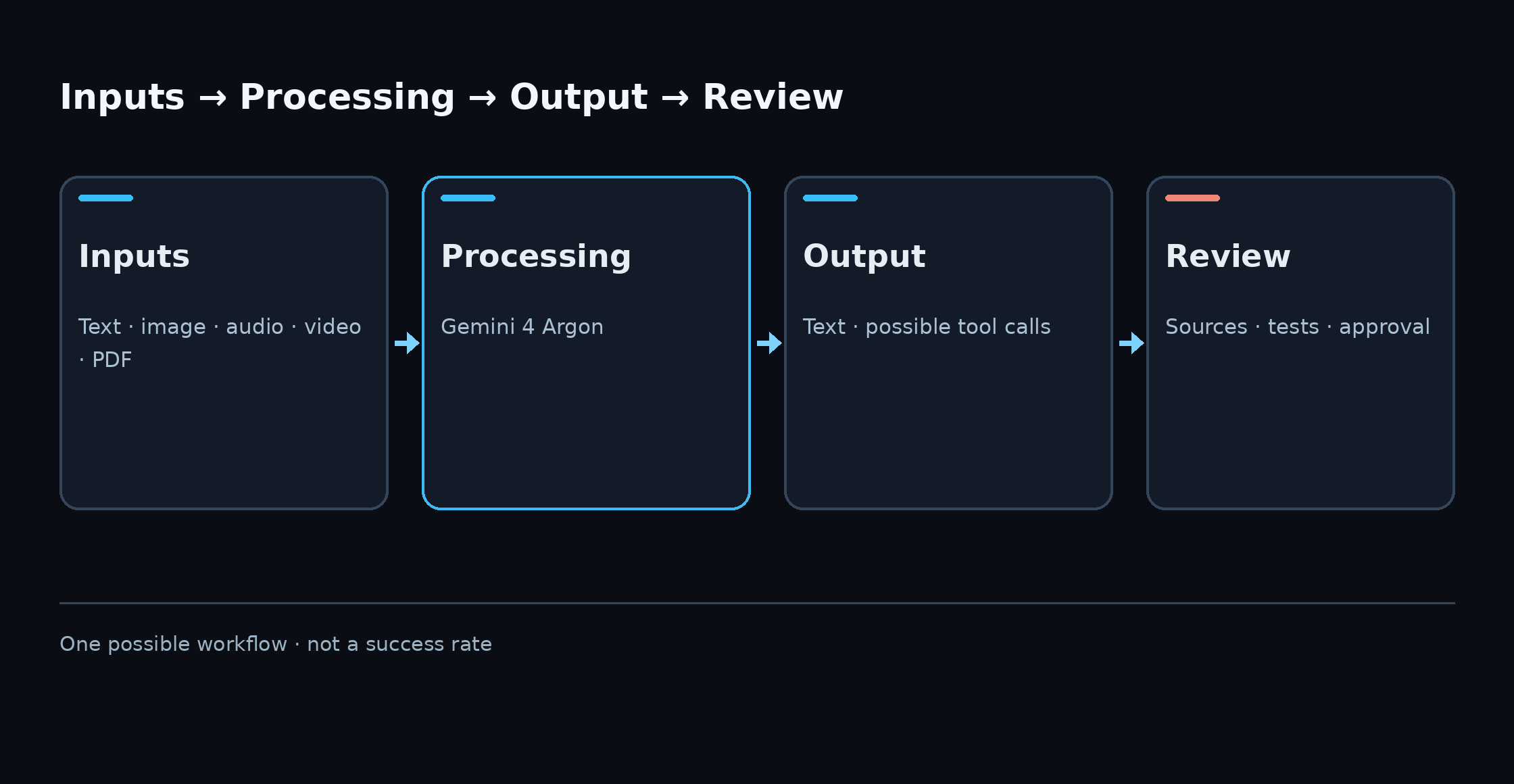
Multimodal analysis: Google’s model page lists text, images, audio, video and PDFs as inputs. Screenshots, charts or a recorded process can therefore be considered alongside written requirements. Argon’s output is text. The current model page does not list image generation, audio generation or Live API support for Argon. [1]
Multi-step workflows: The API supports function calling, structured output, code execution, search grounding and URL context. An application can combine retrieval, calculation and a defined result format. The integration and its permissions determine which external actions actually occur. Narrowly scoped tools, logs and approval points help when actions have consequences. [1]
What the million-token window means
Google specifies a shared limit of 1,048,576 tokens for input, internal thinking and output. This is capacity for large tasks, not a promise that every detail in a long document will be recalled or weighted correctly. The default synchronous output ceiling is 65,536 tokens. Longer output up to the shared limit requires the documented long-decode process with background execution. [1][2]
A large context can avoid splitting a substantial case file or codebase into many separate requests. Clear subquestions, filenames and requested source locations still improve the audit trail. For conflicting material, a concise evidence list often carries more value than an extremely long answer.
Limits, latency and cost
The model card lists hallucinations and occasional slowness or timeouts among known limitations. Its knowledge cutoff is March 2026, and knowledge in some domains may be older. Recent developments therefore require fresh, verifiable sources rather than an answer drawn only from model memory. [3]
For the API, Google lists introductory rates through 30 November 2026 of US$2 per million input tokens and US$10 per million output tokens. From 1 December, the stated rates are US$4 and US$20. Output billing includes thinking tokens. Implicit caching may lower repeated-prefix costs, while explicit caching is unsupported. Google does not offer Argon on the free API tier. These are API prices, not subscription prices for the Gemini app. [2]
Deeper reasoning and long contexts can increase processing time and expense. The API offers low, medium and high thinking levels, with medium as the default. For frequent routine work, the same sample task should be compared across settings and against a smaller model. Error rate, latency and total workflow cost matter more than a general model ranking. [2]
A reproducible first test
A short evaluation using approved sample data offers more evidence than a promotional example. Three tasks cover distinct strengths: a known software bug with executable tests, two documents containing a deliberate contradiction, and a chart with questions about axes and scale. Expected facts, permitted sources, elapsed time and cost can be specified in advance.
For code, the useful measures are passing tests and a readable diff. For documents, correct source locations and detected contradictions matter. For images, conclusions must follow visible evidence rather than plausible guesses. A second check against the input remains necessary where an error could have professional or financial consequences.
Gemini 4 Argon is therefore most relevant to demanding analysis and drafts whose results can be verified. The same model effort may be unnecessary for a short routine question. The task and review process determine the value.
Questions and answers
Can Gemini 4 Argon generate images?
The current API model page lists images as input but does not list image generation for this model. Argon produces text. Other Gemini models or product features may differ.
Is the million-token context also the normal answer length?
No. The million-token limit is shared by input, thinking and output. Synchronous answers have a default output limit of 65,536 tokens; longer output requires the separate background process.
Are model answers enough for recent facts and consequential decisions?
Recent facts require current, checked sources. The model card gives a March 2026 knowledge cutoff and notes possible hallucinations. Consequential work requires checking the evidence and the result.
Sources
- Google AI for Developers: Gemini 4 Argon model page
- Google AI for Developers: latest model, API, pricing and migration
- Google DeepMind: Gemini 4 Argon Model Card
- Google Blog: Gemini app availability, 13 October 2026
Sources checked: 20 October 2026. Product claims and prices come from Google. No independent performance or quality measurement is claimed.
Related articles