Meta Conversions API: Maximizing Event Match Quality (EMQ) and Deduplication
Part 6 of 6 in the series From pixel to server: tracking that holds
Contents
Meta Conversions API: Maximizing Event Match Quality (EMQ) and Deduplication
In modern server-side analytics, deploying the Meta Conversions API (CAPI) alongside the browser-based Meta Pixel requires precise data engineering. The primary objective is to maximize Event Match Quality (EMQ)—the metric indicating how accurately incoming server events can be matched to active Meta user accounts—while implementing seamless event deduplication to prevent double-counting conversions. Achieving high EMQ without violating strict data privacy regulations like GDPR requires advanced server-side data normalization, cryptographic hashing, and structured identifier pairing.
1. Advanced Server-Side PII Normalization and SHA-256 Hashing
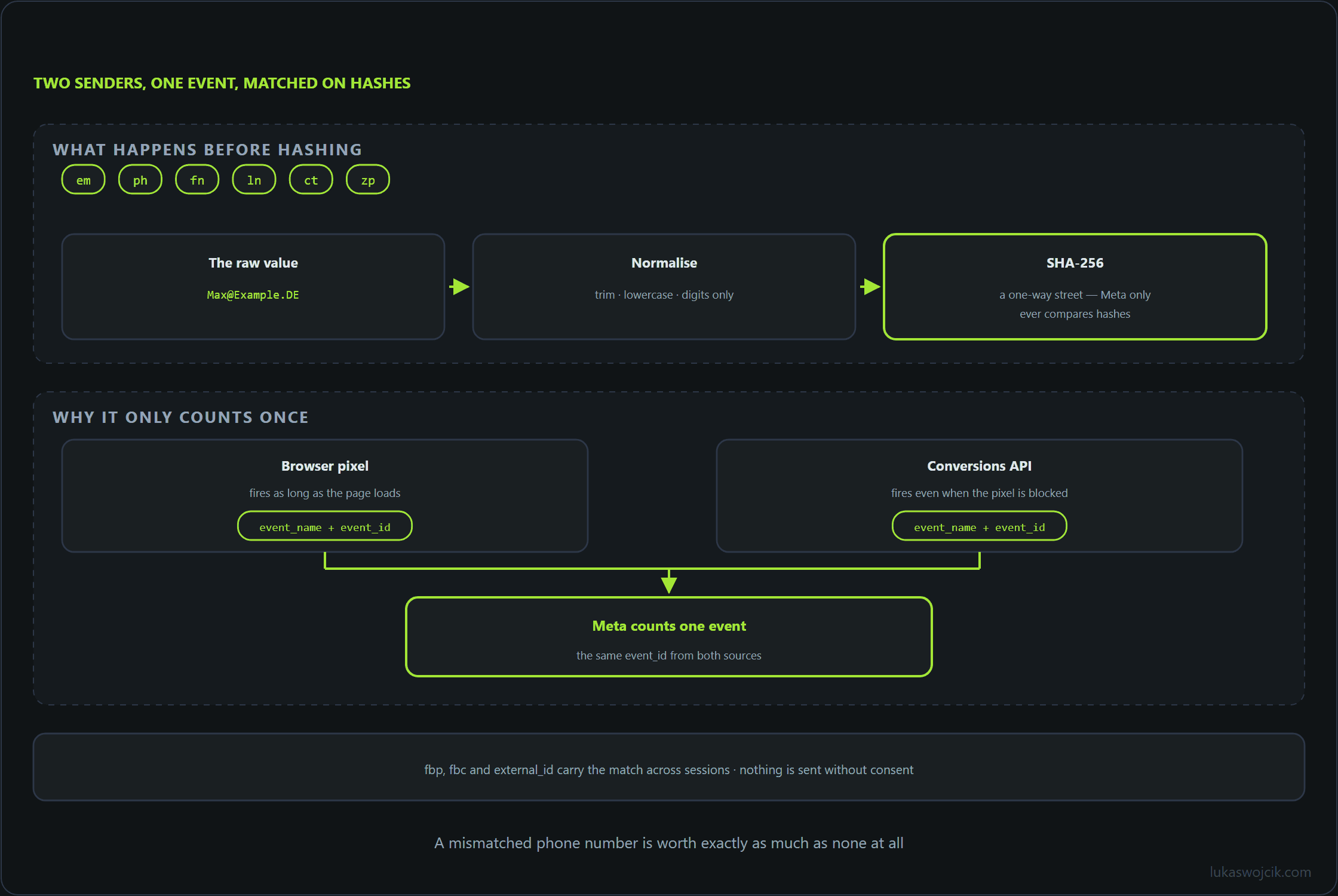
Meta requires all Personally Identifiable Information (PII)—such as email addresses, phone numbers, names, and postal codes—to be transmitted as SHA-256 cryptographic hashes. However, hashing raw user input directly in the browser or on the server without prior normalization leads to severe match failures. A single trailing whitespace or an uppercase letter produces a completely different SHA-256 digest than Meta’s normalized database records.
To guarantee optimal match rates, a server-side analytics pipeline (e.g., Server-Side Google Tag Manager) must execute strict normalization routines prior to applying SHA-256 hashing:
- Email Addresses (
em): Convert all characters to lowercase, trim leading and trailing whitespaces, and remove any invisible Unicode symbols before hashing. - Phone Numbers (
ph): Strip all symbols, hyphens, spaces, and leading zeros. Phone numbers must contain only numeric digits formatted according to the international E.164 standard (including the country code, such as48...or49...) prior to hashing. - Names and Geographic Data (
fn,ln,ct,zp): Convert to lowercase, remove punctuation and special accents where applicable, and trim extraneous whitespace.
// Example: Server-side normalization logic prior to SHA-256 hashing
const normalizeEmail = (rawEmail) => {
  return rawEmail.trim().toLowerCase();
};

const normalizePhone = (rawPhone) => {
  // Strips all non-digit characters and ensures leading country code
  return rawPhone.replace(/\D/g, '');
};
2. Flawless Event Deduplication via event_id and event_name
Best practices dictate sending conversion events simultaneously via the browser Pixel and the server-side Conversions API. This dual-channel approach ensures data resilience against ad blockers and network failures. To prevent Meta from recording two purchases for a single transaction, the deduplication engine relies on exact parameter pairing.
Every event payload sent across both channels must include an identical event_name and a shared, cryptographically unique event_id. When Meta’s processing servers receive both payloads within a 48-hour window bearing the exact same event_id, the redundant event is automatically discarded while retaining the enriched user parameters from the server payload.
- ID Generation: The
event_idshould be generated dynamically in the browser (e.g., using UUIDv4 or a composite timestamp-random string) during the initial conversion trigger and passed identically to both the Pixel tag and the server-side transport tag. - Timing Consistency: Both browser and server events must reach Meta’s endpoints in close temporal proximity to ensure immediate deduplication in reporting dashboards.
3. Leveraging external_id in GDPR-Compliant Environments
In strict European privacy environments governed by GDPR, relying solely on third-party tracking cookies (fbp and fbc) is often insufficient due to consent restrictions and cookie expiration policies. The external_id parameter offers a resilient, privacy-safe alternative for cross-device identity resolution.
The external_id represents a permanent, unique customer identifier assigned by a backend CRM, e-commerce database, or loyalty system. When transmitted to Meta CAPI:
- Consent Gating: The transmission of any PII, including SHA-256 hashed
external_idvalues, must remain strictly gated behind explicit user consent (e.g., advertising consent signals managed via Consent Mode v2). - One-Way Cryptographic Hashing: The internal customer ID must never be sent in plain text. Hashing the identifier ensures that Meta can match the profile against existing user graphs without exposing underlying CRM database structures.
- Cross-Session Continuity: Incorporating a hashed
external_idallows Meta to attribute conversions accurately even when a user switches from a mobile browser to a desktop device weeks after the initial ad interaction.
Summary
Maximizing Event Match Quality in the Meta Conversions API requires disciplined data engineering. Normalizing and hashing PII strictly on the server, pairing identical event_id values across browser and server streams for deduplication, and integrating hashed external_id parameters under GDPR-compliant consent controls ensure superior attribution accuracy and marketing performance.
From pixel to server: tracking that holds
- The Evolution of Web Tracking: From Log Files to the Server-Side Future
- Implementing Google Tag Gateway: A Complete Guide
- GA4 & Server-Side GTM: The “Migrate from JavaScript Managed Client ID” Feature Explained
- Server-Side GTM on GCP Cloud Run: Architecture, Auto-Scaling, and Cost Optimization
- GA4 Measurement Protocol: Server-Side CRM Offline Conversion Integration
- Meta Conversions API: Maximizing Event Match Quality (EMQ) and Deduplication
Related articles