CCTV Cabling: PoE Compared With Coax for Security Installations

Contents
When planning a CCTV system, whether for a small home or a sprawling commercial complex, the most critical decision comes before the cameras are even picked out. The backbone of the security infrastructure—the cabling—determines how flexible, scalable, and high-quality the system will be.
For decades, traditional Coaxial (COAX) cables were the industry standard. However, the surveillance landscape has fundamentally shifted. Today, Power over Ethernet (PoE) IP camera systems have become the undisputed champions of modern security. Here is why configuring and deploying a PoE-based CCTV system is infinitely superior to legacy COAX setups.
1. Unmatched Scalability and Expandability
The biggest drawback of a COAX system is its rigid architecture. Every single analog camera requires a dedicated, direct cable run all the way back to the central Digital Video Recorder (DVR). Adding three cameras to the far side of a warehouse means running three separate cables across the entire building.
PoE changes this completely by utilizing standard IT network infrastructure. With PoE, a single Ethernet cable (like Cat5e or Cat6) runs to a central point in that warehouse, feeds a PoE switch, and branches out to the new cameras from there. This network-based topology allows for near-infinite expandability. As security needs grow, the network scales with them without massive rewiring projects.
2. Superior Image Quality and Smart Features
Analog signals sent over COAX cables are highly susceptible to interference, signal degradation over long distances, and ground loops, all of which result in static or rolling lines on the footage.
PoE IP cameras transmit digital data. This means the image is processed on the camera itself and sent as a pure data stream to the Network Video Recorder (NVR) or server. The advantages include:
- True 4K (and beyond) resolutions: Without the bandwidth limitations of analog cables, IP cameras deliver crystal-clear, high-definition footage.
- Lossless transmission: The digital signal remains perfect regardless of minor environmental interference.
- Edge AI computing: Modern PoE cameras can process advanced analytics (like facial recognition, license plate reading, and smart vehicle detection) right on the device, sending only the relevant alerts through the network.
3. Simplified Configuration and Deployment
The brilliance of PoE lies in its name: Power over Ethernet. A single cable delivers both the data connection and the electrical power required to run the camera.
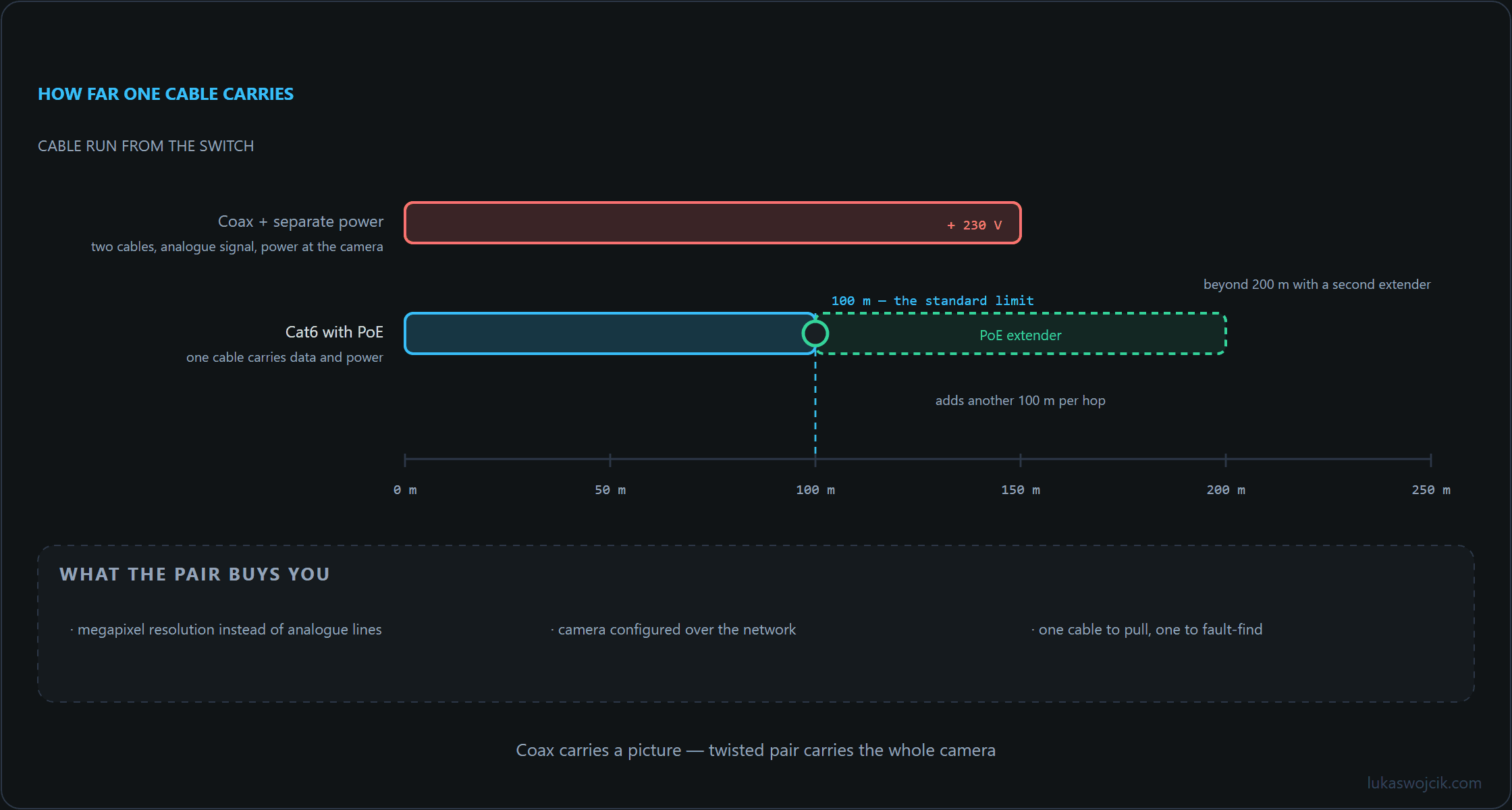
A traditional COAX setup often needs a “Siamese” cable (a combined coax and power wire) plus an adequate power supply box or wall outlet near the camera locations. With PoE, a standard PoE switch or NVR powers the cameras directly. This cuts installation time in half, reduces material costs, and makes configuring the network incredibly straightforward.
Pushing the Limits: The Power of PoE Extenders
Standard Ethernet cables have a physical data transmission limit of 100 meters (about 328 feet). In large installations, cameras may sit further away than this limit allows. This is where PoE Extenders and passthrough switches come into play, making PoE even more versatile.
Instead of running fiber optics or setting up new electrical outlets, a PoE-powered switch extends the network. A prime example is the Ubiquiti USW-Flex.
- The USW-Flex is an indoor/outdoor, weatherproof Layer 2 switch.
- It can be powered by a high-power PoE++ source and, in turn, provides PoE power to up to four additional devices (like cameras or access points).
- A USW-Flex placed at the 100-meter mark instantly adds another 100 meters of reach and hooks up four cameras from a single cable run out of the main building.
Other great extenders on the market include the Dahua PFT1300 or the Axis T8129, both of which allow daisy-chained connections and easily overcome traditional distance barriers without needing a local power source.
Summary
Transitioning from COAX to PoE for CCTV installations is a massive leap forward in security technology. PoE systems offer unmatched expandability by utilizing network switches rather than relying on direct cable runs to a central recorder. They deliver superior, interference-free digital image quality and simplify deployment by combining power and data into a single Ethernet cable. Furthermore, with the use of advanced hardware like the Ubiquiti USW-Flex PoE extender, overcoming distance limitations is easier than ever, making PoE the smartest, most future-proof choice for any surveillance project.
Related articles