Customer Match: 60 or 540 Days of Membership, Depending on the Method
A trade publication reported in August 2026 that the newer matching method inside Customer Match carries a maximum membership duration of sixty days, against five hundred and forty for the established list. Whether those exact figures hold is a question for the documentation. What they illustrate is worth knowing regardless, because membership duration is the least understood setting in audience management.
It looks like a retention policy. It behaves like a multiplier.
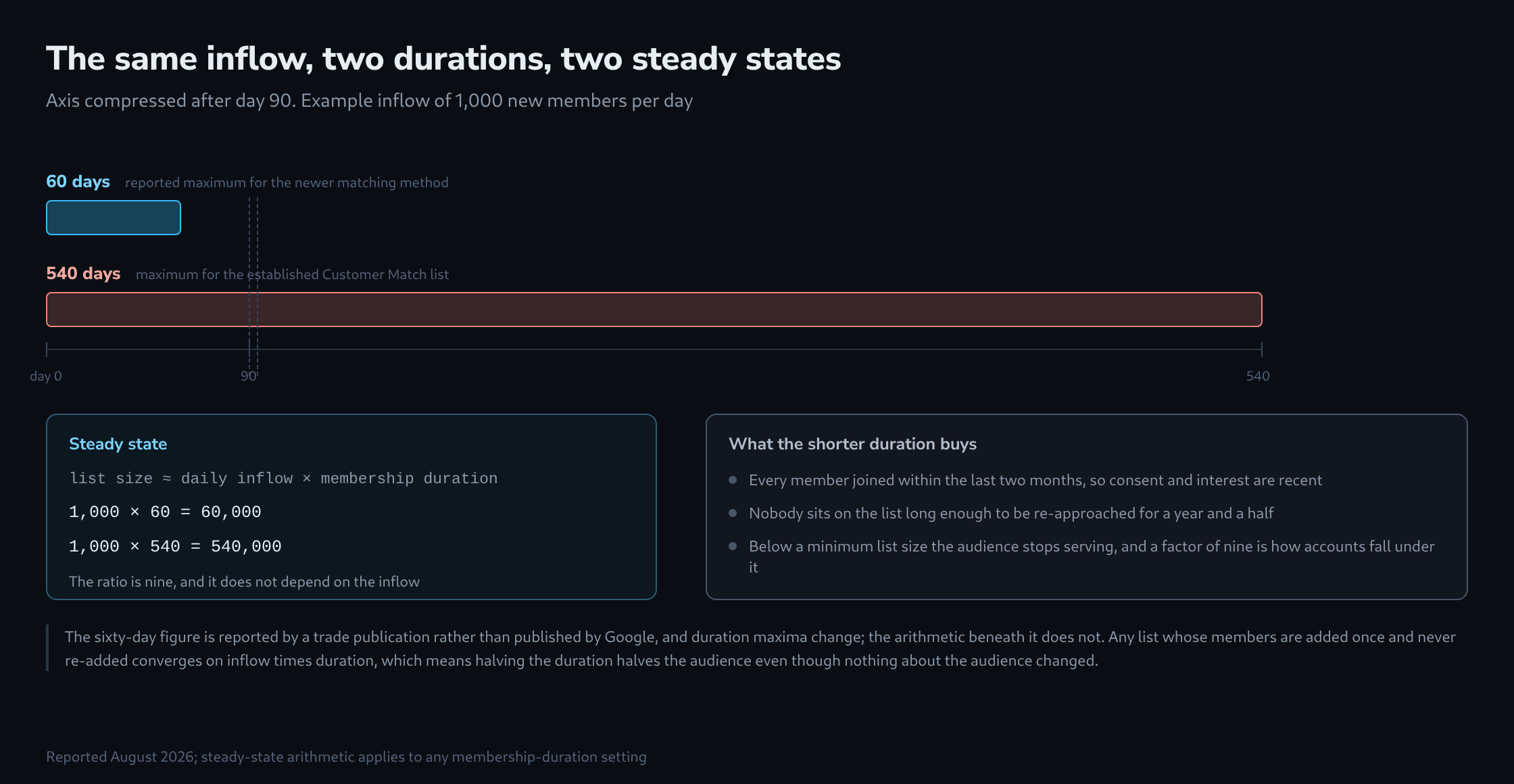
Why duration sets the size
Consider a list that gains a thousand new members a day and loses members only when their duration expires. On day one it holds a thousand. On day sixty it holds sixty thousand. On day sixty-one the first thousand drop out while a new thousand join, and from then on the list stays at sixty thousand.
steady state       size = daily inflow x membership duration

  1,000/day x  60 days  =   60,000
  1,000/day x 540 days  =  540,000

  ratio 9 : 1, and the inflow cancels out entirely

what it is not     a data retention setting. Expiry removes
                   someone from the audience, it does not
                   delete the underlying customer record

what breaks it     members who are re-added. A list fed by
                   repeat purchases converges lower than the
                   formula suggests, because each re-add
                   restarts one clock instead of starting two
The inflow cancelling out is the part worth carrying away. The ratio between two lists with different durations does not depend on how big the business is. It is the ratio of the durations, whether the list gains ten members a day or ten thousand.
The floor that a shrinking list runs into
Audience lists have a minimum size below which they stop being served. That threshold does not move when a duration setting changes, which produces the failure that actually costs money: a list that worked at five hundred and forty days sits comfortably above the floor, and the same list at sixty days does not.
Nothing about this announces itself as a configuration problem. The campaign simply stops delivering, the audience shows as too small, and the cause is a setting somebody changed weeks earlier for a good reason.
The check is arithmetic and takes a minute: divide the current list size by the current duration to get the effective daily inflow, then multiply by the proposed duration. If the answer is near the floor, the shorter duration is not available at the current volume, whatever its other merits.
What the shorter duration is actually for
Given all that, a sixty-day cap sounds like a downgrade. It is better understood as a different trade.
Everyone on a sixty-day list interacted within the last two months. Consent, if consent is the basis, was given recently rather than eighteen months ago. Contact details are recent enough to still match. And the list cannot contain someone who has been receiving the same remarketing for a year and a half, which is a real outcome on a five-hundred-and-forty-day list and rarely an intended one.
Matching described as working without third-party cookies belongs in the same picture: shorter, fresher, first-party. The size is the price of that, and for a large enough audience it is a price worth paying.
Before changing the setting
Two figures make the decision straightforward. The first is the current list size divided by the current duration, which gives the daily inflow the list actually has rather than the one anyone assumes. The second is the serving floor for the audience type in question.
With those two numbers the answer falls out without an experiment, and the experiment is expensive: an audience that drops below the floor takes a full duration cycle to grow back, and during that time the campaign attached to it is not running.
Related articles