Key Events and Conversions in GA4: Two Counters and What the Data API Release of May 2026 Shows

Contents
On 4 May 2026 cross-channel conversion data became available through the Analytics Data API, in alpha, for properties linked to Google Ads. Read as a release note it is a modest item: a report that existed in the interface can now be fetched programmatically.
Read as a piece of evidence it is more useful than that. To return conversions the API has to say what a conversion is, and the answer exposes a split that the interface has carried quietly since 2024. Two counters run beside each other in every GA4 property. Only one of them is always there.
What the 2024 rename actually did
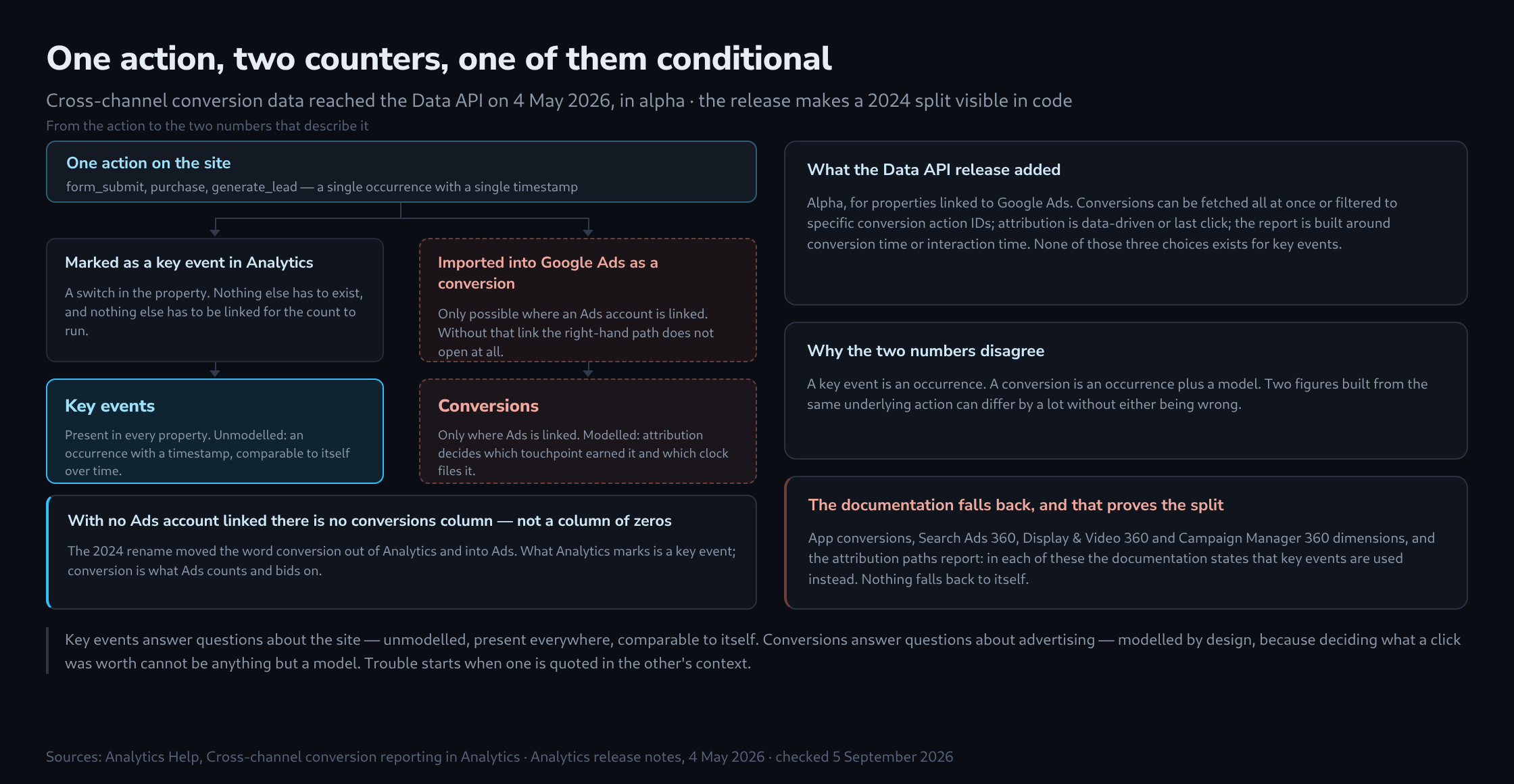
Until 2024 the thing GA4 counted was called a conversion. The rename moved that word out of Analytics and into Google Ads: what Analytics marks is now a key event, and conversion became the term for what Ads counts and bids on.
This was widely read as cosmetics, one word swapped for another to tidy up the vocabulary across two products. It was not. The rename separated two counts that had been sharing a name, and the sharing had been hiding the fact that they do not agree.
The consequence that shows up in the interface
Inside Analytics, conversion now refers specifically to a key event that has been imported into Google Ads. That definition has a blunt edge to it: with no Ads account linked, a property has no conversions at all. Not zero conversions — no column. There is only the key events column, and nothing missing from it.
Where both exist, they can be compared, and they will rarely match. The reason is that they are attributed by different models, scoped to different data, and counted under different rules, which is exactly why keeping one word for both was misleading enough to be worth a rename.
What the API release added
The alpha exposes the same figures the Conversion performance report shows in the interface: paid and organic conversion performance across channels, retrievable in code for the first time. Two options in the request are worth noting because they are where the differences from key events become concrete.
Conversion action    all conversions at once, or filtered
                     to specific conversion action IDs

Attribution model    data-driven, or last click

Time basis           conversion time - the report is built
                     around when the conversion happened

                     interaction time - the report is built
                     around the ad interaction that preceded it
None of those three choices exists for key events, and that is the point. A key event is an occurrence with a timestamp. A conversion is an occurrence plus a model that decides which touchpoint earned it and which clock it is filed under. Two numbers built from the same underlying action can differ by a lot without either being wrong.
The documentation confirms the split by falling back
The clearest evidence that these are two separate systems is not a definition but a list of exceptions. In several places the cross-channel conversion documentation states that conversions are not available and key events are used instead.
App conversions                    key events used instead
Search Ads 360 dimensions          key events used instead
Display & Video 360 dimensions     key events used instead
Campaign Manager 360 dimensions    key events used instead
Attribution paths report           key events used instead
A fallback list of that shape only makes sense if the two are genuinely different quantities. Nothing falls back to itself. Anyone reading a report that mixes web and app, or that carries SA360 or DV360 dimensions, is reading a mixture of the two counts, and the column heading does not say so.
Which number belongs where
The division of labour is clean enough to write down once and follow.
Key events answer questions about the site. How many people completed the form, whether that rose after the redesign, which page precedes it most often. The count is unmodelled, present everywhere, and comparable to itself across time, which is what makes it the right basis for anything internal.
Conversions answer questions about advertising. What a campaign earned, what to bid, which channel to credit. The count is modelled by design, because deciding what a click was worth is a modelling question and cannot be anything else.
Trouble starts when one is quoted in the other’s context: a campaign report defended with key events, or a redesign judged by conversions that moved because the attribution window changed rather than the page. Both counts are honest about what they are. Neither is honest about being used for the other job.
One caveat about the alpha
Alpha in the Data API means the surface can change without the notice a stable version would get. That is not a reason to leave it alone — it is the only programmatic route to these figures — but it is a reason to keep the extraction thin. A pipeline that pulls conversions and stores them raw survives a field rename with an edit in one place. A pipeline that joins, reshapes and aggregates on the way in has to be understood again from scratch each time the shape moves.
Related articles