Camera Resolution and Lens: Pixels per Metre and the DORI Thresholds for Identification

Contents
A camera is bought by its megapixels and mounted by its coverage. Both decisions are made without the number that determines whether anything on the recording can be used: how many pixels fall on one metre of the scene at the distance where something happens.
That number is not on any data sheet, because it is not a property of the camera. It follows from four values – resolution, sensor width, focal length and distance – and it changes with every one of them. The most common outcome of ignoring it is a recording that shows an event in perfect sharpness and a person nobody can name.
The Number That Is Not on the Data Sheet
Resolution describes the image. Pixel density describes the scene. A 4K camera has 3840 pixels across whether it looks at a doorway three metres away or at a car park eighty metres out – the pixels are the same, the metres they are spread over are not.
Which is why the useful unit is pixels per metre: the horizontal resolution divided by the width of the scene at the distance in question. Everything a recording can and cannot prove follows from that one figure.
How Focal Length and Sensor Width Become a Field of View
How wide a camera sees at a given distance fits into one sentence: the scene width is the distance times the sensor width, divided by the focal length. A longer lens therefore sees a narrower slice, and every lens sees wider the further out it looks. The angle of view printed in catalogues says the same thing in a unit that is harder to calculate with.
An example with a common sensor – 1/2.8 inch, 5.6 millimetres wide, 3840 pixels across – at a distance of 20 metres:
| Lens | Angle of view | Scene width at 20 m | Pixels per metre |
|---|---|---|---|
| 2.8 mm | 90° | 40.0 m | 96 |
| 12 mm | 26° | 9.3 m | 411 |
Two consequences follow and are worth stating on their own. Pixel density is exactly proportional to focal length: twice the focal length, twice the pixels per metre. And it is inversely proportional to distance: the same camera delivers a quarter of the density at four times the range.
Four Thresholds, Four Tasks
EN 62676-4 puts numbers on what a recording can be used for, and the four levels are known by their initials – DORI. Detect at 25 px/m means something is there. Observe at 62 px/m means the behaviour is visible: someone walks, someone carries. Recognise at 125 px/m means a known person can be matched to the image. Identify at 250 px/m means an unknown person can be described well enough to be found.
The steps are factors of two, which makes them easy to reason about backwards: whatever the density at a distance, half of it is one level down. And the levels are not opinions about image quality – they are what a court or an insurer expects the material to carry.
The Same Camera, Two Lenses
| Distance | 2.8 mm: field | 2.8 mm: density | 12 mm: field | 12 mm: density |
|---|---|---|---|---|
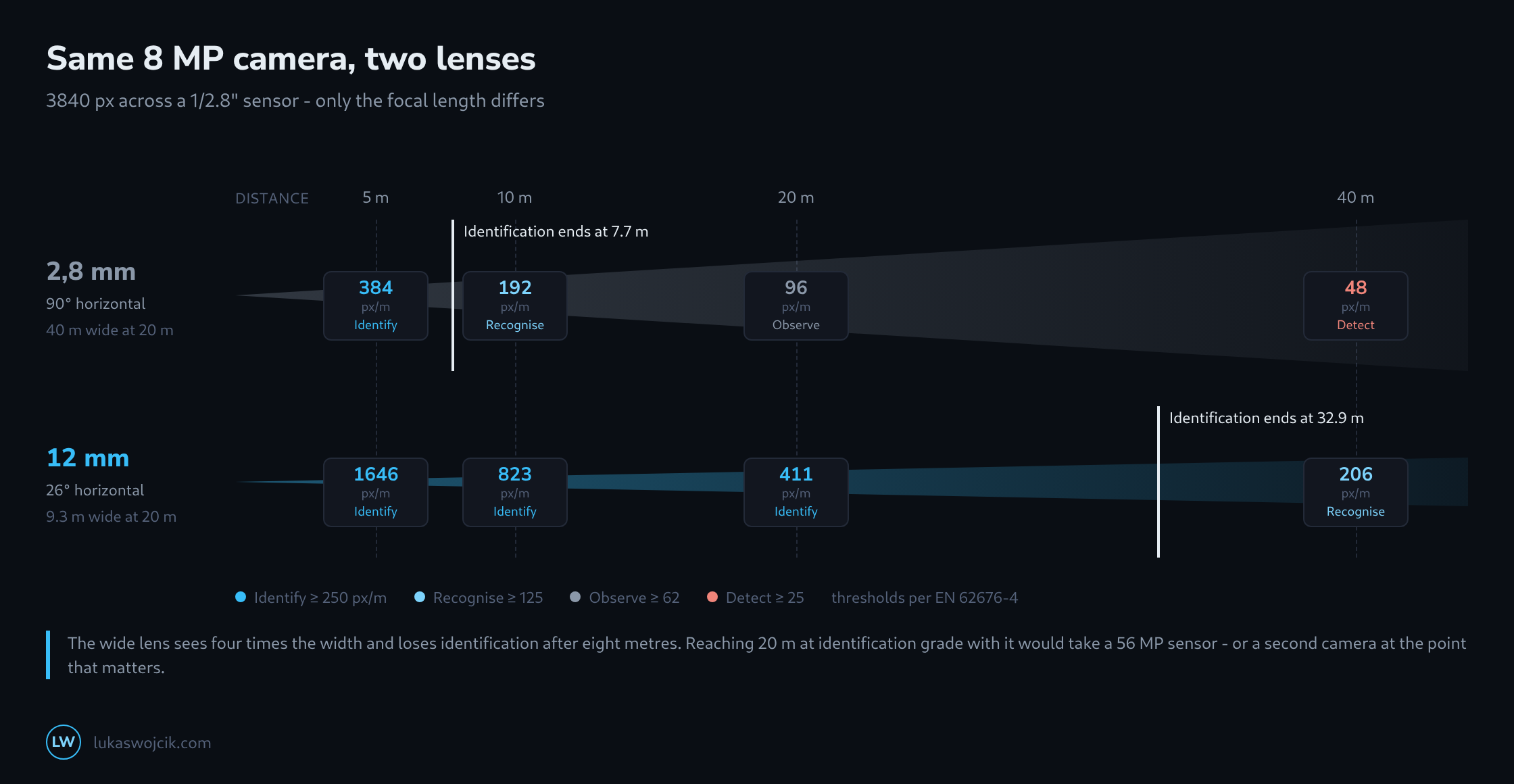
| 5 m | 10.0 m | 384 px/m · Identify | 2.3 m | 1646 px/m · Identify |
| 10 m | 20.0 m | 192 px/m · Recognise | 4.7 m | 823 px/m · Identify |
| 20 m | 40.0 m | 96 px/m · Observe | 9.3 m | 411 px/m · Identify |
| 40 m | 80.0 m | 48 px/m · Detect | 18.7 m | 206 px/m · Recognise |
The wide lens crosses out of identification grade at 7.7 metres and out of recognition at 15.4 metres. The long lens holds identification to 32.9 metres and covers 9.3 metres of width at 20 metres instead of 40. Neither is the better lens; they answer different questions, and a plan that asks one camera to answer both gets the wide answer everywhere.
Why More Megapixels Is Rarely the Answer
Megapixels count area, pixel density counts a line. Doubling the megapixels multiplies the pixels per metre by the square root of two – roughly forty per cent. Going from 4 MP to 8 MP takes the horizontal count from 2688 to 3840, and the step from a 2.8 mm to a 4 mm lens buys the same forty per cent for the price of a lens rather than a camera.
Run it the other way and the point is blunt: holding 250 px/m at 20 metres with a 2.8 mm lens needs 10 000 pixels across the frame, which is a 56 MP sensor. The lens is not a detail of the installation. It is the installation.
What the Calculation Does Not Cover
Pixel density is a ceiling, not a result. At night the aperture opens, noise rises, and the noise reduction that follows smears exactly the fine detail the pixel count promised. A person walking at 1.4 m/s moves 4.7 cm during a 1/30 s exposure, which at 411 px/m is nineteen pixels of smear straight across a face – so identification at night is a shutter problem before it is a resolution problem. Compression finishes the job: a low bitrate spends its budget on the moving parts of the frame and throws away the texture that made the face readable.
Geometry has the last word. Pixel density assumes the subject is across the frame, not below it. A camera four metres up, angled down at a doorway two metres away, records the top of a head at a wonderful density and identifies nobody. The plan that works is the boring one: a wide lens for the overview, and a second camera at the point everyone has to pass, mounted at face height and close enough that even a short lens delivers.
Related articles