The AI Channel Counts What Left a Trace
Since 13 May 2026 Google Analytics has recognised traffic from AI assistants on its own, and since 7 June the AI Assistant channel has been in the Default Channel Group across properties. The medium becomes ai-assistant, the campaign becomes (ai-assistant), and no configuration is required to make it happen.
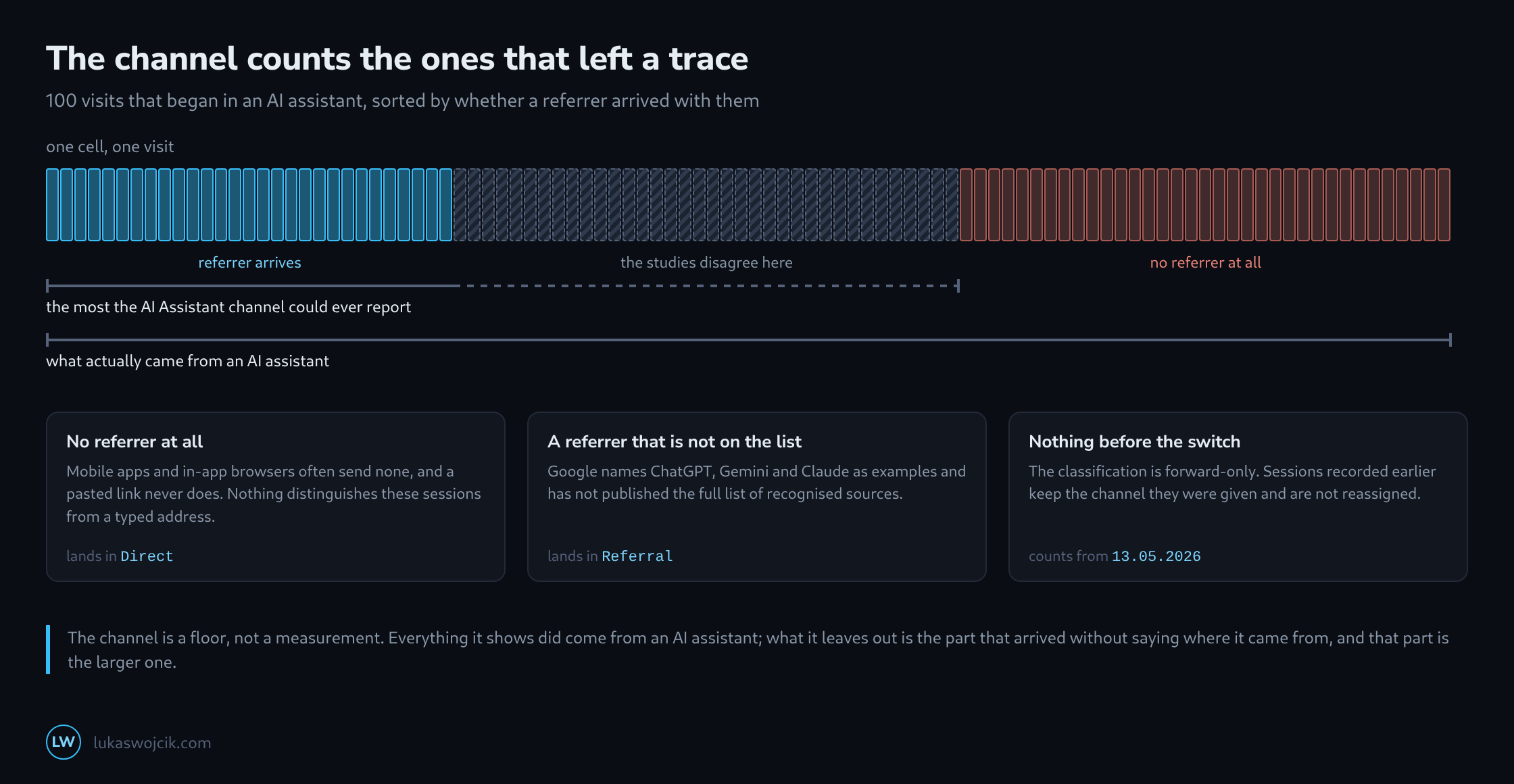
The channel is real and the number in it is correct. What deserves care is the sentence usually built on top of it – that this is now how much traffic comes from AI assistants. It is not; it is how much of that traffic arrived carrying a referrer.
Three Ways a Visit Misses the Channel
A session reaches the AI Assistant channel only if it carries a referrer and that referrer is on Google’s list. Each half of that condition fails in its own way, and there is a third failure that has nothing to do with either.
| Where it lands | Why | What can still be done |
|---|---|---|
| AI Assistant | Referrer present and recognised | Nothing needed, it is already counted |
| Referral | Referrer present, source not on the list | A custom channel group placed above Referral catches it |
| Direct | No referrer sent at all | It can be bounded, never attributed |
The middle row is worth a moment. Google names ChatGPT, Gemini and Claude as examples and has not published the full list of sources it recognises. An assistant that is not on it produces an ordinary referral, indistinguishable in the report from a link on someone’s blog, and no amount of waiting will move it – the list is Google’s, not the property’s.
How Large the Missing Part Is
The published counts do not agree with each other, and the honest summary is a range rather than a figure. One analysis of roughly 446,000 visits put the share arriving with no referrer at 70.6 per cent; other reports place it between a third and two thirds. All of them are vendor studies of particular sites, none is a measurement of the web, and the spread between them is itself the finding.
What every one of them agrees on is the direction: the part that arrives anonymously is not a rounding error. Two behaviours produce it. Mobile apps and in-app browsers frequently send no referrer at all, and a link copied out of an answer and pasted into an address bar never had one to send. Neither is a defect in the analytics setup, and neither can be repaired from the receiving end.
Putting a Bound on What Landed in Direct
Direct contains two populations that no referrer can separate: people who typed the address and people who pasted a link. They can still be told apart statistically, because they behave differently on arrival. A typed address is nearly always the home page or a bookmarked section; a pasted link from an answer is usually a specific article several levels deep, and it is usually a first visit.
WITH sitzungen AS (
  SELECT
    CONCAT(user_pseudo_id, (SELECT value.int_value FROM UNNEST(event_params)
                            WHERE key = 'ga_session_id')) AS sitzung,
    MAX((SELECT value.string_value FROM UNNEST(event_params)
         WHERE key = 'page_referrer')) AS referrer,
    MIN((SELECT value.string_value FROM UNNEST(event_params)
         WHERE key = 'page_location'))  AS einstieg
  FROM `projekt.analytics_123456789.events_*`
  WHERE _TABLE_SUFFIX BETWEEN '20260701' AND '20260731'
  GROUP BY sitzung
)
SELECT
  referrer IS NULL                              AS ohne_referrer,
  REGEXP_CONTAINS(einstieg, r'/[^/]+/[^/]+/')   AS tiefer_einstieg,
  COUNT(*)                                      AS sitzungen
FROM sitzungen
GROUP BY 1, 2
ORDER BY 1 DESC, 2 DESC
The cell with no referrer and a deep landing page is the upper bound on pasted arrivals. It is an upper bound and nothing more – a bookmark to a deep page falls in it too – but watching that one cell over months is far more informative than watching the channel, because it moves when the invisible half moves and the channel does not.
Why the Custom Group Has to Sit Above Referral
Channel rules are evaluated in order and the first match wins. A custom group that lists the unrecognised assistants is useless if it sits below Referral, because every one of those sessions matches Referral first and never reaches the later rule. The same ordering trap costs more sessions in acquisition reports than any single misconfigured source.
One further consequence of the switch belongs here: the classification only works forward. Sessions recorded before 13 May 2026 keep whatever channel they were given at the time and are not reassigned, so any comparison spanning that date compares two different classification schemes. That is worth an annotation in the property rather than a discovery six months later.
What the Number Can and Cannot Answer
The channel answers one question well: whether assistant traffic is growing. A floor that rises is a real signal, because nothing about the measurement got more generous over the period – the recognised list may lengthen, but the referrer either arrives or it does not.
It does not answer what share of visitors came through an assistant, and it should not be put into a report that implies it does. The defensible sentence names the boundary: this many sessions arrived from a recognised assistant, an unknown and probably larger number arrived from one without saying so, and the second number is bounded rather than measured. A report that says that is more useful than one that quotes a single confident figure, because the confident figure will be revised the moment someone checks it.
Related articles