English
 Deutsch
 Polski
Google Ads API v25.1: Reading Conversion Lift Data Without Creating a Study

Contents
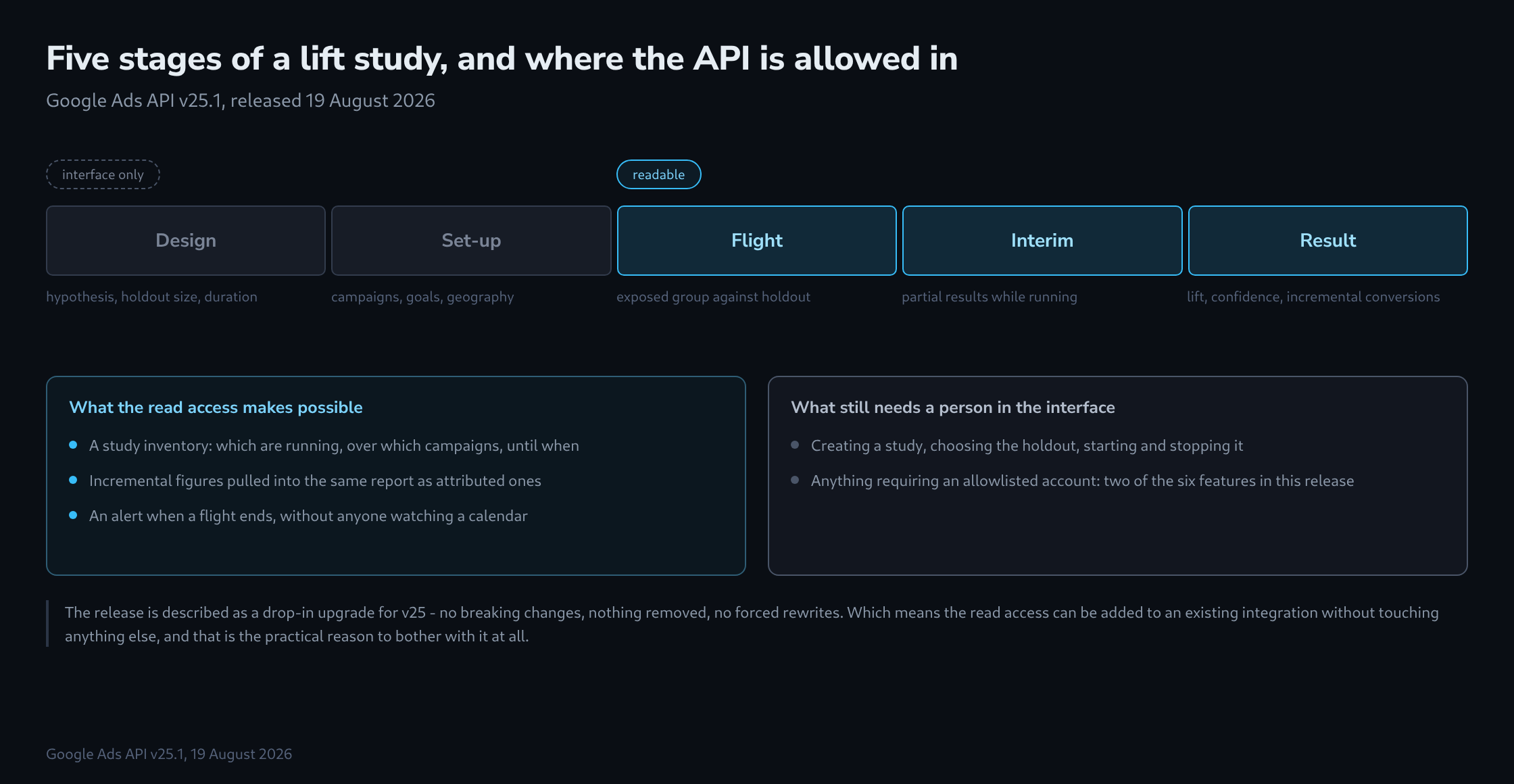
Google Ads API v25.1 shipped on 19 August 2026. It adds twenty-four Conversion Lift metrics and read-only resources for lift and brand lift studies: their configuration, flight dates, the campaigns they cover, the conversion goals they use. Two of the six features in the release require an allowlisted account.
Read-only defines the limit: the API lets you inspect a study, but you cannot create, start or stop one through it.
What a lift study measures, and why it disagrees
A lift study holds a group back. Part of the audience is deliberately not shown the advertising, conversions are counted in both groups, and the difference is the incremental effect. That is a different question from attribution, which takes conversions that happened and assigns credit for them among the touchpoints that preceded them.
The two answers routinely disagree, and not by accident. Attribution assigns credit to a campaign for conversions that would have happened anyway, because it has no way to know which ones those were. A lift study measures precisely that gap and generally finds it large, especially on branded search and on remarketing, where the audience was already going to arrive.
Having both numbers reachable from the same interface is the substantive change here. Until now the attributed figure lived in the API and the incremental figure lived in a report someone opened occasionally, which meant the comparison happened rarely and by hand.
What read access is actually good for
inventory     which studies exist, over which campaigns,
              with which goals, until when
              answers "is this campaign inside a holdout
              right now" - which changes how its numbers
              should be read

alerting      a flight ending is a date in a resource, so
              it can raise a notification instead of being
              noticed three weeks later

joining       incremental conversions next to attributed
              conversions for the same campaign and period,
              in one table, without manual assembly

what it       creating, editing, starting, stopping
cannot do     all of that stays in the interface
The inventory case is the one worth building first, and it is easy to underrate. A campaign inside an active holdout is reporting numbers from a deliberately reduced audience. Anyone comparing that campaign to last month without knowing a study is running will read a real, intentional effect as a performance problem.
The allowlist
Two of six features are limited to allowlisted accounts, so a straightforward read of the release notes will not tell anyone whether their own account can see this. The only reliable answer is to query and find out, which is quick, and to write the integration so that an empty result is a normal outcome rather than an error.
That last part matters more than it sounds. A missing permission and a genuinely empty study list return something very similar, and code that treats absence as failure will page someone at three in the morning over an account that simply has no lift study running.
Whether to bother
For an account that never runs lift studies, this release changes nothing. For one that runs them occasionally, the honest answer is that the inventory and the alert are worth an afternoon and the joined reporting probably is not, because two or three studies a year do not justify a pipeline.
Where it earns its place is an account running holdouts continuously, on several markets, where somebody currently keeps a spreadsheet of which studies are live. That spreadsheet is now a query. And v25.1 is described as a drop-in upgrade from v25 – no breaking changes, nothing removed – so the cost of finding out is genuinely small.
Questions and answers
Does the incremental figure from a lift study replace the attributed conversions in reporting?
No, the two answer different questions and belong side by side. Attribution distributes conversions that happened among the touchpoints that preceded them; a lift study counts only what would not have happened without the advertising. The gap between them is the informative part: it stands for the conversions credited to the campaign although they would have happened anyway.
How can an account that is not allowlisted be told apart from one whose study list is genuinely empty?
Usually not from a single response, which is why it takes a cross-check outside the API. The simplest is an account in which the interface currently shows a running lift study: if the query comes back empty there, what is missing is the allowlisting, not the study. For accounts that have never had a study the question stays open, and that does no harm as long as the integration can handle it.
In operation it helps to record three outcomes instead of two: genuine errors such as expired credentials or timeouts, which still raise an alert; an empty result, stored as the state “no study visible”; and actual results. The query should also run regularly rather than once at setup, because allowlisting can arrive later, and an account that was empty yesterday then returns data without any change to the code.
What does an active holdout mean for automated alerts and comparisons with earlier periods?
Alerts fire without cause for as long as the study runs, and comparisons mislead, because a campaign inside a holdout reports numbers from a deliberately reduced audience. A rule that triggers on a drop against the previous week takes the intended effect of the study for a performance problem, and anyone who responds by changing the campaign intervenes in the middle of a running measurement.
The inventory described in the article is the right source for an exception: campaigns with an active study are flagged in alerts and reports, and the study period does not serve as the baseline for later periods. Because the flight dates are stored in the resource, this can be handled without manual work.
Sources
Related articles