English
 Deutsch
 Polski
Meta Attribution Change of March 2026: Link Clicks, Engage-Through and the One-Day Window

Contents
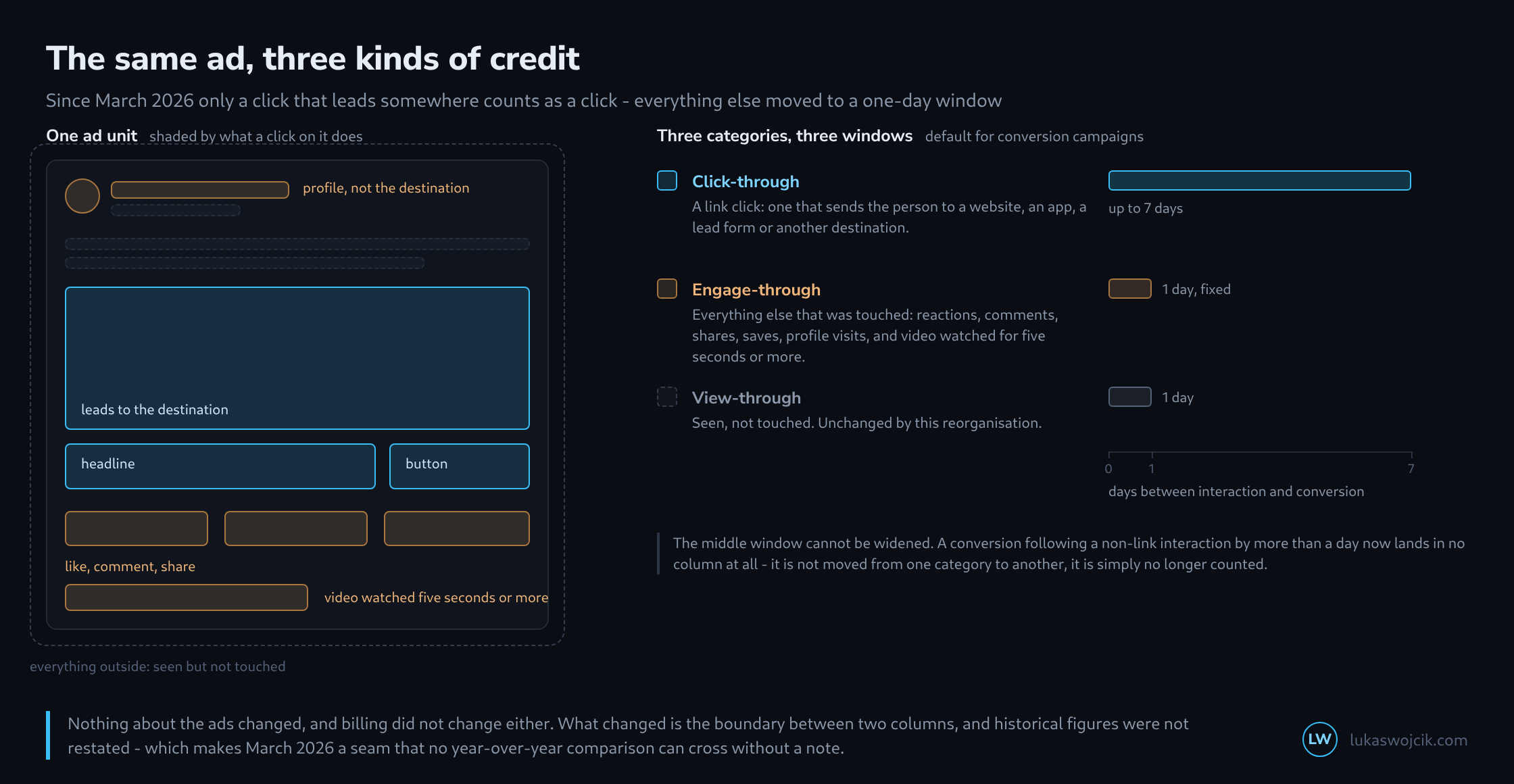
On 3 March 2026 Meta announced how conversions would be attributed from then on, and the change moved across accounts during that same month. Since then only a link click counts as a click: one that sends the person to a website, an app, a lead form or another destination.
Everything else that can be touched on an ad has not disappeared but moved into a category of its own – with a window one twelfth as long. Anyone who saw conversions drop in March without having changed anything was probably looking at exactly this shift.
What a click is now
The new boundary is unusually simple: a click counts if it leads somewhere. The image of a link ad, the headline and the button lead to the destination and therefore remain click-through. A click on the page name leads to the profile and is therefore no longer one, even though it arguably reveals more attention than an accidental tap on an image.
Previously any click on any part of the ad counted. That rule was convenient and imprecise at once, because it mixed the route to the offer with the route into the comments. The new one separates them – which is progress for analysis and a problem for year-over-year comparison.
Where the rest went
Reactions, comments, shares, saves and profile visits now form the engage-through category, and so does watching a video for five seconds or longer. The category is on by default for conversion campaigns and carries a fixed window of one day that cannot be extended.
The common default for website conversions is therefore seven days click-through, one day engage-through, one day view-through. The third category is untouched by the reorganisation; it still counts those who only saw the ad.
The gap this creates
The most important point appears in no announcement but follows from the arithmetic. A conversion following a non-link interaction by more than a day does not move from one column to another – it falls out of all of them. Under the old rule it would have been captured as click-through with a window of up to seven days.
The same sequence, before and after

  day 0   someone comments on the ad
  day 3   the same person buys

  before    click-through, 7-day window        counted
  after     engage-through, 1-day window       not counted

  day 0   someone clicks the button
  day 3   the same person buys

  before    click-through, 7-day window        counted
  after     click-through, 7-day window        counted

  The difference lies not in the purchase but in the region
  that was touched three days earlier.
How large that share is depends entirely on the kind of advertising. A campaign whose ads generate a lot of engagement and whose purchase decision takes days loses visibly. A campaign with a terse message and immediate action barely notices.
What was not restated
Nothing has been recalculated retroactively. Figures before March 2026 still sit in the reports under the old rule, those after it under the new one. The two periods are therefore not the same measure, and a comparison across that seam measures the rule change rather than the campaign to an unknown degree.
Billing is likewise unchanged. What is paid does not follow these columns, and a decline in attribution does not mean a decline in effect. That is the sentence most often missing from internal reporting and the one that saves the most unnecessary alarm.
What follows from it
Three things are worth doing. First, a note at the seam: any report reaching past March 2026 deserves a marker on the axis, otherwise someone will eventually declare a rule change to be a performance collapse. Second, looking at the two columns separately, because added together they reproduce the old blurred number and give away exactly the insight the separation was made for.
Third – and this is the real conclusion – none of these columns is evidence that an ad caused a purchase. They attribute; they do not measure. Establishing what the spend actually caused requires an experiment with a comparison group, and no refinement of attribution rules substitutes for one.
Sources
Related articles