What 24 GHz mmWave Radar Sees Through the Wall

Contents
The complaint about mmWave presence sensors is almost always the same: the light does not go out. Someone leaves the room, the sensor keeps reporting presence, and the search for the cause goes to sensitivity settings, to the absence delay, to the firmware.
The cause is usually none of those. It is that the sensor is still perfectly correct – it is detecting a person, and that person is in the corridor.
What Counts as a Wall at 24 GHz
Radar at this frequency passes through most of what a flat is built from on the inside. What stops it is metal and water, which is also why it detects people at all: a human body is largely water and reflects strongly.
| Material | At 24 GHz | Consequence |
|---|---|---|
| Plasterboard, wood, plastic | transparent | the next room is inside the detection zone |
| Glass | largely transparent | the pavement and passing cars register |
| Brick, concrete | strongly attenuating | usually a sufficient boundary |
| Metal, foil-backed insulation | opaque | a reliable boundary – and a blind spot behind it |
| A person | reflects strongly | the signal the sensor exists for |
The glass row is the one that catches people out in a room with a window onto a street. A sensor pointed at the window reports every pedestrian, and does so most reliably in the evening, when the light is supposed to be switching off.
The Cone Leaves Sideways First
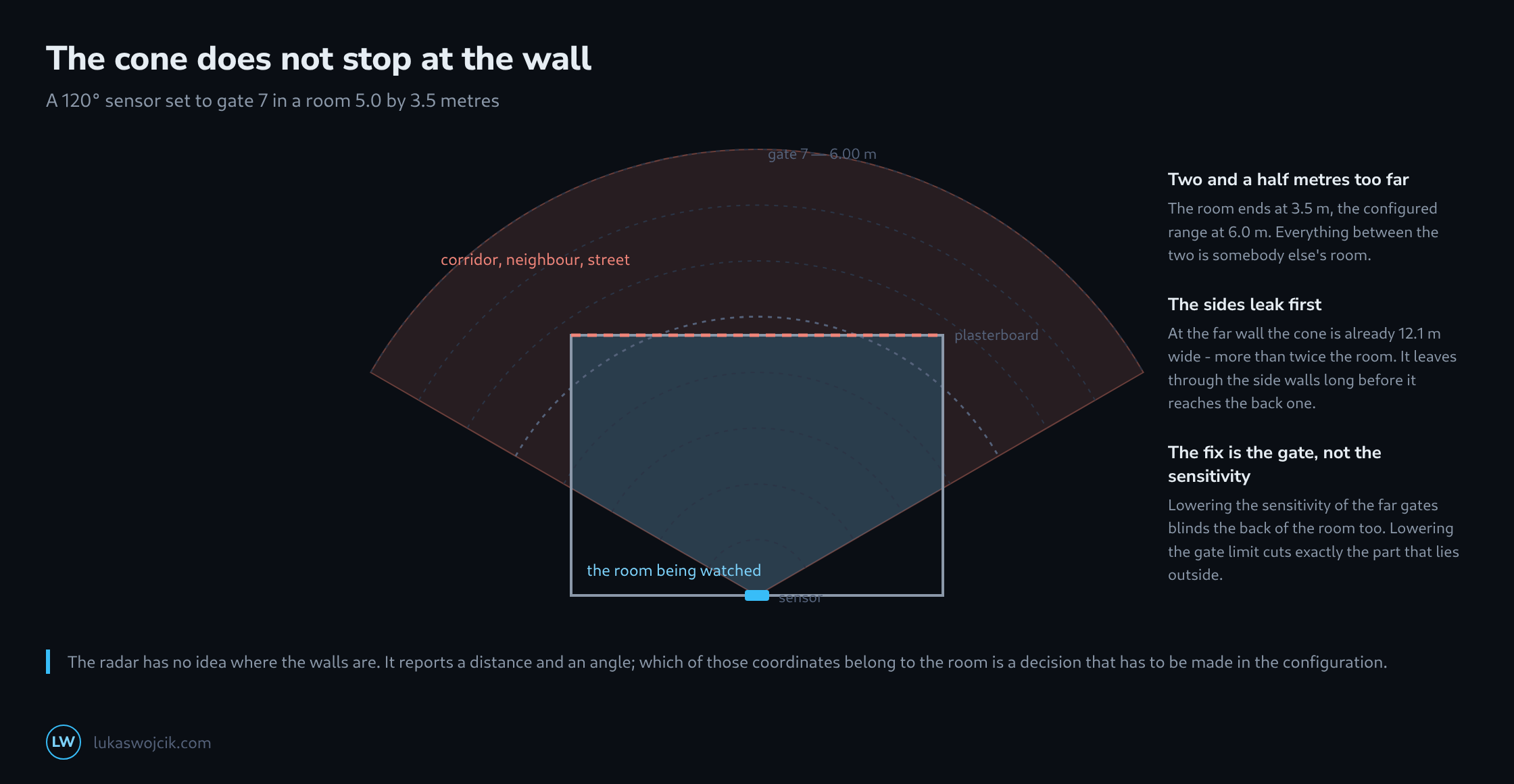
Detection range is easy to picture as a straight line and behaves like a sector. At 120 degrees horizontal, the width at distance d is about 3.5 times d – so at three and a half metres the cone is already twelve metres wide.
In a five-metre room that means it left through both side walls somewhere around a metre and a half in. Everything the neighbours do on either side is inside the zone long before the back wall is even reached, which is why a sensor that looks correct on paper – range 6 m, room 5 m – is watching three rooms.
Why Turning Down the Sensitivity Is the Wrong Lever
The obvious response to a sensor that sees too much is to make it less sensitive. It works, in the sense that distant weak reflections stop registering – and the reflections it stops registering first are exactly the ones that matter: a person sitting still at the back of the room, breathing, producing the faintest signal in the whole scene.
What sensitivity controls is how weak a reflection may be. What it cannot control is where that reflection came from. A person in the corridor two metres away produces a stronger echo than a person motionless at the desk four metres away, so lowering the threshold removes the desk before it removes the corridor.
The lever that matches the problem is the gate limit. Gates are distance bands of 75 centimetres each, and capping the maximum gate cuts the zone at a distance rather than at a signal strength. A room 3.5 metres deep needs gate 4, which reaches 3.75 metres – and everything past that stops being reported at all, regardless of how loudly it moves.
Where the Sensor Belongs
Two placement decisions do more than any parameter. The first is direction: pointing along the room rather than across it puts the far gates against a wall that is far away, and pointing away from doors and windows keeps the corridor out of the cone in the first place.
The second is height. At chest height the sensor looks across a body and sees the breathing motion it needs for stationary detection. Mounted high and angled down, it sees the top of a head – the worst geometry for the one thing mmWave is bought for. Between two metres and the ceiling, presence detection quietly degrades into motion detection with extra steps.
What Can Actually Be Measured
Both the LD2410 and the LD2450 expose the energy value per gate, and that is the number that settles an argument. With nobody in the room, the per-gate energies should sit near the noise floor. A gate that reads high while the room is empty is looking at something, and its distance says what.
The routine takes five minutes: leave the room, watch the per-gate values for a minute, then have somebody walk down the corridor and watch which gate answers. If gate 6 lights up on cue, the setting was never a sensitivity problem.
For an LD2450 there is a second layer available, because it reports coordinates rather than only distance and can filter rectangular regions in software. That turns the question from how far to which part of the floor – which is what was meant all along, and the only form in which a corridor running parallel to the wall can be excluded without also excluding the sofa.
Related articles