

 English
 Deutsch
One intensive customer, missing margin: cost limits for AI SaaS

Management Summary
In online software with AI, a small number of intensive customers can generate much higher costs than the average. A low monthly price may then fail to cover usage. The article explains cost limits: clear boundaries on tasks and the service included in a subscription. These limits help providers sustain the service and help customers understand the offer. Additional work needs appropriate allowances or add-on packages; an unlimited promise still carries real costs.
Contents
An inexpensive average AI call does not guarantee a profitable subscription. Long responses, large attached documents and retry attempts change individual customer costs. A sustainable offer combines an understandable allowance, an enforced technical boundary and a reserve for unexpected usage.
Averages, peaks and abuse are different
Intensive legitimate usage is not abuse. A business processing many valid documents needs a larger allowance; a faulty loop needs a technical brake. Combining both under an undefined fair-use notice complicates support and pricing.
Three separate boundaries help: monthly cost budget, maximum concurrent jobs and a cap per individual job. A long job can become expensive before a monthly limit intervenes. Tokens are the model’s processing units, often words or word fragments for text. Input size, maximum response length and the number of tool calls must be bounded before a job starts.
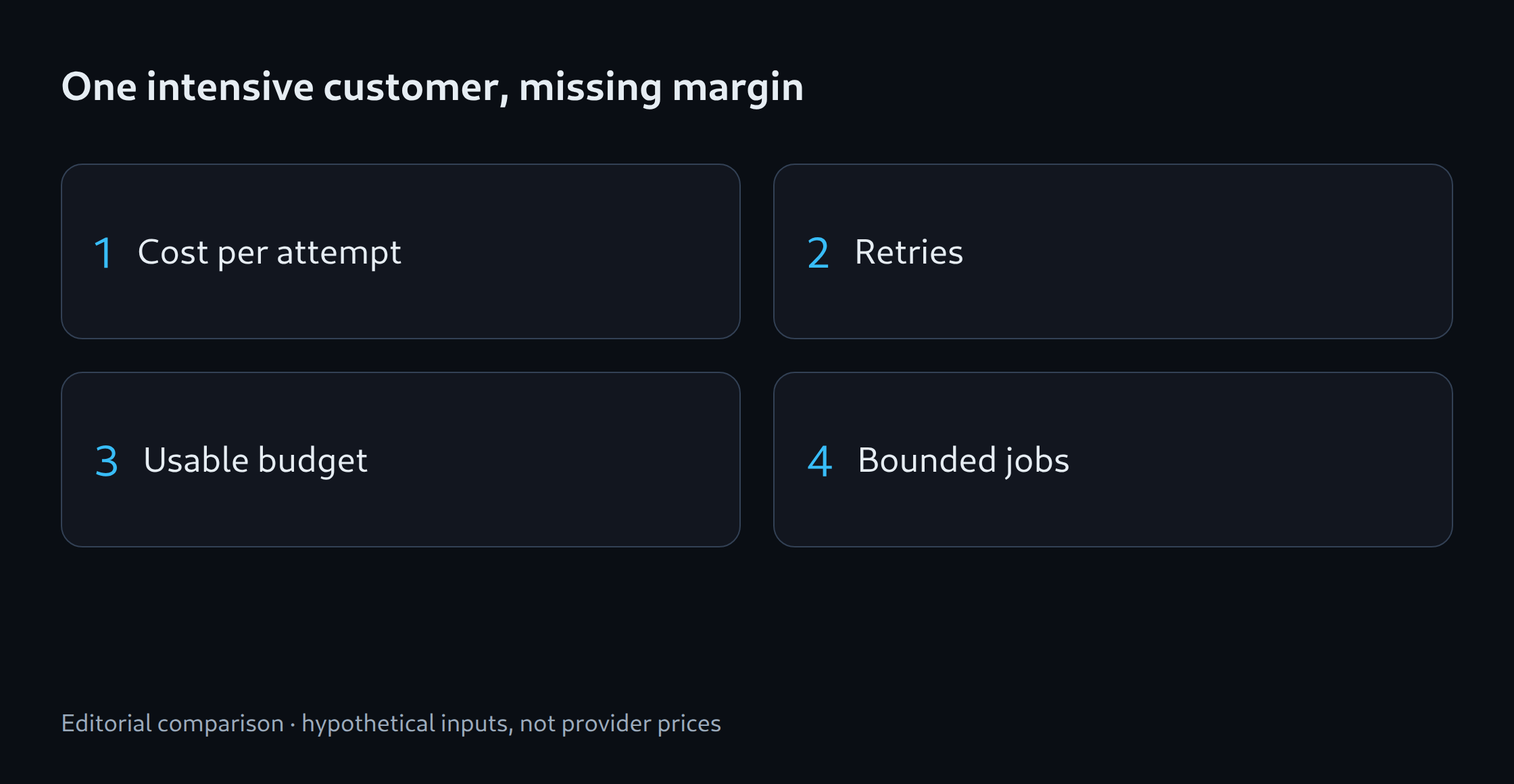
Four offer structures compared
Fair use here means usage governed by published rules instead of a completely fixed allowance. Those rules must state when a warning, review or suspension follows. A vague reference to unusual usage supplies no measurable boundary.
Credits are allowance units consumed when the service is used. The unit should have a clear business meaning, such as a short document run within defined size limits. Credits unrelated to context, output or tool calls conceal cost variation.
Hard limits stop further jobs when an allowance is exhausted. A queued state, remaining-allowance preview and export options reduce surprises. Add-on packs permit legitimate extra usage at a price covering fees and support too.
Worked example with retries
All values below are hypothetical assumptions in the same currency unit, not provider prices. One attempt uses 2,000 input and 500 output tokens. Prices of three and fifteen per million tokens produce input costs of 0.006 and output costs of 0.0075. Adding 0.001 overhead gives an uncached attempt cost of 0.0145.
Ten additional attempts per hundred original requests raise average original-request cost to 0.01595. A budget of fifteen with a 20% reserve leaves twelve usable. At exactly these average costs, the calculation gives 752 original requests rounded down. This is a planning figure, not a safe cost boundary: longer responses or more retries can exhaust the budget sooner. Five hundred requests cost 7.975; triple usage costs 23.925 and substantially exceeds the usable budget.
A prompt cache can reuse already processed identical prefixes, such as unchanged instructions at the beginning of the input. This can change input pricing; a new response still needs to be generated. Actual hits need measurement; write premiums and eligibility depend on the provider. The budget calculator therefore separates regular input price, cache-read price and additional costs. [2]
Technical enforcement of the budget boundary
Before execution, the server calculates an upper cost bound from enforced input, output and tool limits. It reserves that amount atomically, in one indivisible operation. An average estimate is not a reliable upper bound. Actual usage replaces the reservation on completion. For example, with ten currency units remaining, two simultaneous jobs requiring a reservation of eight each must not both start. For aborted jobs, costs already incurred must be established. A reservation must not simply be erased while those costs remain unknown.
Provider limits do not automatically enforce an individual product budget. Anthropic documentation distinguishes spending and rate limits, for example; customer-level product controls remain an additional responsibility. [1] Retries require a maximum count, waiting policy and unique job identifier.
A pricing promise with a verifiable boundary
A useful offer page states included usage, exhaustion behavior, add-on prices and the effect of long jobs on consumption. An initial test compares normal usage, double usage and a realistic peak.
The calculator supports planning. Production cost control relies on measured token and tool costs per job. Customer billing instead follows the agreed model, such as a fixed subscription or consumed credits. Reserve levels follow the gap between assumptions and actual usage, rather than turning a cheap average into an unlimited promise.
Related tools
Sources
Sources checked: 26 October 2026.
Questions and answers
Does the budget calculator enforce an API limit?
No. It calculates scenarios locally. Cost reservations, access control and technical limits belong in the product backend.
Are credits automatically profitable?
No. Profit depends on included work, actual costs, fees and support. An overly generous credit unit can also create losses.
Related articles


