The Post-Cookie Era: Inside Topics API and Protected Audience in Google Privacy Sandbox

Contents
The deprecation of third-party cookies across modern web browsers fundamentally restructures how digital advertising, remarketing, and audience analytics operate. Without shared deterministic identifiers stored in third-party HTTP contexts, cross-site tracking via central ad servers is no longer viable. In its place, the Google Privacy Sandbox introduces a paradigm where the individual web browser assumes responsibility for interest categorization and auction orchestration through APIs such as the Topics API and the Protected Audience API.
1. The Architectural Shift Away from Third-Party Cookies
In traditional advertising pipelines, third-party cookies allowed ad networks to track browsing histories across unrelated domains, building centralized behavioral profiles on external servers. The Privacy Sandbox flips this data architecture from a server-side tracking model to an on-device computation model. Raw browsing history remains exclusively within the local browser storage, while standardized APIs expose only privacy-preserving, aggregate, or noise-injected signals to authorized ad tech platforms.
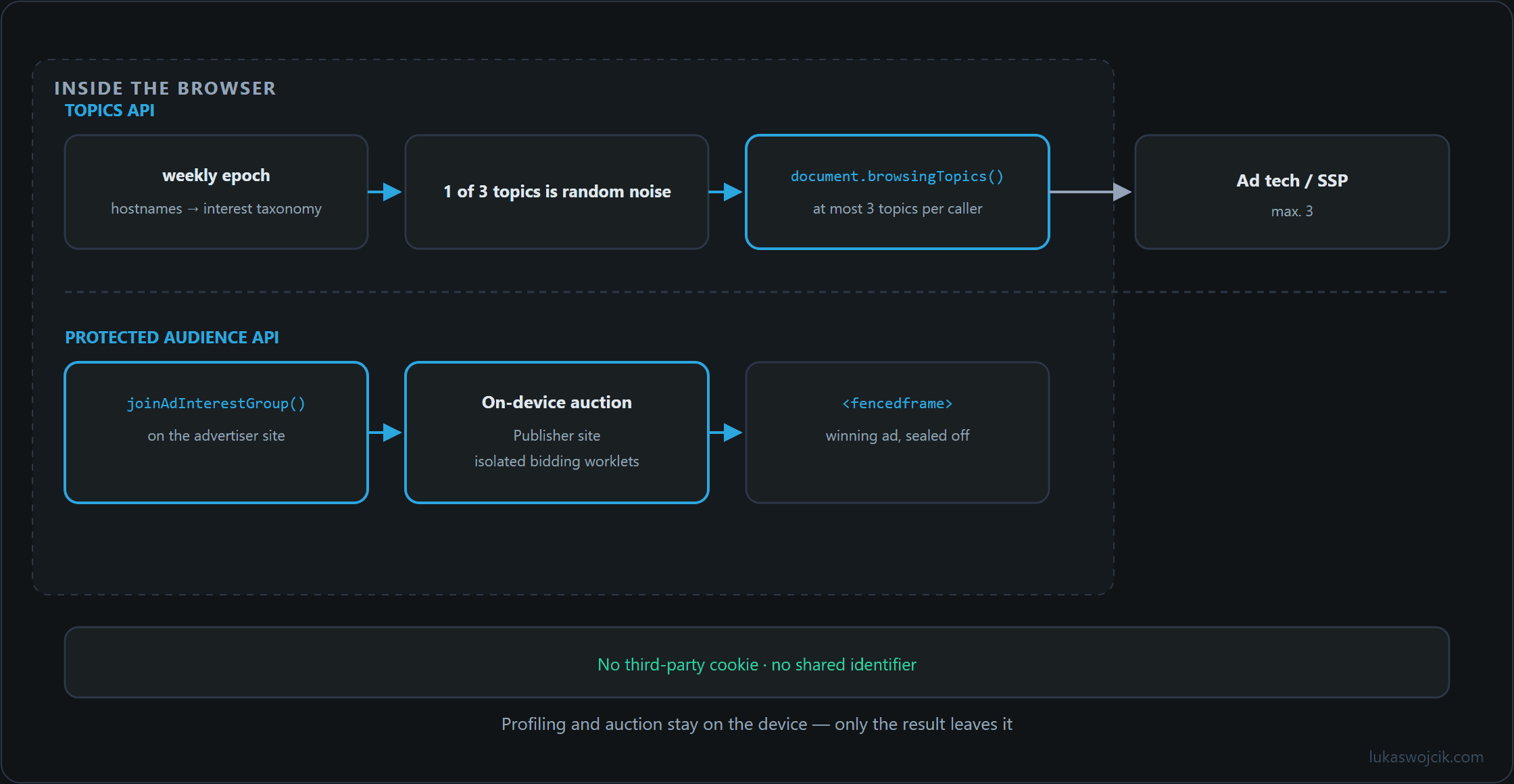
2. Topics API: Coarse-Grained On-Device Interest Profiling
The Topics API replaces granular behavioral tracking by assigning coarse-grained interest categories directly within the browser based on recent navigation patterns:
- Local Epoch Classification: During weekly epochs, the browser analyzes visited hostnames and maps them to a human-curated taxonomy of interest categories (e.g., “Autos & Vehicles”, “Consumer Electronics”).
- Restricted Signal Exposure: When an ad tag queries the Topics API via JavaScript (using
document.browsingTopics()), the browser returns up to three topics—one from each of the preceding three weekly epochs. - Noise Injection & Privacy Budgets: To prevent fingerprinting, a random topic from the taxonomy is returned in 5% of API evaluations, ensuring deterministic re-identification of individuals across origins remains mathematically infeasible.
3. Protected Audience API: On-Device Ad Auctions for Retargeting
Formerly known as FLEDGE, the Protected Audience API enables custom audience retargeting without sharing site-visitation history with third parties. The entire bidding and auction logic executes within isolated browser environments:
Interest Group Management
When a visitor interacts with specific products or conversion funnels, a website tag instructs the browser to join an Interest Group (using navigator.joinAdInterestGroup()). The browser stores the group name, owner domain, and bidding script URLs locally.
In-Browser Auction Orchestration
- Isolated Bidding Worklets: On a publisher site, the browser executes bidding scripts inside isolated JavaScript worklets without network access, evaluating ad relevance without leaking user state.
- Fenced Frames Rendering: The winning advertisement is rendered inside a secure
<fencedframe>HTML element. This restricted container isolates the displayed ad creative from the surrounding page, preventing DOM inspection or third-party tracking pixel injection.
4. Implications for Website Tagging and Analytics Architecture
Adapting website tagging to the post-cookie era requires significant adjustments to tag management implementations:
- First-Party Data Prioritization: Tagging infrastructures must focus on robust first-party context collection and server-to-server data flows (e.g., via Server-Side Google Tag Manager) rather than relying on external browser pixels.
- Permissions Policy Headers: Publishers must explicitly control which embedded third-party scripts can invoke Privacy Sandbox APIs by declaring structured HTTP response headers (such as
Permissions-Policy: browsing-topics=(self), run-ad-auction=(self)). - Asynchronous Attribution Reporting: Conversion tracking shifts to the Attribution Reporting API, where measurement reports are encrypted, delayed, and processed through secure Trusted Execution Environments (TEEs) before being delivered to analytics endpoints.
Sources
Related articles