Local Energy Management: Integrating PV Inverters and Battery Storage via Modbus TCP
Part 2 of 2 in the series Home Assistant without the cloud
Contents
Local Energy Management: Integrating PV Inverters and Battery Storage via Modbus TCP
Modern residential and enterprise microgrids require instantaneous energy routing to maximize self-consumption and prevent grid export losses. Relying on cloud-based manufacturer APIs for photovoltaic (PV) inverters and battery storage systems introduces unacceptable latency, rate limits, and external network dependencies. Establishing a robust Local Energy Management System (LEMS) requires querying telemetry directly over the local network using Modbus TCP or SunSpec protocols. Achieving sub-second response times enables precise surplus diversion into domestic hot water (DHW) heating or electric vehicle (EV) charging infrastructure.
1. High-Frequency Telemetry via Modbus TCP and SunSpec Register Maps
Direct local polling of hardware inverters (such as Fronius Symo or hybrid Deye units) and smart bidirectional energy meters eliminates cloud polling restrictions. By addressing standardized holding registers over port 502, an automation controller can read real-time power production, battery state-of-charge (SoC), and net grid exchange at intervals under one second.
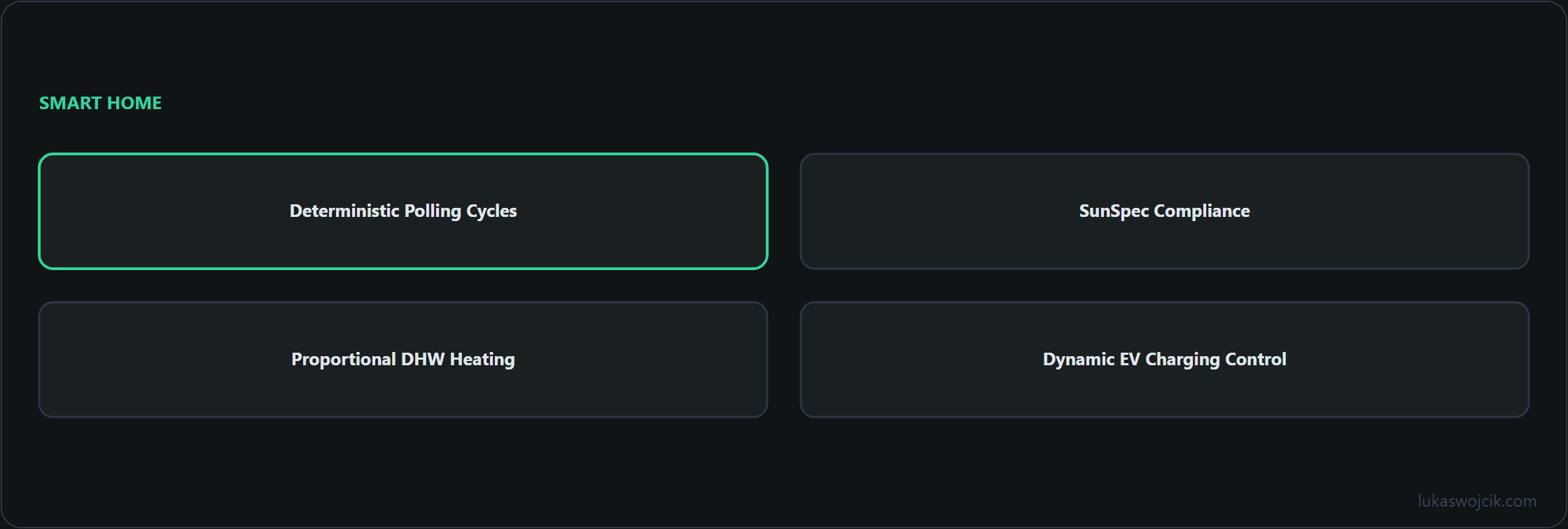
- Deterministic Polling Cycles: Querying active power registers via Modbus TCP provides raw 16-bit or 32-bit signed integer values without JSON parsing overhead or TLS handshake delays.
- SunSpec Compliance: Standardized SunSpec register blocks (such as Model 101 or Model 103) allow uniform integration logic across different inverter manufacturers without rewriting low-level register addresses.
2. Automating Excess Solar Utilization: Dynamic Load Shedding and Diversion
Once real-time net grid export is computed locally, surplus energy can be dynamically routed to high-capacity thermal or chemical storage before triggering grid export limiters.
- Proportional DHW Heating: Controlling immersion heaters via thyristor power regulators or smart relays allows modulating water heating power precisely to match available solar excess.
- Dynamic EV Charging Control: Interfacing with OCPP-compliant or Modbus-enabled EV charging stations permits adjusting charging current between 6 A and 16 A per phase dynamically, absorbing excess PV production without drawing from the utility grid.
# Example: Home Assistant Modbus TCP sensor configuration for inverter telemetry
modbus:
  - name: "pv_inverter_local"
    type: tcp
    host: 192.168.10.150
    port: 502
    sensors:
      - name: "Inverter Active Power"
        slave: 1
        address: 40083
        input_type: holding
        data_type: int16
        unit_of_measurement: "W"
        device_class: power
        state_class: measurement
        scale: 10
3. Ensuring Control Loop Stability
Implementing rapid surplus diversion loops requires careful hysteresis planning. Introducing moving average filters and deadband thresholds prevents rapid cycling of mechanical relays or EV charging contactors during transient cloud cover.
Summary
Local energy management utilizing Modbus TCP guarantees zero-cloud dependency, sub-second telemetry, and maximum PV self-consumption. Combining direct inverter register polling with intelligent load modulation for hot water and electric vehicle charging transforms a standard solar installation into an autonomous, highly efficient microgrid.
Home Assistant without the cloud
- Zigbee2MQTT vs. ZHA: Building a Highly Reliable Mesh Network in Home Assistant
- Local Energy Management: Integrating PV Inverters and Battery Storage via Modbus TCP
Related articles