Safari ITP, CNAME Cloaking, and the Challenges of First-Party Tracking

Contents
Modern browser privacy engines, most notably Apple’s Intelligent Tracking Prevention (ITP) in Safari and Enhanced Tracking Protection (ETP) in Firefox, have systematically restricted third-party cookies. In response, digital analytics and advertising platforms increasingly turned to first-party tracking methods, including CNAME cloaking. However, contemporary browser algorithms now actively detect and mitigate CNAME delegation techniques, imposing severe restrictions on cookie lifetime and posing significant challenges for attribution modeling and session persistence.
1. The Mechanics of CNAME Cloaking
CNAME cloaking relies on Domain Name System (DNS) delegation to disguise a third-party tracking endpoint as a first-party subdomain. By configuring a canonical name (CNAME) record—such as mapping data.example.com to an external analytics provider like collector.vendor.com—tracking scripts attempt to bypass third-party cookie restrictions and write persistent identifiers under the primary domain (eTLD+1).
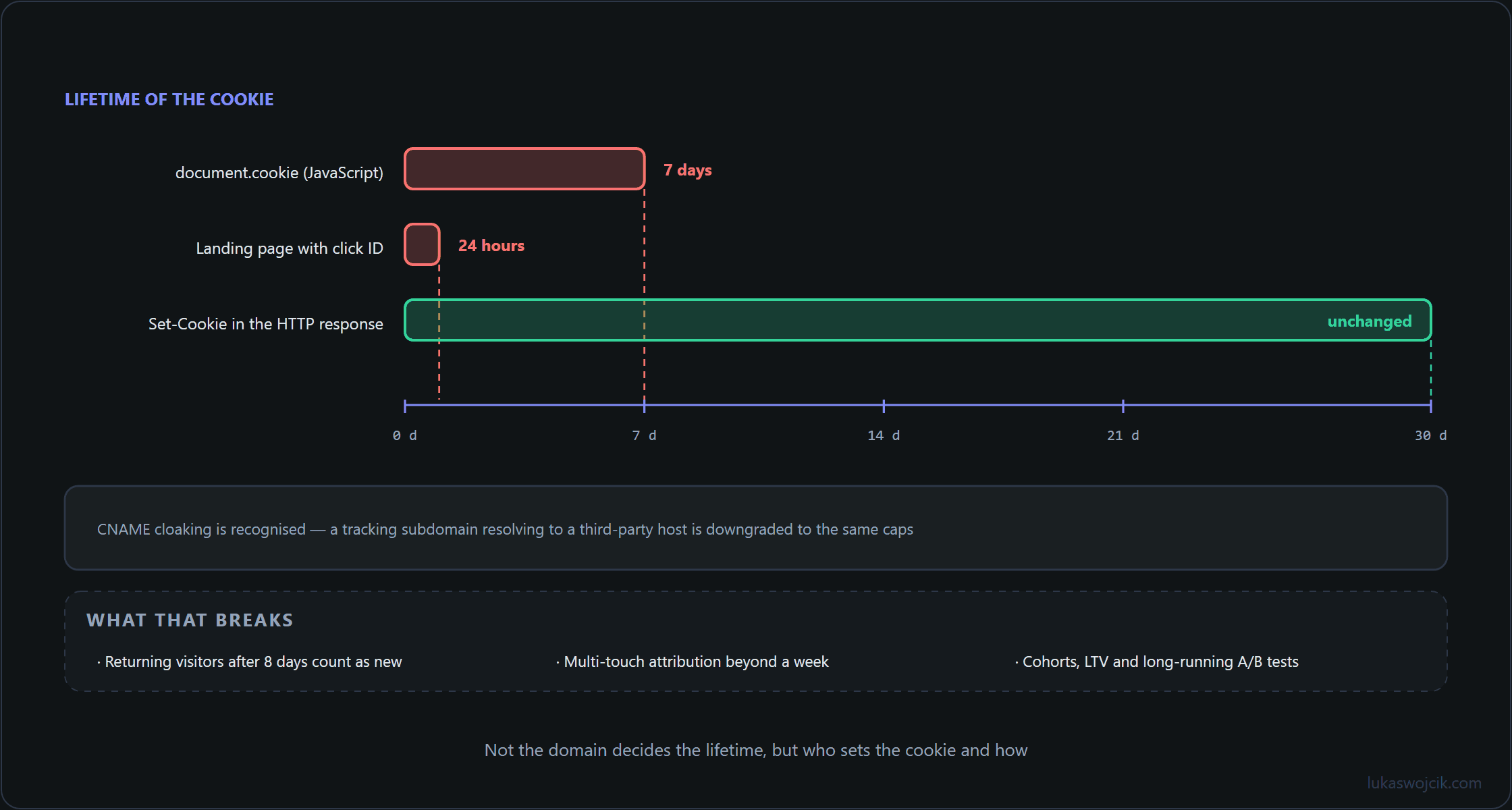
2. ITP Enforcement: 7-Day and 24-Hour Expiration Caps
Apple’s WebKit engine integrates native DNS resolution directly within the browser network stack to uncover CNAME cloaking. When an HTTP response from a subdomain attempts to set a cookie, ITP checks the underlying IP address and DNS routing chain. If the CNAME record resolves to an external entity outside the primary site’s organizational ownership, strict expiration caps are automatically applied:
- 7-Day Expiration Cap: Any first-party cookie created via JavaScript (using
document.cookie) or set via HTTP response headers from a CNAME-cloaked third-party endpoint is forcibly restricted to a maximum lifespan of 7 days, overriding longer declared expiration dates. - 24-Hour Expiration Cap: If the landing page URL contains known cross-site tracking identifiers (such as link decoration parameters like
fbclid,gclid, or UTM tags) and the user arrived from an external classified tracking domain, cookie lifetime is further reduced to just 24 hours.
3. Impact on Digital Analytics and Attribution Modeling
The reduction of cookie persistence from two years down to 7 days—or a single day—disrupts historical data continuity across digital marketing suites:
- Artificial Visitor Inflation: Returning users visiting a website after an 8-day absence are assigned a completely new client identifier, artificially inflating unique visitor metrics.
- Broken Multi-Touch Attribution: Customer journeys involving consideration cycles longer than seven days lose historical touchpoints, shifting credit disproportionately toward bottom-funnel direct or branded search interactions.
- Cohort Analysis Degradation: Long-term retention metrics, lifetime value (LTV) calculations, and A/B testing variations become statistically unreliable for Safari and iOS audiences.
4. Architectural Solutions for Sustainable Cookie Durability
To maintain legitimate session continuity without violating browser privacy protections, tracking architectures must evolve beyond DNS-level evasion tactics toward truly integrated same-origin infrastructures:
Same-Origin Server-Side Reverse Proxies
Rather than relying on CNAME DNS records pointing to external servers, data collection endpoints should be routed through an internal same-origin reverse proxy (such as Cloudflare Workers, AWS CloudFront, or an NGINX proxy hosted on the primary domain’s infrastructure). Because the TCP/TLS connection terminates on the organization’s own server and IP address space, WebKit evaluates the endpoint as a genuine first-party service.
Backend HTTP-Only Cookie Generation
Persistent identifiers should be generated and set directly by the primary backend application server using secure Set-Cookie HTTP response headers accompanied by the HttpOnly, Secure, and SameSite=Lax/Strict directives. Cookies issued directly by the primary origin server—rather than through third-party CNAME delegation or client-side script execution—remain exempt from ITP’s 7-day and 24-hour expiration caps.
Related articles