Matomo vs. GA4 in Enterprise Environments: When to Choose Self-Hosted Analytics?
Contents
In enterprise-grade digital analytics, choosing between a managed SaaS platform like Google Analytics 4 (GA4) and a self-hosted infrastructure like Matomo On-Premise requires a careful architectural evaluation. While GA4 offers native integrations with Google Cloud and the Google Marketing Platform, self-hosted analytics platforms provide absolute data sovereignty, unconstrained access to raw database tables, and full compliance with the strictest European privacy frameworks.
1. Architectural Differences: BigQuery SaaS vs. Own MySQL Database Ownership
The foundational difference between GA4 and Matomo lies in data ownership and infrastructure control:
- GA4 (Managed SaaS): Event data is collected and stored within Google Cloud infrastructure. Raw data access requires an export to Google BigQuery. While BigQuery allows powerful SQL querying, data retention policies, schema modifications, and geographic server locations remain governed by vendor terms of service.
- Matomo (Self-Hosted On-Premise): All tracking hits are written directly to an independent MySQL or MariaDB database hosted on internal enterprise servers or a private cloud. Complete administrative ownership over the database enables custom indexing, direct connections to extract, transform and load (ETL) pipelines, and absolute physical control over data residency without external third-party access.
2. Complete Data Fidelity: Eliminating Sampling and API Quotas
High-traffic enterprise platforms frequently encounter data threshold limitations within managed analytics tools:
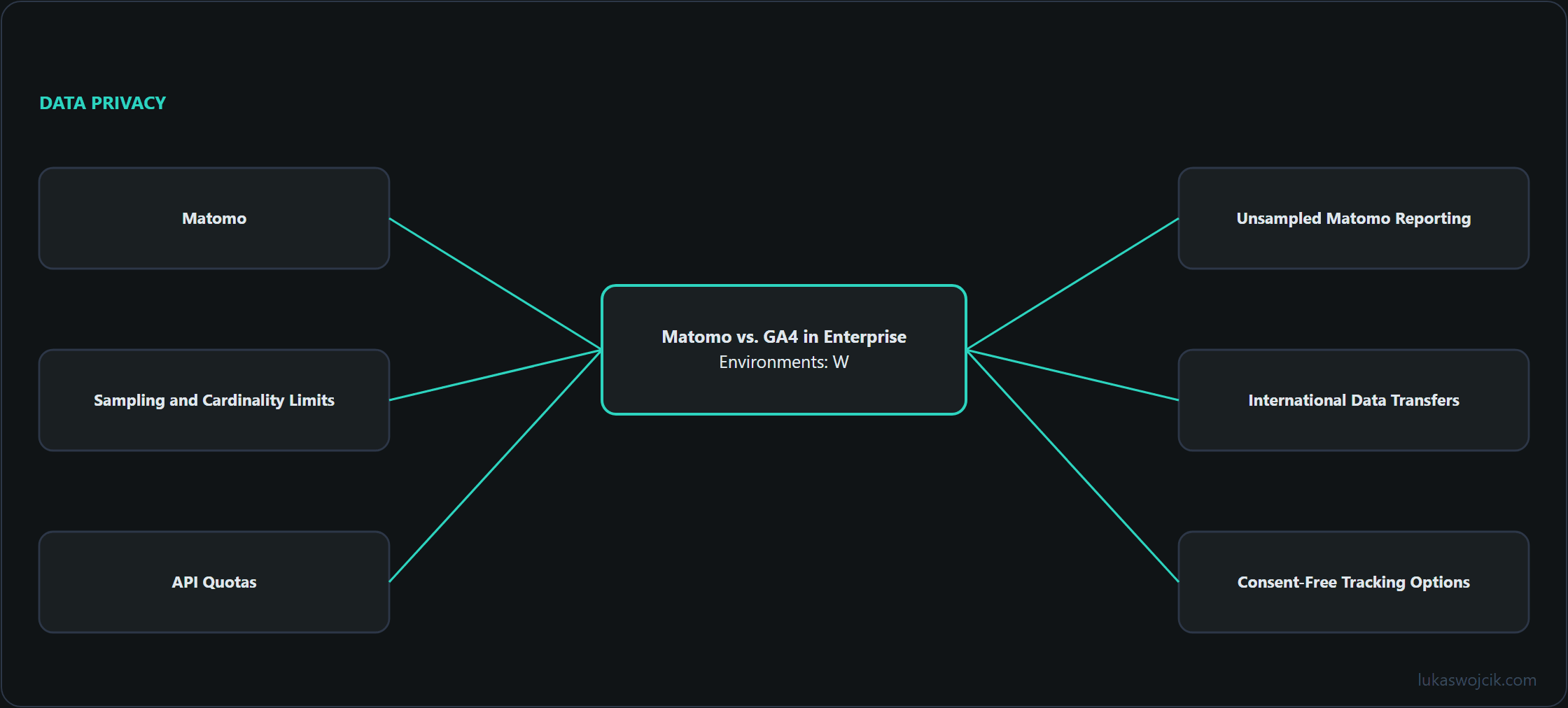
- Sampling and Cardinality Limits: GA4 standard reporting applies cardinality limits and data sampling whenever high-cardinality dimensions (such as unique user IDs or granular timestamps) exceed specific thresholds, aggregating rare values under an (other) label.
- API Quotas: Data extraction from GA4 via the Data API is constrained by strict token quotas, which can restrict automated business intelligence (BI) dashboards and frequent data synchronization routines.
- Unsampled Matomo Reporting: Self-hosted Matomo instances execute queries directly against internal relational tables. Processing power is limited solely by the allocated hardware resources (CPU and RAM of the MySQL server), guaranteeing 100% unsampled reports and unlimited API data extractions.
3. European Privacy Compliance and Zero-Cookie Tracking
Adhering to strict European privacy regulations (GDPR, ePrivacy Directive, and national interpretations by data protection authorities such as France’s CNIL or Poland’s UODO) presents complex challenges for SaaS analytics:
- International Data Transfers: Using managed analytics platforms often involves transferring metadata across international borders, necessitating legal safeguards and Data Privacy Framework evaluations.
- Consent-Free Tracking Options: Matomo can be configured to operate entirely without tracking cookies, utilizing short-lived, anonymized session hashes that expire after 24 hours. When self-hosted within the European Union and configured without cross-site profiling, Matomo can frequently be deployed without requiring explicit opt-in consent banners under applicable European privacy exemptions.
Summary
Selecting self-hosted Matomo over GA4 in enterprise architectures is justified whenever legal compliance, data sovereignty, and unrestricted database access take precedence over pre-integrated advertising ecosystems. Direct MySQL ownership, zero data sampling, and the elimination of API quotas establish a resilient, privacy-safe analytics foundation.
Related articles