Zero-Server-Side Browser Tools: Designing Secure Utilities in Vanilla JavaScript
Contents
Zero-Server-Side Browser Tools: Designing Secure Utilities in Vanilla JavaScript
Modern web engineering increasingly requires tools that process sensitive Personally Identifiable Information (PII) without transmitting a single byte over the network. Designing zero-server-side utilities in pure Vanilla JavaScript ensures compliance with strict regulatory frameworks like GDPR and ePrivacy by eliminating backend PII exposure entirely. Operating purely within the browser sandbox guarantees absolute data confidentiality and zero-latency execution.
1. Eliminating Backend Exposure Through Client-Side Architecture
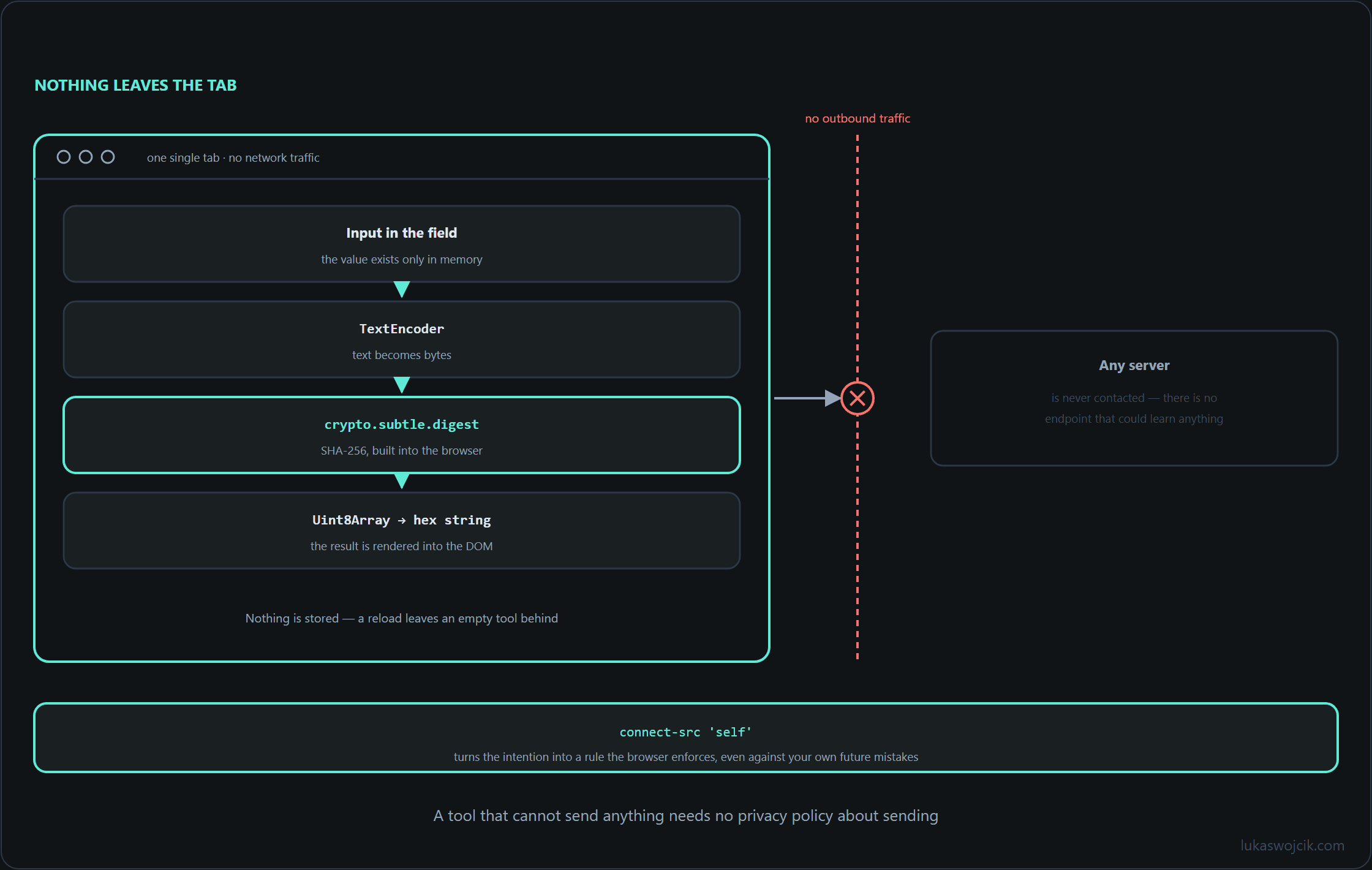
Traditional utility web applications often rely on REST API endpoints to perform cryptographic hashing, data parsing, or text transformations. This architecture introduces critical privacy vulnerabilities: server access logs, load balancer traces, and application telemetry can accidentally persist raw user data. By shifting computation entirely to the client device, the browser acts as a self-contained, isolated processing engine.
- Zero-Network Footprint: Event listeners trigger local memory transformations without initiating HTTP requests, preventing accidental interception via man-in-the-middle (MitM) attacks or server breach exploitation.
- Stateless Sandbox: Since no database persistence or remote session storage is utilized, clearing the browser tab memory permanently purges all processed inputs.
2. Leveraging Native Web APIs: TextEncoder, TextDecoder, and Web Crypto API
Modern browser engines provide highly optimized, native APIs that outperform external JavaScript cryptography libraries while maintaining superior security standards:
- TextEncoder & TextDecoder: These interfaces handle character encoding conversion directly at the engine level, transforming DOM strings into UTF-8
Uint8Arraybyte streams without memory bloat. - Web Crypto API (
window.crypto.subtle): Offers asynchronous, hardware-accelerated cryptographic operations. Generating SHA-256 digests or HMAC signatures occurs inside secure browser threads, preventing thread-blocking in high-volume data loops.
// Example: Zero-Server-Side SHA-256 Hashing using Native Web Crypto API
async function generateClientSideHash(plainText) {
  const encoder = new TextEncoder();
  const data = encoder.encode(plainText.trim().toLowerCase());
  const hashBuffer = await crypto.subtle.digest('SHA-256', data);
  const hashArray = Array.from(new Uint8Array(hashBuffer));
  return hashArray.map(byte => byte.toString(16).padStart(2, '0')).join('');
}
3. Architectural Patterns for Privacy-First Toolbox Utilities
Constructing enterprise-grade client-side utilities requires strict architectural boundaries:
- Content Security Policy (CSP) Hardening: Implementing strict CSP headers that deny outbound connection directives (such as restricting
connect-src 'self') mathematically prevents third-party injection scripts from exfiltrating local DOM variables. - DOM Lifecycle Decoupling: User inputs should be processed within isolated Web Workers when handling large datasets, keeping the user interface responsive while preventing third-party trackers from monitoring main-thread execution frames.
Summary
Zero-server-side browser tools represent the gold standard for privacy-preserving web utilities. By combining native Web Crypto API capabilities with strict Vanilla JavaScript execution pipelines, developers can build powerful analytical and cryptographic utilities that eliminate server-side PII risks by design.
Sources
Related articles