UniFi Protect & PoE CCTV: Superiority of Twisted Pair over Coax and Full Isolation of IP Cameras
Contents
Modern video surveillance architecture has shifted decisively from legacy analog coaxial cabling to structured Power over Ethernet (PoE) networks. While older CCTV deployments relied on RG59 coaxial cables paired with separate power distribution lines, contemporary IP-based deployments utilizing twisted-pair copper cabling (Cat6 or Cat6A) provide significant technical advantages in scalability, signal integrity, and centralized power management.
1. Superiority of Twisted-Pair over Coaxial Cabling
Coaxial cables were designed primarily for analog baseband video transmission. They suffer from rapid high-frequency attenuation, ground-loop interference, and physical rigidity. By contrast, twisted-pair cabling offers standardized digital packet transmission over Ethernet protocols. The benefits include:
- Single-Cable Deployment (PoE): Power and high-bitrate video streams travel simultaneously over a single Cat6/Cat6A cable, eliminating the need for local power supplies near camera endpoints.
- Higher Bandwidth & Resolution Support: While analog coax struggles with uncompressed multi-megapixel streams without proprietary modulation, 1000BASE-T twisted-pair networks effortlessly carry multiple 4K (8MP) streams with HDR and high frame rates.
- Galvanic Isolation & Noise Immunity: Standard differential signaling on twisted pairs, especially when using shielded variants (F/UTP), protects video feeds from electromagnetic interference (EMI) often encountered in industrial or enterprise environments.
2. Security Risks of Unisolated IP Cameras
Despite their physical and operational superiority, network-connected IP cameras present an inherent cybersecurity attack surface. Embedded IoT devices frequently run proprietary firmware with unpatched vulnerabilities, hardcoded backdoors, or aggressive cloud-tethering services. Allowing surveillance cameras unconstrained access to the Internet introduces severe risks, including credential harvesting, lateral network reconnaissance, and unauthorized remote streaming.
3. Network Architecture: Dedicated CCTV VLAN & Zone-Based Isolation
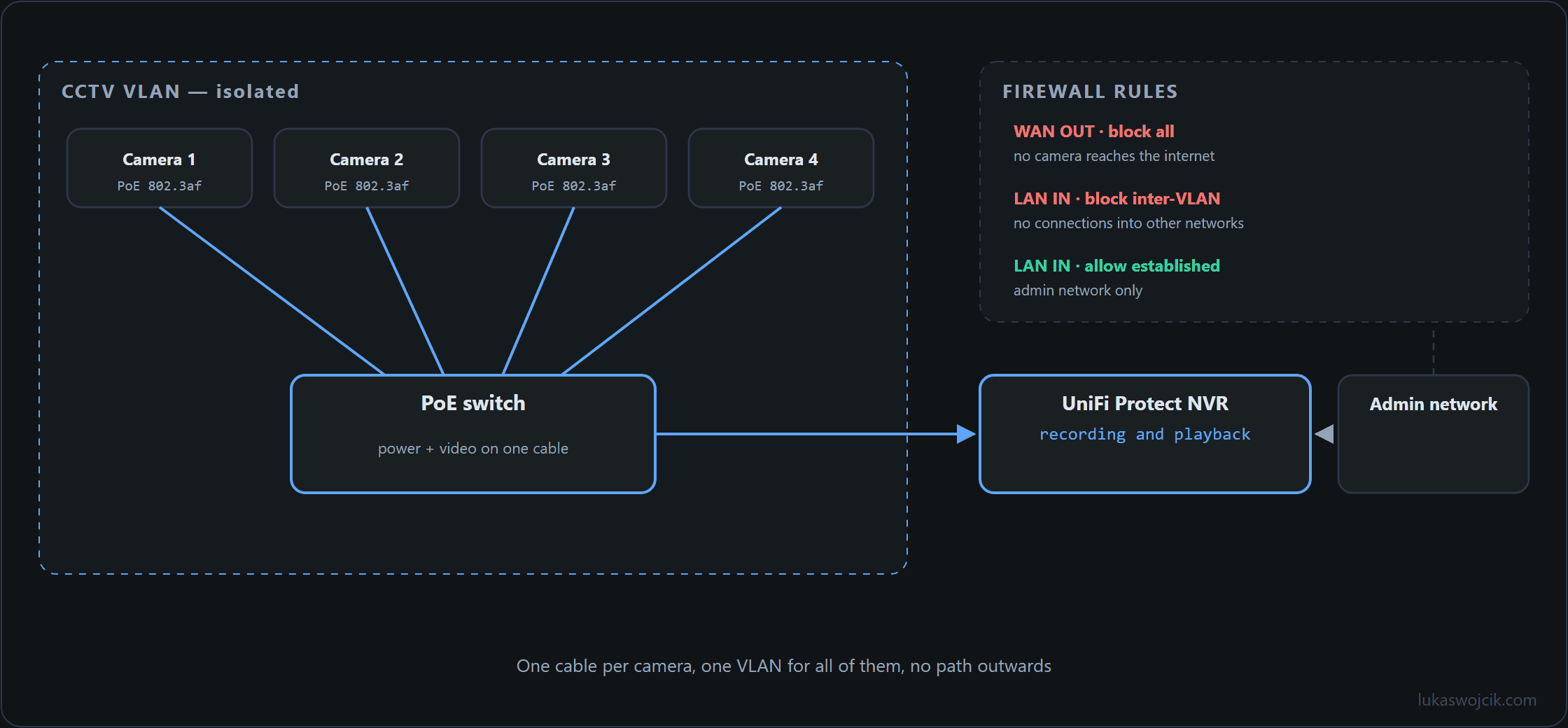
To mitigate IoT-related vulnerabilities without sacrificing operational functionality, a strict network segmentation architecture must be enforced. Within a UniFi network deployment, surveillance endpoints should reside in an isolated Virtual Local Area Network (VLAN).
Firewall Policy Configuration (Zone-Based Firewall)
Since UniFi Network 9.0 the gateway groups networks into firewall zones and defines policies between those zones; the earlier interface-based rule sets (LAN IN, WAN OUT) have been superseded, and existing rules are migrated automatically once the zone-based firewall is activated under Settings → Security. Total internet isolation requires the CCTV VLAN to be assigned to its own zone, together with the following policies:
- CCTV → External – Block All: A policy from the CCTV zone to the External zone must drop all packets originating from the dedicated CCTV VLAN subnet (e.g.,
10.0.50.0/24) and destined for any external IP address. This prevents outbound telemetry, cloud home-calling, and potential data exfiltration. - CCTV → Internal – Block All: Traffic originating from the CCTV zone must be blocked from initiating connections to trusted internal zones (such as management or client networks).
- Internal → CCTV – Allow: The opposite direction requires its own explicit allow policy, ideally narrowed down to authorized administrative devices and the recorder. Because the firewall is stateful, the return traffic of these sessions is permitted automatically; a rule restricted to established and related connections covers only that return path and can never open a session toward the camera endpoints.
4. Local Video Retention on UNVR or UNAS
When external Internet access is completely blocked, video storage and processing must be handled locally within the perimeter. The recording and management software itself is UniFi Protect, which runs on the UniFi OS console — that is, on the UNVR or on a Cloud Gateway that supports the application. A UNAS cannot run Protect and serves only as an archive target for footage that has already been recorded, so a dedicated Ubiquiti Network Video Recorder (UNVR) remains the component that ensures high-capacity, on-premise retention.
Local storage architecture eliminates subscription fees, prevents bandwidth saturation on external WAN links, and ensures full compliance with strict data privacy regulations by keeping all sensitive recordings strictly inside the local infrastructure.
Related articles